Swedish emigration to America (1845–1930)
The EmigrantsSwedish emigration to America (1845–1930) was not a single exodus but a decades-long movement whose group phase transformed pressures in Swedish rural life into collective departures for an uncertain New World. In The Emigrants, migration becomes both a practical chain of choices—information, household consent, money, transport—and a wager between the known hardship of home and an imagined future whose promises cannot be verified in advance.
Historical Scale and Rural Pressures
Between 1845 and 1930, 1.2 million people left Sweden for America; more than 300,000 came from Småland. The scale of departure was already present in family histories: Vilhelm Moberg recalled that his parents’ siblings had emigrated, leaving only his parents to continue their respective family lines in Sweden, and that he had more relatives in America than in Sweden. As a boy he associated America with greater wealth, amid letters, dollar money orders, and Swedish-American newspapers arriving at home. At eighteen he planned to emigrate himself, but his mother and grandmother lamented that seeing a son off at the railway station was like attending his funeral, and he did not go.
In the novel’s historical setting, population and landholding patterns sharpen the pressures to leave. Ljuder Parish counted 1,925 inhabitants on January 1, 1846, after its population had nearly tripled since 1750. Over the same century, the number of people outside the assessed landowning population—including servants, cottagers, squatters, dependents, and people without permanent homes—increased fivefold. The parish’s 43 original homesteads had been divided among 87 owners by 1750; by 1846 further subdivision had produced 254 independent farms, two-thirds no larger than one-eighth of an original homestead. These figures give material context to the novel’s recurring conflict between growing households and diminishing plots.
From Group Movement to Individual Motives
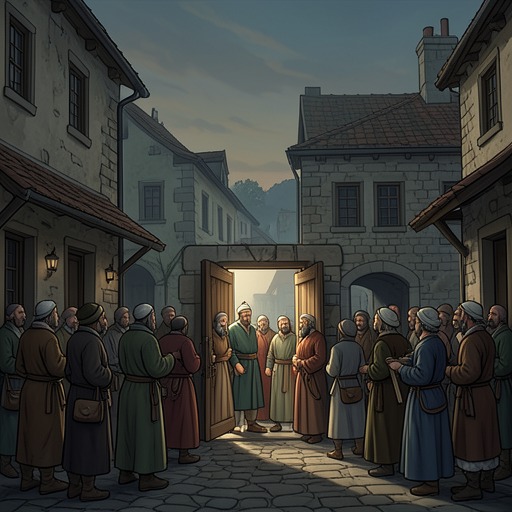
Group emigration was most common from 1845 to 1865. Groups typically numbered fifteen to two hundred people, joining in hopes of establishing farming or religious settlements in America. The novel presents the Ljuder party as one such group, but not as a body united by a single grievance. Crop failure, conflict with civil authorities, religious dissent, personal troubles, social ostracism, and unfair employment practices each push different people toward departure. Their common route therefore gathers unlike motives without erasing them.
The movement begins as information entering settled communities: rumors, news, and accounts of fertile land travel from neighbor to neighbor, while pictures and printed reports stand in for direct experience. The prospect of America unsettles a familiar world, but the ocean and destination remain unknown. In the novel, the attraction of land and possibility competes with caution, family disagreement, and the absence of trustworthy firsthand testimony. Migration becomes imaginable before it becomes knowable.
Household Decision and the Means to Leave
The debate between Karl Oskar Nilsson and Kristina Johansdotter makes the distance between aspiration and evidence explicit. After four years at Korpamoen, they were several hundred riksdaler poorer than when they began. Karl Oskar sees continued labor leading toward exhaustion and dependence on the reserved room for aging parents, with little to show for years of work. Kristina, by contrast, fears that America may be a wild-goose chase: no government has promised them land, they have no deed awaiting them, and they know no farmer with wife and children who has made the journey and returned to describe the country. Newspapers and books do not provide the certainty she wants. Their disagreement is not simply hope against reluctance; it is a dispute over what evidence can justify risking a household’s future.
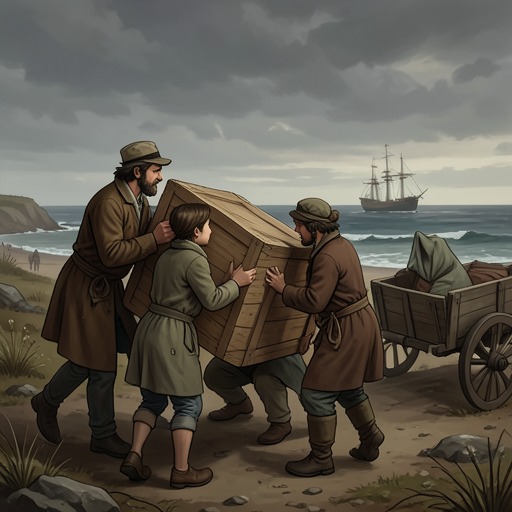
Leaving also requires money, timing, and access to transport. Karl Oskar and Robert Nilsson arrange passage with a firm in Karlshamn aboard the Charlotta, a merchant vessel carrying both cargo and emigrants, and pay a hundred daler down for six passengers. The plan is to sail directly to New York, embarking around the second week of April. Spring is considered advantageous because winter storms have passed and an early arrival may leave time to till and sow before the fall harvest. Danjel Andreasson asks to join if space remains; Robert is to seek a contract for him, and Danjel expects nine people from Kärragärde, including children and household members. One family’s arrangements thus open a route for another.
The financial reckoning reveals how narrow that route is. After selling Korpamoen, auctioning belongings and cattle, and paying the mortgage and other debts, Karl Oskar has 1,200 daler. Passage for the family—three adults and three children—costs 675 daler, leaving about 500 for arrival, onward travel to an unknown settlement, and the tools and livestock needed to begin again. He hopes land will be nearly free, but the money remaining for establishing a farm is limited. The five hundred daler is sewn into a sheepskin bag that can be fastened to a belt and carried against the body. The family’s imagined freedom is secured, for the moment, in a concealed and vulnerable bundle of cash.
The Collective Journey and Its Costs
At Åkerby Junction, the travelers’ separate households assemble into a company of sixteen emigrants: nine adults and seven children. Three drivers will return from Karlshamn. The group includes Danjel’s wife, four children, and Ulrika of Västergöhl; Jonas Petter of Hästebäck travels with his hired man, while Arvid and Elin join him because Danjel’s wagon has no room. The party’s practical composition—who can carry whom, which wagon has space, and who will turn back—shows how migration depends on linked decisions rather than individual resolve alone.
The crossing exposes the cost of the promise that brought them aboard. After storms, illness, confinement, and monotonous days at sea, scurvy and ship fever have weakened the passengers, while many have grown depressed and ceased to care what life may bring. When America finally appears, the sight of green earth reverses that exhaustion: the travelers crowd on deck, and the sight renews strength, initiative, and hope even among the sick and timid. The landfall does not erase the hardship or guarantee success, but it makes the destination tangible after a passage endured largely in uncertainty.
Literary and Historical Significance
The novel places a historically recognizable group movement inside the close particulars of households: divided farms, debts, children, religious conflict, disputed testimony, and the cost of passage. America’s pull is real, but its benefits remain largely imagined at the point of departure. The emigrants must act without the written guarantees Kristina seeks, and their ability to move depends on resources and relationships as much as on desire.
That tension gives the migration its double character. Departure promises release from poverty, restricted prospects, and other forms of pressure, yet it demands the sale of home, the spending of scarce capital, and endurance of a dangerous crossing. The first sight of green land offers a moment of renewed confidence, not proof that the emigrants’ hopes will be fulfilled. By joining large-scale movement to distinct household calculations, the novel presents emigration as both a demographic transformation and a deeply uncertain human decision.