The American ideal of the New World
The EmigrantsThe American ideal of the New World is the belief that migration can transform hard work into a better life: land will be fertile, opportunity open, and social rank less binding than at home. For Karl Oskar Nilsson, that vision gives practical meaning to leaving Korpamoen; for Robert Nilsson, it becomes a sweeping portrait of abundance and equality. The novel also tests the hope against uncertainty, the cost of passage, and the emigrants’ suffering at sea, distinguishing the power of an ideal from proof that every promise will be fulfilled.
An image that makes possibility tangible
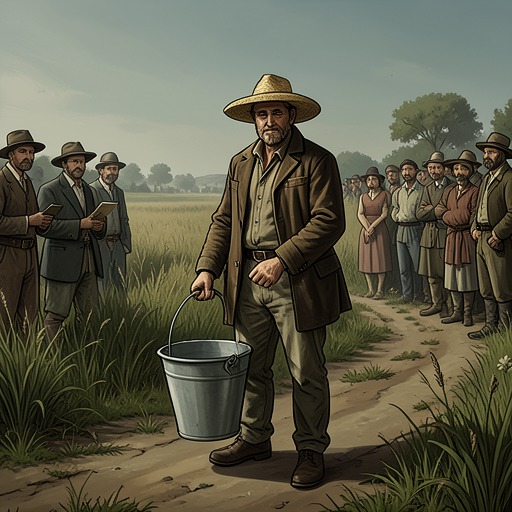
Karl Oskar’s hopes take shape when he sits inside Korpamoen after a broken plow has brought him back from the field. Looking at the unplowed rye stubble, he handles a borrowed sheet carefully and sees its picture, “A Wheat Field in North America.” The image shows an immense, even field, free of the stones and hillocks that define his own seven acres. Its abundant standing grain turns a distant country into something he can see and assess with a farmer’s eye. He regards the picture as evidence: unlike a story or description, he believes an image cannot lie. If the field has been pictured, it must exist somewhere.
The contrast between the pictured field and Korpamoen’s stony soil becomes more than a difference in agricultural conditions. Karl Oskar understands the Old World as soil cursed because of human sin, while the New World’s ground remains blessed. That contrast supplies a religious coloring to an otherwise practical hope: America appears to offer not only better farmland but release from a landscape in which effort has brought little reward. The picture does not promise that Karl Oskar already owns such land; it makes possible land feel real enough to pursue.
Work, land, and the family’s future
The attraction of America grows out of the family’s experience at home. After four years at Korpamoen, Karl Oskar and Kristina are several hundred riksdaler poorer than when they began, despite spending their strength on the farm. He fears that staying will mean work without improvement, followed by old age in the reserved room with little more than meager bread. His comparison with his crippled father sharpens the prospect: the parents’ future seems to repeat the life already visible before them, with exhaustion but no adequate return.
Karl Oskar does not imagine that work will disappear across the Atlantic. He allows that emigrants may face as much drudgery as they do in Sweden. The decisive difference, as he sees it, is that in America their labor might improve their circumstances. He believes fertile, stone-free land can be obtained for little, and that he and Kristina need bring above all their strength, health, and familiarity with hard work. In this vision, labor ceases to be a trap and becomes a means of advancement.
His calculation is also directed toward the children. In Sweden, he sees no satisfactory future for those who do not inherit the farm: they may have to become hired hands or squatters, in a countryside already crowded with workers and poor cottagers. The American ideal therefore turns migration into a family decision about opportunity across generations, not simply Karl Oskar’s wish to escape an unproductive farm. He believes that if the parents take responsibility for the children’s prospects, they must leave.
Freedom and Robert’s enlarged picture
The ideal is social as well as agricultural. Information reaching Karl Oskar presents America as a country where the old four-class hierarchy has been abolished, the people elect a president, and citizens meet on equal terms. In this account, authority is less remote and ordinary people have more liberty. Such claims give political form to the promise of land: America seems to offer a society in which a farmer’s effort and standing are not fixed by inherited rank.
When Robert returns to the family home, his description book carries this imagined country into the cottage. He has mentally mapped its lakes, rivers, plains, mountains, and routes, and he offers vivid claims about its abundance: grass grows belly-high for cattle, wild horses and oxen roam in great numbers, and a sling would be useless for want of stones. His portrait extends from nature to social mobility: America has one class, the people’s class, and one nobility, the nobility of honest work. It also promises freedoms and conveniences that make the destination sound unlike the world the family knows.
Robert’s account becomes most revealing when Karl Oskar asks about unguarded iron railway tracks. Robert explains that metal is so plentiful that no one bothers to steal even filings; with work easy to find and wealth abundant, he says, dishonesty has no attraction. He further claims that thieves are swiftly punished and that the country is populated by unusually honest people. Karl Oskar remains more cautious, suggesting that there must be scoundrels there too. The exchange shows how the ideal grows through confident report, while leaving room for a listener to notice the gap between extravagant assurances and what can actually be verified.
Doubt, cost, and the test of passage
Kristina does not share Karl Oskar’s confidence in printed accounts. She fears that the proposed journey may prove a wild-goose chase: no one has promised them land, no deed awaits them, and neither spouse has met a person who has seen North America. To her, a consequential move requires reliable knowledge and written agreements, not descriptions in books and newspapers. Her resistance identifies the ideal’s central uncertainty. A vivid image can inspire departure, but it cannot establish what the family will find upon arrival.
The preparations make that uncertainty material. The Nilsson family packs tools for farming and carpentry, fishing gear, clothes, and the equipment Kristina can take in place of the implements she must leave behind. Their old oak chest, inherited across generations and associated with family ceremonies, becomes their roomiest packing case. It is a practical object for a new life, but its departure also marks the transfer of a household’s accumulated possessions into an unknown future.
The financial reckoning narrows the distance between hope and capability. After Korpamoen is sold and debts deducted, 1,200 daler remain. Passage for three adults and three children costs 675 daler, leaving Karl Oskar about 500 daler before the family pays its entry costs and travels an unknown distance to a place of settlement. He hopes to acquire land for very little, but little money remains for livestock and farm implements. Kristina sews the remaining money into a sheepskin bag that Karl Oskar can fasten to his belt. The ideal promises opportunity, but reaching it requires the family to risk nearly half its available capital before knowing where it will live.
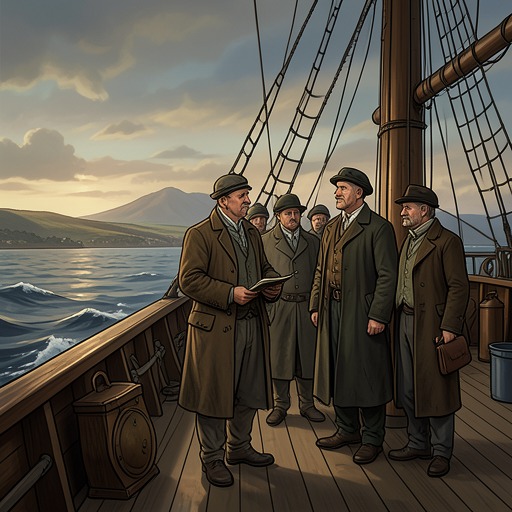
The passage itself challenges the emigrants’ assumptions about freedom. A week into the voyage, Robert concludes that life at sea is no freer than farm service: seamen work dangerous watches, sleep closely packed in the forecastle, and remain confined aboard ship. He compares their restricted quarters and monotonous meals with the hardships he knows from Nybacken and decides that a farmhand on land had more freedom than a sailor. This comparison does not disprove his hopes for America, but it makes clear that the route to the imagined future imposes its own controls and privations.
By the time the emigrants see the green earth of America, the long voyage has brought storms, illness, confinement, and low spirits. The first sight of living ground changes their immediate outlook: passengers who had grown depressed recover energy and ambition, and the sick and exhausted feel renewed. The scene realizes one part of the ideal with force—the return of land after the ship’s confinement—without yet confirming the promised farm, wealth, or social future. The New World’s significance lies both in what the emigrants can see and in what they still have to discover.