The Charlotta’s 1850 Atlantic crossing
The EmigrantsThe Charlotta’s 1850 Atlantic crossing is the dangerous, materially constrained passage that transforms the emigrants’ hope of a new life into an irreversible departure. A brig sailing from Karlshamn to New York, the Charlotta carries people across an ocean whose scale they had never grasped at home; after ten weeks, arrival brings not instant security but precarious first steps on unfamiliar ground.
From rumor to departure
News of fertile land across the ocean had reached communities where plots dwindled as families grew, carried neighbor to neighbor through parishes and counties. The new country remained unseen, known through pictures and rumor, while the ocean itself made departure frightening. Against the safety of familiar customs, the crossing offered possibility but demanded a practical commitment: a route, a ship, money, and a group prepared to leave together.
Spring was chosen because winter storms had passed and the emigrants could arrive early enough to till and sow for a fall harvest. Karl Oskar Nilsson and Robert Nilsson had written to a firm in Karlshamn and paid a hundred daler in advance for passage for six people. The Charlotta was to sail directly to New York without stopping at an intermediate harbor. When Danjel Andreasson decided to join, Robert undertook to obtain a contract for his passage if there was room; Danjel’s party numbered nine, including children and household members.
The journey to the port had already gathered separate households into a shared migration. At Åkerby Junction, sixteen emigrants—nine adults and seven children—met in wagons, while three drivers were to return from Karlshamn. Danjel traveled with his wife, four children, and Ulrika of Västergöhl; Arvid and Elin rode with Jonas Petter of Hästebäck. Robert moved to Jonas Petter’s wagon, reuniting with Arvid, his fellow farmhand from Nybacken. Their imagined clandestine escape from service had become a public journey among families and fellow emigrants.
The ship and its rules
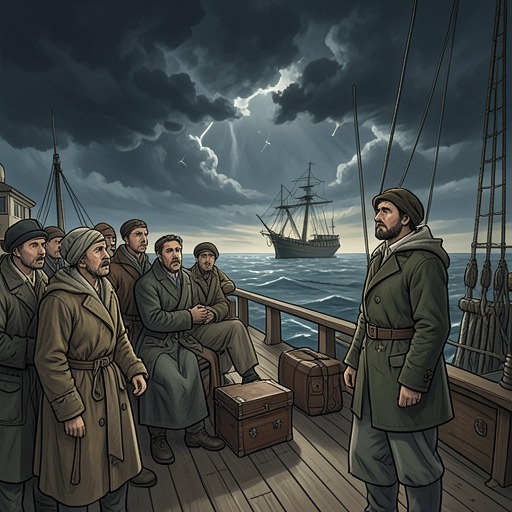
The brig Charlotta, commanded by Captain Lorentz, sailed on April 14, 1850. She was 124 feet long and 20 feet wide, with a capacity of 160 lasts; her fifteen-person crew carried pig iron and sundries as well as 78 emigrants, making 94 people aboard. This was her seventh voyage as an emigrant ship. The figures establish the crossing’s scale, but the passengers experienced it as a struggle for room and air.
Canvas partitions divided the hold into spaces for families, unmarried men, and unmarried women. The emigrants made up berths for 78 among bedding, food baskets, knapsacks, and bundles; the low overhead and choking air left hardly a place to step. The family space resembled a pen, and Karl Oskar, unable to fit there, shared a two-man bunk with Robert in the men’s compartment. Jonas Petter slept above them and Arvid nearby. The physical arrangement separated passengers by household status even as it pressed them into an intensely shared space.
Shipboard order governed food, water, cleanliness, and movement. Provisions were distributed by family in fixed weekly portions, to be prepared in turns in the galley; passengers could not return after a few days demanding more. Refuse and dishwater had to be thrown overboard to leeward, never windward. Each person received half a gallon of fresh water daily for drinking and washing, and passengers had to clean the hold before the water was issued. Fire was tightly regulated, lights were prohibited after ten at night, and the captain’s authority extended to punishing disobedience. These rules made survival depend not only on supplies but on coordinated labor and discipline.
The bodily ordeal
The daily cleaning made the passengers’ dependence on scarce water immediate. Men carried buckets while women scrubbed, washed, and hung wet clothing on deck; only after the quarters were cleaned could the thirsty drink or the dirty wash. Half a gallon had to serve for cooking, drinking, and washing people and babies. When rain fell, sailors stretched a sail to collect water, and some passengers followed their example. Danjel interpreted the rain as a provision from heaven, while the practical scarcity remained unchanged.
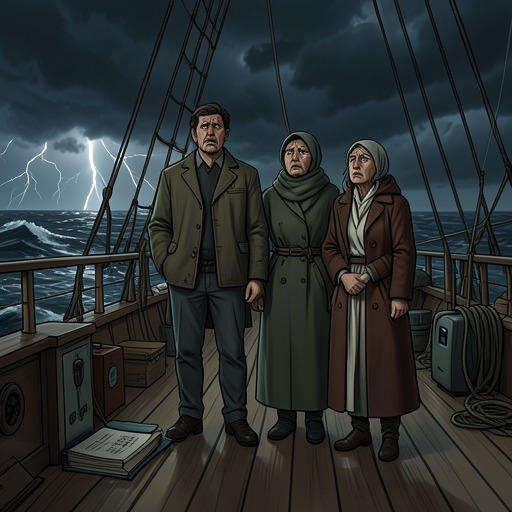
The crossing’s discomfort was intensified by weather and confinement. The passengers spent the daytime on deck in bitter cold, wearing all the garments they had, because the air below was fetid and seasickness often came over them at night. Darkness magnified the difficulty: after lights were forbidden, a sick passenger might be unable to find a bucket in time. Morning exposed the consequences, and the emigrants began again with the work of cleaning their quarters.
Illness could become acute. When Kristina Johansdotter suffered dangerous bleeding, Captain Lorentz went to his papers and searched for his Medical Adviser for Seafarers. The handbook described how severe bleeding from the mouth or nose could weaken a patient and set out measures using cool air and sea-water packs. The scene places the captain’s responsibility within the limits of available shipboard care: medical help depended on a printed manual, the ship’s supplies, and the judgment to act.
Distance, arrival, and significance
As the Charlotta crossed the Atlantic, contrary winds often slowed her, and the passengers felt as if the same billow lifted and tossed them again and again. After two months at sea, they looked back mentally over the immense water they had crossed and understood its magnitude in a way they could not have done at home. The ocean was no longer merely the frightening interval before a new country; it had become a distance of its own, vast enough to make return inconceivable. The emigrants came to regard the move as a passage they would make only once.
The brig sailed toward Midsummer, its prow’s eagle facing west and its masts—fir trees from the ship’s homeland—bending under gusts before rising again. The image binds vessel and passengers to the stony landscape they had left: both the pines and the emigrants endure pressure without ceasing to move forward. The ocean crossing thus becomes more than transportation. It tests bodies and convictions while severing the familiar geography of home from the uncertain promise of settlement.
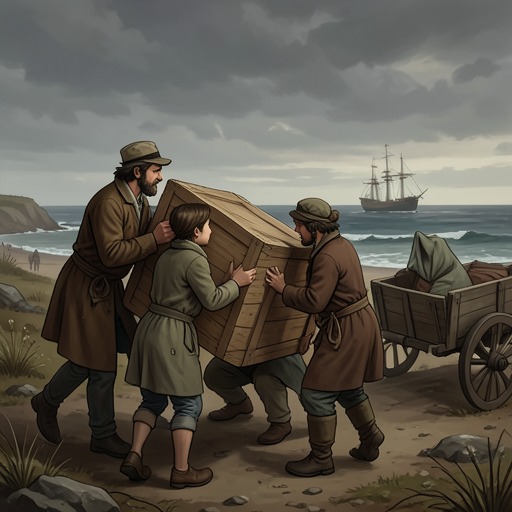
On Midsummer Eve, 1850, after ten weeks from its home port, the Charlotta tied up at a New York pier. The passage ended, but arrival did not erase its instability. Kristina walked up the steep gangplank by herself, and Harald was set down to walk beside his father; Karl Oskar, stepping onto solid ground, found it seemed to roll beneath him. The emigrants had reached America, yet even the ground felt unfamiliar. Their first steps completed the voyage while opening a new and uncertain life.