The Gate to the Road to America
The Emigrants“Gates on the Road to America” is a recurring expression that turns emigration into a sequence of thresholds: some controlled by masters and circumstance, others opened by money, family decisions, and collective arrangements. For Robert, the image first gives form to a blocked escape; when he finally travels with his family and fellow emigrants, opening and counting roadside gates makes the imagined route tangible.
A Road Blocked
Robert’s route west is obstructed before it begins. In the autumn, his master, Aron of Nybacken, takes the team that is hauling oak timbers toward Karlshamn, explaining that he is too concerned about Robert’s injured hand to let him undertake long journeys. The decision closes what had seemed an available passage. Robert has been obedient and attentive, yet his position as a servant leaves his movement subject to Aron’s judgment. Earlier, Aron had kicked him in the groin for not fetching water quickly enough; the injury swelled and made him walk with difficulty. The closed gate is therefore more than an inconvenience: it stands for the power a master holds over a worker’s body and prospects.
The barrier is also inward and bodily. While cleaning a deep ditch, Robert grows hungry, thirsty, and exhausted, and imagines that his future will consist of endless years of farm service. His injured ear carries a persistent hum that he comes to hear as the sea’s voice calling him. Yet even this call cannot immediately move him: the gates on the road remain closed. The contrast between a summons that follows him day and night and the lack of any present means to answer it makes the expression both an image of desire and a measure of his dependence.
From Private Hope to Shared Decision
The route opens through a chain of linked decisions rather than a single leap. Karl Oskar’s wish to leave Korpamoen grows from material failure: after four years of work, the household is several hundred riksdaler poorer, and further labor seems likely to end only in exhaustion and a meager place in his parents’ home. Kristina, by contrast, doubts the assurances about America. No land deed awaits them, no trusted person who has seen North America can confirm the reports, and printed accounts do not provide the guarantees she wants. Their disagreement shows that the road is not equally open in imagination even within one household.
Practical arrangements give the plan a route. Karl Oskar and Robert secure passage aboard the Charlotta, a merchant vessel sailing from Karlshamn directly to New York, and pay a hundred daler down for six places. Spring is chosen so the travelers can reach their destination early enough to plant and harvest before winter. Robert offers to obtain a passage contract for Danjel as well, if the ship has room; Danjel’s party numbers nine, including children and household members. A private family plan is thus extended through kinship and cooperation into a larger movement.
Money remains another gate. After selling Korpamoen, paying debts, and auctioning the household’s belongings and cattle, Karl Oskar has 1,200 daler left. Passage for his family of three adults and three children costs 675 daler, leaving about 500 for entry into America, onward travel, and the hoped-for purchase of land and equipment. Kristina sews that remaining money into a sheepskin bag for Karl Oskar to carry against his body. The migration’s opening is real, but it is narrow: every step depends on funds that must survive the journey and stretch across expenses still unknown.
Robert Opens the Gates
When the party sets out on a Thursday under a new moon, Robert’s movement becomes visible in the landscape. The wagons pass Nybacken, where he whistles, and then the parsonage, where he thinks of the unanswered parish records that may continue to list his whereabouts as unknown. He has not gone to the dean for his papers because he escaped service. His departure is therefore both a release and a break with the formal record of the community he leaves behind.
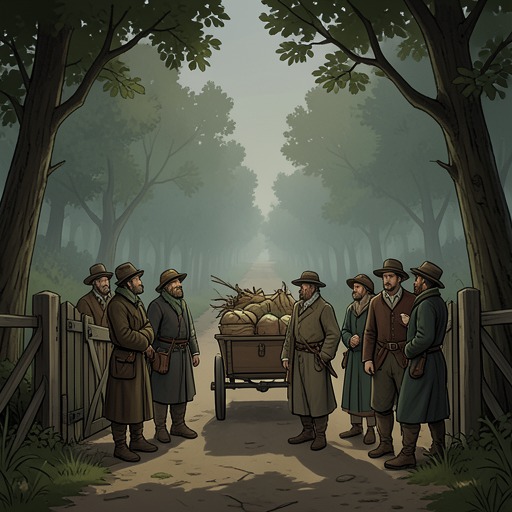
At each gate along the road, Robert jumps down to open it. Before the travelers reach Åkerby Junction, he has opened five and carefully counted them, taking the role of gate-boy. Even openings in winter pastures where the gates have been removed count for him: had the departure been delayed a month, he reasons, those gates too would have been closed. The small acts of opening convert an abstract hope into a repeated physical gesture. They also reverse his earlier helplessness: no longer is a gate shut in his face by his master; now he is the one who makes passage possible.
The Emigration Becomes a Group
At Åkerby Junction, separate plans become a shared departure. Danjel’s wagon carries his wife, four children, and Ulrika of Västergöhl; Jonas Petter of Hästebäck drives another, accompanied by his hired man. Arvid and Elin, who cannot fit on Danjel’s wagon, ride with Jonas Petter. Robert moves to that wagon too, where Arvid greets him with a grin. The two farmhands who had imagined slipping away together from Aron’s service are now traveling openly among families and other emigrants.
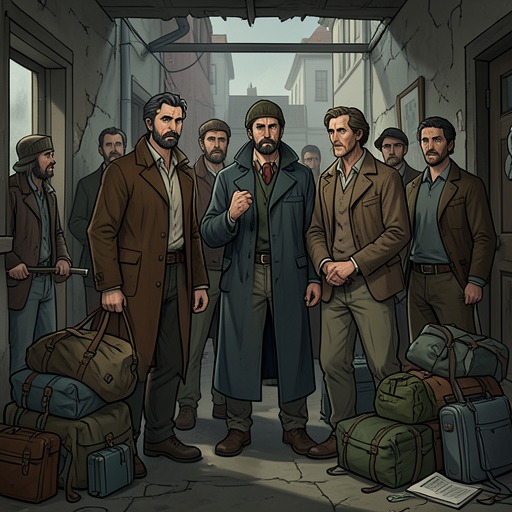
Nineteen people meet at the junction: three drivers who will return from Karlshamn and sixteen emigrants, nine adults and seven children. Jonas Petter calls them a suitably large family and raises the question of who should lead it; the group looks to Karl Oskar, who protests that he is the youngest of the three farmers, before Jonas Petter is named as the oldest. The road’s gates have brought people with different reasons for leaving into one traveling company. The novel’s wider account identifies those motives as varied—crop failure, persecution by civil authorities, religious dissent, personal troubles, social exclusion, and unfair employment—rather than a single shared grievance.
An Open Threshold, Not a Guaranteed Arrival
The heading “ALL GATES OPEN ON THE ROAD TO AMERICA” gives the departure a moment of apparent release, but the expression does not promise an effortless or secure passage. The emigrants must still cross the sea, endure its storms and illness, and reach an unfamiliar shore. On arrival, after the long confinement aboard ship, scurvy, ship’s fever, and despair have weakened them. The sight of green earth near New York revives their energy and ambition: the shore offers visible ground after the monotonous, restrictive life at sea. That later opening sharpens the image’s limits. A gate on the road can be opened; it cannot guarantee what lies beyond it.
As a motif, the gates bind together Robert’s individual escape and the group’s collective migration. They register who controls movement, what resources make departure possible, and how a hoped-for future becomes a road traveled by actual people. Robert’s count turns the threshold into a personal record of progress, while the company assembled at Åkerby Junction shows that the road to America is made not by one impulse but by many distinct decisions meeting at the same point.