The contrast between land and sea
The EmigrantsThe contrast between land and sea is a governing opposition in the emigrants’ journey: the earth they know is at once scarce and sustaining, while the sea they must cross is the necessary passage to a hoped-for future and a power beyond their command. The movement from one to the other changes not only the landscape around them but their ability to work, move, and feel secure.
Land as home and livelihood
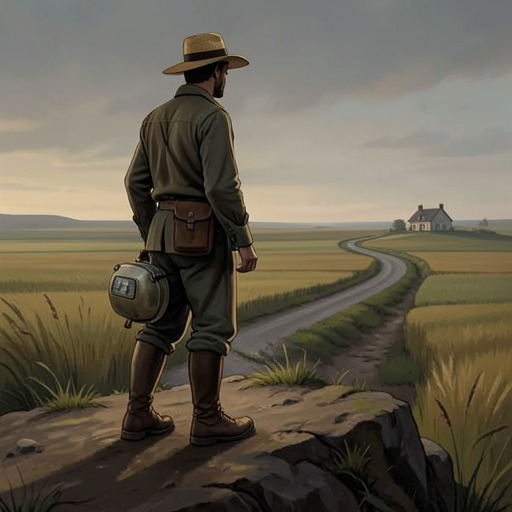
The emigrants begin as people of the soil. Their lives have been shaped by plots of land, inherited customs, and practical knowledge acquired through farming. Yet the familiar ground cannot provide for everyone: holdings diminish as families grow, and food is scarce in communities accustomed to living by tradition. News of fertile land across the ocean gives that pressure a possible direction. The promise of another continent unsettles hamlets once associated with unchangeableness, but it remains hearsay and pictured possibility, not knowledge gained at first hand.
That uncertainty makes departure a choice between two kinds of risk. The home community is familiar and comparatively safe, while the ocean and the destination are unknown. Debate divides the cautious from the daring, and the young from the old; the first emigrants’ departure begins a movement that others had not yet dared to make. The contrast is therefore present before anyone reaches the coast: the secure ground they know is also ground that cannot meet every need, while the land they hope to reach is attractive precisely because it is unseen.
Crossing from solid ground
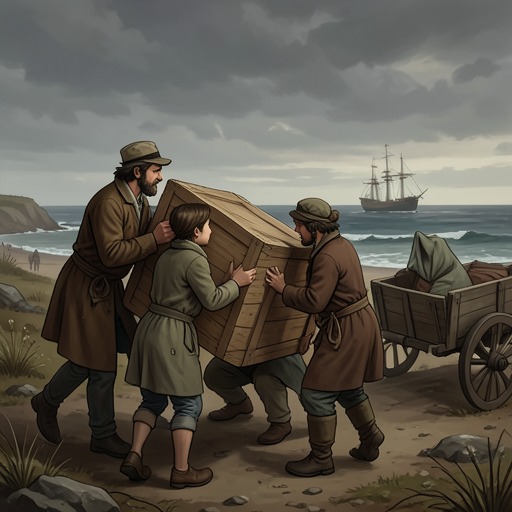
The practical preparations express the emigrants’ continuing dependence on land even as they prepare to leave it. Spring is chosen because the winter storms have passed and an early arrival would give them time to till and sow before winter. Karl Oskar and Robert arrange passage on the Charlotta from Karlshamn, paying a hundred daler in advance for six passengers; Robert also offers to obtain a passage contract for Danjel if the ship has room. A chain of information, payment, and personal assistance turns the wish to emigrate into a route the group can actually take.
At Åkerby Junction, the movement becomes collective and countable. Sixteen emigrants—nine adults and seven children—gather with their wagons, while three drivers are to return from Karlshamn. Danjel’s family travels with Ulrika of Västergöhl; Jonas Petter brings Arvid and Elin in his wagon, and Robert joins them there. The departure gathers households and connections into one traveling party, rather than sending isolated individuals toward the coast.
On the road, Robert jumps down to open and count the gates, calling himself the gate-boy on the road to America. He even counts openings in pasture fences where the gates have been removed for winter. His playful tally gives the journey a sequence of thresholds, while the family’s silence gives it a different weight: Karl Oskar and Kristina look at familiar places, remembering a brook and a meadow they expect never to see in the same way again. The road still lies on land, but the travelers already experience it as a passage away from their former lives.
The sea reverses the emigrants’ command
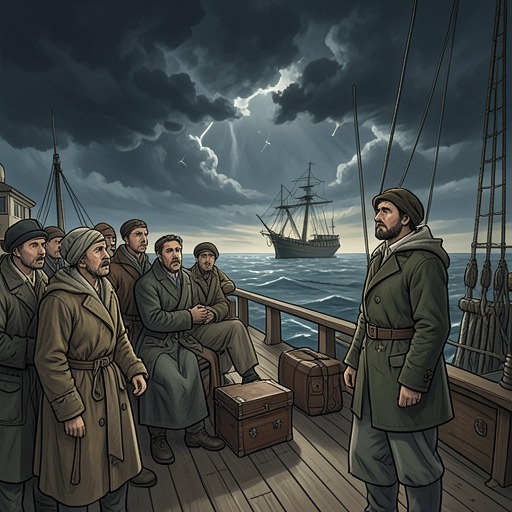
At Karlshamn, the emigrants look across water without seeing land on the other side for the first time in their lives. The sea does not initially appear as an open route so much as a boundary: a cold coastal wind meets them before they have even begun the crossing. Their habitual protections—coats, shawls, and heavy peasant clothing—cannot make this environment familiar. The people of the earth meet the sea with little time to understand it before the wind brings tears to their eyes.
Boarding the Charlotta makes the contrast bodily and immediate. The passengers have lived on the solid quarter of the globe; now they must spend an indefinite period on its moving waters. The deck is made of planks, but it is not like the dependable floor of a cottage. It slopes toward the rail, and the waves lift and lower the ship beneath their feet. Their steps become uncertain; instead of directing their own movements on firm ground, they must adjust to the vessel and the sea.
The change also unsettles the value of the emigrants’ skills. Their strength comes from work among stones and junipers: breaking rock, twisting branches, cultivating fields. On the ship, strong backs and practiced hands do not confer control. The most capable farmers and farm wives are equally helpless before an unfamiliar element. The novel presents the sea as an antagonist not because it has a human intention, but because its scale and motion place the passengers under a power they cannot negotiate with or master.
The ship’s dimensions make this loss of space concrete. Robert and Arvid pace the Charlotta and estimate that she is forty paces long and eight wide, room that must serve nearly a hundred people for living, sleeping, eating, and other necessities. The emigrants have exchanged open fields for a crowded deck bounded by rails; even the possibility of everyone being on deck at once raises the prospect of dangerous congestion. The ship is both their means of mobility and the small enclosure that contains them for months.
Fear, distance, and the uncertain destination
For Robert, the contrast sharpens into private fear. As evening falls and the land disappears from view, the ship seems to him a fragile structure above an immense depth. He imagines himself carried across it inside an old wooden vessel and considers hiding below. The thought marks how far he has moved from the confidence associated with firm land: on shore, movement belongs to the person who walks; at sea, safety depends on a vessel and conditions beyond his control.
His account of lying in his bunk makes the distance between ship and water seem dangerously small. He fears that the sea could enter through the hull and that he would be unable to swim. The fear is tied to a memory from childhood, when he tried to drown a cat and was frightened by its struggle in the water. The remembered episode returns at night, while his brother does not show the same fear. The sea thus unsettles Robert in a way that cannot be reduced to the group’s general unfamiliarity: it draws his attention to vulnerability, memory, and the difference between his response and his brother’s.
The crossing also stretches distance into time. Contrary winds and currents, together with fog and waves, prolong the voyage. The emigrants count the passage not in miles but in days spent at sea, and begin to suspect that they were misled about how far North America lies. Sweden grows incalculably remote, but the new home remains remote too. The sea holds them between two lands, making the promised destination no more immediately available than the homeland they have left.
The opposition’s significance
The contrast between land and sea is not a simple opposition between an oppressive old world and a liberating new one. Land offers the emigrants familiarity, skills, and the possibility of work, but scarcity and family growth have narrowed their prospects. The sea offers passage toward fertile ground, but exacts a period in which their familiar abilities and habits provide little protection. The emigrants’ hopes depend on crossing the element they mistrust.
That tension gives the journey its emotional and narrative shape. The road out of the parish turns remembered landmarks and counted gates into signs of departure; the ship turns the open route into confinement and dependence. The sea does not cancel the promise of another land, but delays and tests it. By the time contrary weather has made both homeland and destination seem far away, the travelers inhabit an unsettled interval: no longer securely among the places they know, and not yet able to begin life on the ground toward which they sailed.