The dead sea and its warning of a storm
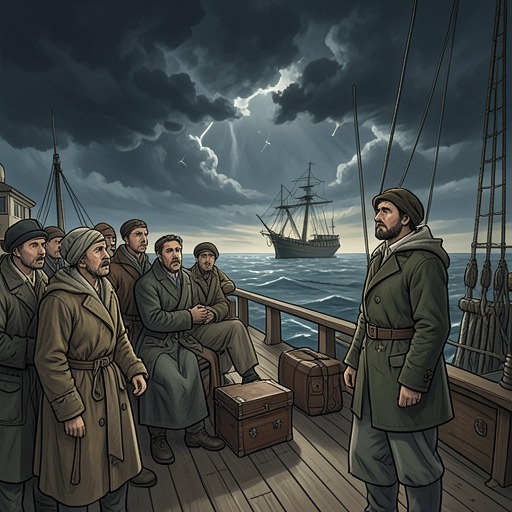
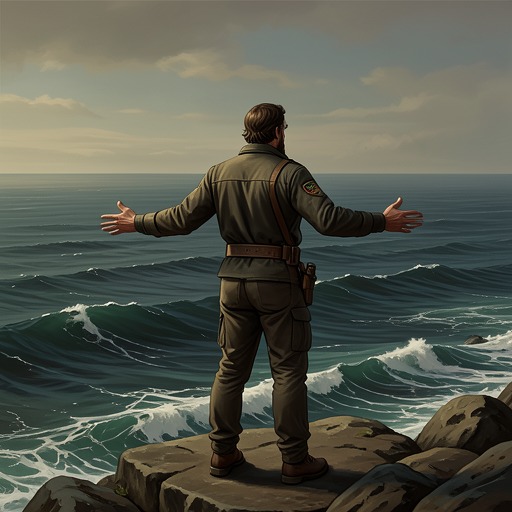
The EmigrantsThe dead sea and its warning of a storm is both a nautical sign and a phrase that takes hold of Robert’s imagination aboard the Charlotta. A sailor explains that these waves are the remnants of an earlier storm, but Robert hears in the words an omen of shipwreck and death. As the brig enters dangerous weather, the warning returns with compulsive force, turning an observation about the sea into a measure of how powerless a passenger can feel inside a ship built to carry emigrants across the ocean.
The warning and its maritime meaning
Robert learns the phrase while standing on the afterdeck at dusk. A seaman says they are nearly in a dead sea, and the words sound to Robert as though they mean a sea where people are going to die. The sailmaker offers a natural explanation: the waves are after-waves left by an old storm, like ghosts of the sea, carrying news of a shipwreck from elsewhere. The image itself preserves the frightening story of danger, even as the explanation identifies a physical cause.
The warning soon acquires a more immediate meaning. Someone says that a dead sea foretells a storm and that the wind has shifted to the northwest. Robert sees steep, white-topped swells rise around the brig; one breaks over the deck and soaks his trousers above the knees. A young sailor laughs at him, and Robert stays on deck after pretending not to care. The incident is small beside the storm to come, but it marks the point at which the sea ceases to be merely a pleasant splash against the hull and becomes a force capable of overwhelming the ship.
From phrase to nightmare
The words persist after Robert has gone to sleep in a two-man bunk beside his brother, Karl Oskar. In his dream, the phrase repeats until it seems to work into his brain like an auger. The bodily immediacy of the remembered wave, followed by the sailors’ warning, gives the storm an advance presence: before the danger is fully experienced, Robert is already caught inside its language.
When the storm rises, the threatening image becomes physical. Waves break over the deck, and the first mate orders the main hatch battened down. Below, a woman is burned by boiling water when the ship rolls; the sick girl with an abscess in her throat, who often moans, is silent that night. Robert lies trapped in the dark as the ship pitches, his brother’s weight pinning him in the bunk. The conditions aboard sharpen the terror: the hold is crowded with passengers and belongings, its air thick and choking, while the closed hatch cuts off the route to open air.
Robert’s fear turns the bunk itself into a sinking vessel. Amid the close-packed sleepers, groans, sickness, and the ship’s movement, he imagines that the mattress and floor are giving way beneath him and that he and Karl Oskar are sinking together toward the bottom of the sea. The imagined descent is not a separate supernatural event; it is the storm refracted through a frightened, seasick body. The phrase supplies the shape of his panic, while the cramped hold deprives him of the distance and freedom that might have calmed it.
The body against the omen
Overcome by the smell of vomit, Robert tries to reach the deck. In the darkness he stumbles between bunks, crawls through the passage, and reaches the ladder, only to find the hatch fastened. The sailors’ shouts overhead confirm the violence of the gale, but he cannot get out. At the ladder he clings and vomits until someone’s arms drag him back to his bunk. Karl Oskar names what is happening as seasickness, an ordinary bodily affliction rather than the death foretold in Robert’s nightmare.
That explanation checks the panic without making the storm disappear. Robert’s repeated “dead sea” has become more than a recalled phrase: it is the thought through which he experiences the hold’s filth, darkness, motion, and confinement. Yet the scene keeps a distinction between forecast and fate. The sailors’ language warns of dangerous weather; Robert’s fear imagines the ship going down. The passage does not establish that the dead sea causes a wreck or predicts a death. Instead, it shows how a real sign of danger can become, under physical distress, an apparently inescapable sentence.
Fear, faith, and human limits
The storm also tests the emigrants’ religious understanding of danger. Danjel Andreasson believes that God is with them aboard the Charlotta and that the storm is a trial of faith. He reads aloud the Gospel account of Christ stilling a tempest, hoping to comfort those suffering in the bunks. But the seasick passengers are absorbed in pain; the scriptural story does not still the present waves or release them from their sickness. Its promise of deliverance stands beside the immediate fact that they remain helpless in the hold.
Elsewhere in the story, Nils Jakob’s Son accepts his disabling injury as part of God’s preordination and refuses to question the Creator. Kristina likewise reads the chain of accidents and choices that brought her to marriage and family life as willed by God. These beliefs provide frames for events after they happen; the storm scene, by contrast, makes the uncertainty of interpretation palpable. The warning has an intelligible maritime meaning, while what it signifies for any individual passenger remains uncertain.
That uncertainty later meets the burden of human responsibility. When Kristina suffers dangerous bleeding during the crossing, Captain Lorentz consults his Medical Adviser for Seafarers, seeking practical instructions for treatment. Karl Oskar, meanwhile, recognizes that he persuaded his wife and children to make the voyage and must bear responsibility for that choice. Neither response erases the ocean’s power: the captain can consult a manual, and Karl Oskar can acknowledge his decision, but neither can make the passengers safe simply by naming the danger. The dead sea’s warning therefore resonates beyond Robert’s nightmare, joining the voyage’s physical hazards to its questions about providence, action, and the limits of control.