The famine year
The EmigrantsThe famine year is more than a backdrop to the emigration from Ljuder: it sharpens the contrast between a homeland that cannot sustain its people and an America imagined to offer land and renewal. Its effects are economic, religious, and bodily, carrying from the failing prospects at Korpamoen into the emigrants’ preparations and the dangerous confinement aboard the Charlotta.
Scarcity and the pressure to leave
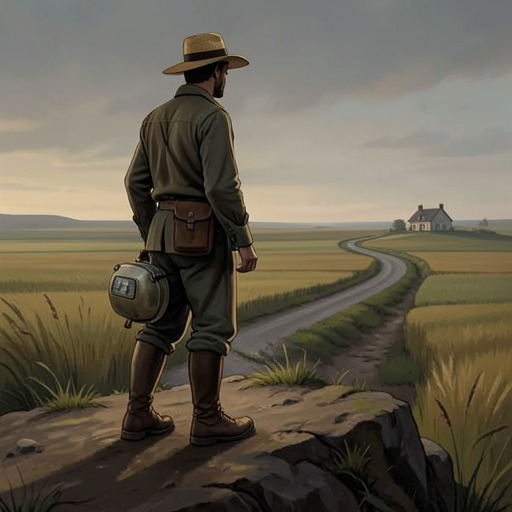
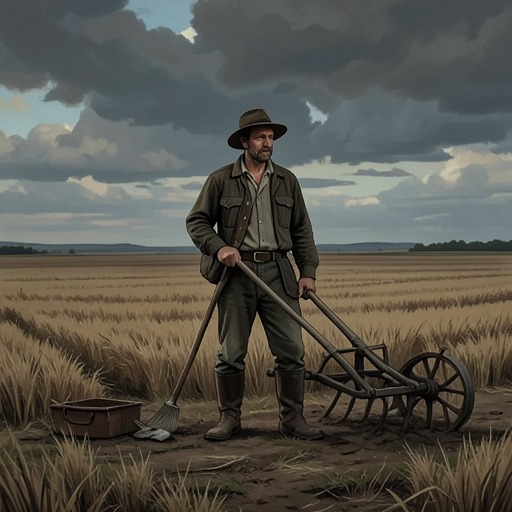
The novel places the famine within a broader rural crisis. As families grew while their plots diminished, news spread of fertile land across the ocean, and scarcity loosened the old certainty of staying put. The emigrants did not share one motive, but crop failure was among the distinct pressures driving this group from Ljuder Parish. The famine thus helps turn individual discontent into a collective movement without making the travelers’ reasons identical.
Karl Oskar’s decision to leave rests on a more extended experience of decline. After four years at Korpamoen, he and Kristina were several hundred riksdaler poorer despite spending their strength on the farm. Staying, he feared, meant years of exhausting labor ending with no reward beyond the reserved room and meager bread of old age. His father’s crippled condition made that prospect tangible. The famine did not alone create the family’s hardship, but it intensified a situation in which work seemed unable to secure their future.
Kristina’s doubts expose the other side of the decision. Karl Oskar believed the reports of America and its available land; she saw no written promise, deed, or firsthand witness to prove that they would find a farm there. The famine and their poor prospects pressed them toward departure, but could not make the destination certain. Their discussion therefore sets material necessity against the risk of exchanging a known, impoverished home for an unverified promise.
Economic consequences and departure
The famine shaped the sale of Korpamoen as well as the decision to abandon it. Because the year’s enforced slaughter had left a shortage of cattle, the family’s animals fetched good prices at auction. The farm itself was less favorable: Karl Oskar had to lower his asking price, since he was compelled to sell while the prospective buyer could wait. After the mortgage and other debts were deducted, about 1,200 daler remained from the farm sale and auction.
The figures made the cost of emigration stark. Passage for the household—three adults and three children—was 675 daler, leaving Karl Oskar with about 500 before the entrance fee and onward transportation in America. Money for tools and cattle would be short even if land proved inexpensive. His parents, Nils and Märta, were dismayed that nearly half the sum needed to buy a farm would be spent on passage. To guard what remained, Kristina sewed the 500 daler into a sheepskin bag that Karl Oskar could wear against his body.
Famine also enters the dispute over whether leaving is faithful or blameworthy. When Karl Oskar asks Dean Brusander for his papers, he gives debts and hardship as his reason and says he cannot improve his situation at home. The dean replies that God sent the famine year and that a Christian should accept tribulation as a trial for the soul. He presents emigration as selfish desire and invokes cholera among earlier Swedish emigrants as a divine warning. The same crisis that Karl Oskar experiences as evidence that staying is untenable is recast by the dean as a reason to endure.
From failed harvest to shipboard vulnerability
The emigrants’ arrangements reveal how the pressure to leave became a tightly constrained journey. Spring was chosen so that the winter storms would be past and the travelers could arrive early enough to sow for a fall harvest. Karl Oskar and Robert secured passage on the Charlotta, sending a 100-daler down payment for six people; the brig sailed from Karlshamn for New York on April 14, 1850. It carried 78 emigrants alongside cargo, with 94 people aboard in total.
The ship offered little relief from the insecurity that had driven them out. Canvas divided the hold into compartments for families, unmarried men, and unmarried women, but the low-ceilinged space filled with bedding, food baskets, and bundles until there was hardly room to step. Dust rose from the unaired mattresses and the air grew choking. There was no room for Karl Oskar in the family compartment, so he shared a two-man bunk with Robert; Jonas Petter slept above them and Arvid nearby.
Scarcity followed the passengers aboard in the form of strict provisions and water rules. The mate allotted each family a weekly share of unprepared food, required them to take turns cooking in the galley, and ordered refuse thrown overboard to leeward. Each person received only half a gallon of fresh water per day for drinking, washing, and food preparation. Passengers had to clean the hold before receiving their water, including removing the night’s vomit and dirt. The rules made sanitation and survival depend on the emigrants’ labor as well as on the ship’s limited stores.
The famine’s meaning and the landfall
The famine’s meaning remains contested. In the pulpit it is a divinely sent test and a warning against emigration; in Karl Oskar’s household it belongs to a continuing material predicament in which toil has not improved their position. The narrative’s account of the group likewise resists a single explanation: crop failure joins persecution, religious dissent, social ostracism, personal troubles, and unfair employment practices as separate reasons for leaving. The famine is a shared historical pressure, not a complete account of every passenger’s choice.
At the crossing’s end, the consequences of deprivation are visible in the passengers’ condition. Storms, illness, confinement, scurvy, and ship fever have worn them down; some have become indifferent to what life may bring. When the emigrants finally see green earth, the sight reverses that exhaustion. They feel renewed energy and ambition, and even the scurvy-stricken believe they may recover. The landfall does not erase the losses or uncertainty that began at home, but it gives the group a moment of physical and spiritual reawakening after a journey shaped, from its start, by scarcity.