The one-way emigrant voyage
The EmigrantsThe one-way emigrant voyage names the crossing’s central paradox: the emigrants leave in search of a possible future, yet come to understand that the journey itself has made their departure effectively permanent. Their passage from Ljuder Parish to America is not a single shared impulse but a collective movement assembled from different pressures, fragile hopes, family negotiations, money, transport, and social ties. Once the Charlotta has carried them far out over the Atlantic, the sea becomes not merely a route but the distance that separates them from a return they can no longer imagine.
From Local Pressures to a Collective Departure
The movement begins in Swedish farming communities where inherited routines offer little protection against shrinking plots, growing families, and scarce food. News of fertile land in America travels through neighbors and parishes, while pictures and rumors stand in for direct knowledge. That information can awaken hopes without resolving the uncertainties that make departure frightening: the ocean is unknown, and the destination has not been seen by anyone in the emigrants’ immediate circle.
The group from Ljuder Parish gathers people whose reasons for leaving are not interchangeable. Crop failure, persecution by civil authorities, religious dissent, personal troubles, social ostracism, and unfair employment practices all contribute to the larger movement. Their shared route therefore does not erase their distinct circumstances; it brings different forms of dissatisfaction into one migration.
For Karl Oskar Nilsson and Kristina Johansdotter, the decision takes shape through sustained disagreement. After four years at Korpamoen, the couple are several hundred riksdaler poorer despite years of work. Karl Oskar sees continued labor leading toward exhaustion and dependence, with only the reserved room and meager bread awaiting them in old age. Kristina fears that his American prospect may be a wild-goose chase: they have no land deed, written guarantee, or firsthand report from anyone they know who has visited North America. The contrast between his urgency and her demand for reliable evidence makes emigration a household decision under uncertainty, not a simple response to an advertised opportunity.
Making the Crossing Possible
The departure depends on practical arrangements as much as aspiration. Karl Oskar and Robert Nilsson have secured passage on the Charlotta, a merchant vessel sailing from Karlshamn directly to New York. Spring is chosen so that the emigrants can reach their destination in time to till and sow for a fall harvest. A down payment of one hundred daler covers passage for six; Robert is to seek a contract for Danjel Andreasson as well, provided the ship has room. Danjel expects nine people from Kärragärde, including children and household members, so one family’s plan opens a route for another.
The cost exposes how narrow the margin is between having the means to leave and arriving with enough to begin again. After the sale of Korpamoen and its belongings, the deductions for mortgage and other debts leave the family twelve hundred daler. Their passage costs six hundred and seventy-five daler for three adults and three children, leaving Karl Oskar with about five hundred before the entrance fee and onward transportation are paid. The hoped-for near-free land in America is therefore set against the immediate expense of the crossing and the uncertain cost of reaching a settlement. Kristina sews the remaining money into a sheepskin bag that Karl Oskar can fasten to his belt and carry next to his body: the family’s future is reduced to a sum that must be kept physically safe through the journey.
At Åkerby Junction, separate departures become a visible company. Nineteen people meet; sixteen emigrants—nine adults and seven children—are to continue toward Karlshamn, while three drivers will return. Danjel’s party includes his wife, four children, and Ulrika of Västergöhl. Arvid and Elin, unable to fit on Danjel’s wagon, travel with Jonas Petter of Hästebäck. Robert joins them too, reunited with Arvid after their earlier plans to escape service separately. The wagon journey gathers people with different histories into one route, and the question of who should lead the group makes their new collective identity briefly explicit.
The Ship as Route and Confinement
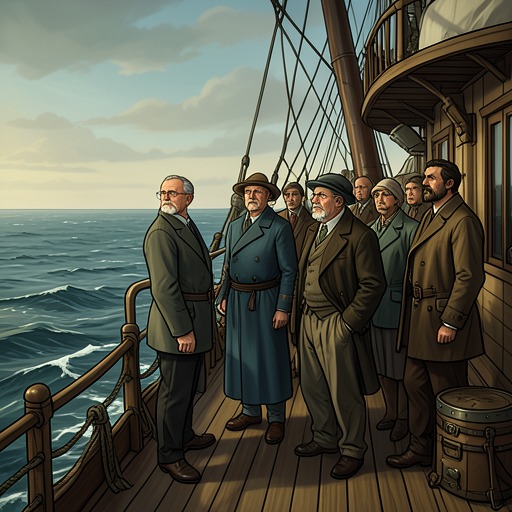
The brig Charlotta sails from Karlshamn on April 14, 1850, bound for New York. Captain Lorentz commands a ship carrying fifteen crew members and seventy-eight emigrants, in addition to pig iron and miscellaneous cargo; this is her seventh voyage as an emigrant ship. These particulars make the crossing a working maritime operation, not an abstract passage: the emigrants travel inside a cargo vessel whose capacity and arrangements determine the conditions of their movement.
Below deck, canvas divides the hold into compartments for families, unmarried men, and unmarried women. The seventy-eight passengers spread their bedding among the bunks and deck space, but possessions crowd the low, airless interior. Dust rises from unaired mattresses, blankets, and skins; food baskets and bundles compete with the people for room, and the main hatch is the only source of daylight. There is no room for Karl Oskar in the family compartment, so he shares a two-man bunk with Robert in the unmarried men’s section. Jonas Petter sleeps above them and Arvid nearby. Their destination may promise land, but the immediate passage is marked by restricted space and dependence on the ship.
Distance Without a Road Back
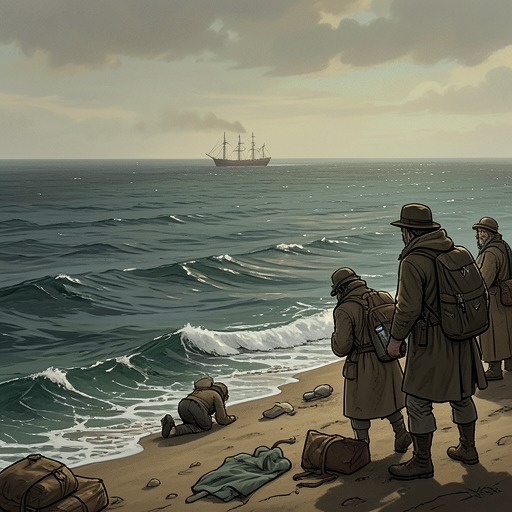
After two months at sea, the emigrants look back over the water they have crossed and feel its immensity in a new way. At home they had not understood the ocean’s scale; aboard the Charlotta, the repeated waves and long distance make it tangible. The passage changes their sense of time and possibility: the water behind them is no longer simply the route they have traveled but a barrier growing harder to conceive of crossing in reverse.
That recognition gives the voyage its one-way character. Whatever awaits them on the new continent, the emigrants come to believe that returning to their homeland is beyond conception. Their move feels final, extending to the end of time, and the crossing becomes a journey people take only once. The finality is not presented as proof that their hopes will succeed; it arises precisely while the destination remains unknown. They have left without the guarantees Kristina wanted, and the sea makes that uncertainty inseparable from the loss of an ordinary way home.
Landfall and the Meaning of Arrival
When America finally appears, the passengers crowd onto the deck, carrying those too weak to climb by themselves. They see houses, churches, piers, streets, and people, but their eyes search for something more elemental: living ground. They find it in a grove of leafy trees and grass, a green shore unlike the dark shore they left at Karlshamn. The sight answers neither every practical question nor every fear about settlement, but it confirms that the sea has been crossed and that earth lies before them again.
The landfall also reveals what the journey has cost. Storms, illness, confinement, scurvy, and ship fever have worn down bodies and spirits; monotony has left some passengers indifferent to what life may bring. The first view of green land reverses that decline for a moment: the weakened feel they may recover, the tired regain strength, and the depressed recover initiative. Arrival therefore does not cancel the crossing’s hardships or restore the abandoned home. It marks the far shore of an irreversible passage, where the emigrants’ renewed energy meets a future they must now face on its own terms.