The wrong road to America
The Emigrants“The wrong road to America” begins as Robert Nilsson’s name for the path out of a life already mapped by landownership and farm service. It develops from his imagined escape route into an emblem of emigration itself: a choice that opens onto possibility, but leads through unfamiliar roads, crowded shipboard quarters, and a prolonged crossing whose destination remains remote.
A road out of service
Robert’s first image of escape comes as he considers how land and water are divided. The sea, unlike the homesteads subdivided among owners, belongs to no one; on land, a person without property becomes a servant to a landowner. He imagines the roads near the bridge over the mill brook as a choice between return to service at Nybacken and a left turn that would take him away. The parish records offer a precedent in Fredrik Emanuel Thron, a farmhand whose whereabouts had been unknown since 1833. Robert knows almost nothing else about him, and that absence makes Thron’s fate an open question—and a possible model for vanishing.
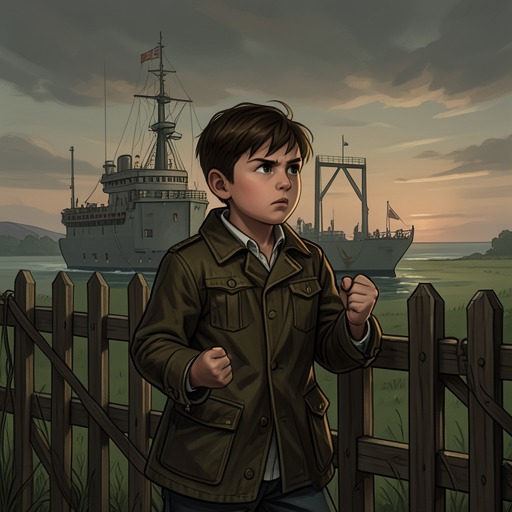
Robert’s first attempt turns the imagined route into action. After his wooden shoe floats into the brook, he sees himself as if already drowned; instead of leaving that image as a thought, he throws his other shoe and jacket into the water, gathers his bundles, crosses the bridge, and takes the left-hand road. The jacket caught in the willow branches becomes a false sign of his fate: to anyone passing, it appears to tell that the hired hand has drowned, as a maid had done years earlier. But Robert has not died. He has taken the road that does not lead to Nybacken.
The escape does not last. Robert is found and taken back with his master, and the wagon crosses the same bridge by the opposite route, toward Nybacken. The day ends as his first attempt to travel toward America, not as a successful departure. The phrase therefore holds both an act of defiance and its immediate defeat: the road can be chosen, but the structures governing a farmhand’s movement can still turn him back.
From private flight to emigration
The novel later gives the wrong road a broader meaning. News of fertile land across the ocean spreads through peasant communities by rumor, pictures, and word of mouth. The old settlements are familiar, but their plots shrink as families grow, and food is scarce. Emigration begins as a disturbance in this established order: some hesitate before the unknown ocean, while others dare to move. Against this background, America becomes the land for someone who has taken the wrong road—not merely a destination, but an alternative to the route laid down by poverty and inherited custom.
That alternative requires arrangements, money, and other people. In planning the voyage, Karl Oskar explains that spring offers a better crossing and gives the emigrants time to sow and harvest after arrival. He and Robert have reserved passage for six aboard the Charlotta, sent one hundred daler as a down payment, and expect to embark at Karlshamn in the second week of April for a direct voyage to New York. Robert offers to secure a contract for Danjel as well, if the ship has room; Danjel’s party numbers nine, including children and household members. The road to America is thus not simply an individual’s turn away from service. It becomes a linked undertaking, made possible through contracts, payment, timing, and expanding social ties.
The preparations make the break tangible. The Nilsson family’s old black oak clothes chest, handed down through generations and associated with baptisms, weddings, and funerals, is taken from the attic and repurposed as a packing case. Its history in the household does not disappear when it is sent away; the very object that has accompanied family life becomes the container for departure. Inside the Korpamoen America chest, Karl Oskar packs tools for building and working, while Robert brings fishing gear. These choices turn the imagined road into a material plan for making a living elsewhere.
Counting the threshold
When the emigrants finally set out, the road’s gates become a measure of passage. Robert jumps down at each gate to open it and counts five before Åkerby Junction. He counts even the openings where gates have been removed for winter, treating them as part of the road to America. The small task gives shape to a journey whose full distance he cannot yet measure: each opening marks another threshold crossed.
At the junction, separate plans join into a group. Nineteen people meet there; three drivers will return from Karlshamn, leaving sixteen emigrants—nine adults and seven children. Danjel’s family travels with Ulrika of Västergöhl, while Jonas Petter’s wagon carries, among others, Arvid and Elin. Robert moves to Jonas Petter’s wagon, where Arvid greets him. The two farmhands who once expected to slip away alone from Nybacken are now traveling together with a larger company. The wrong road has become a shared route, though the group has not agreed on a single leader: Jonas Petter calls them a family, and the others look to Karl Oskar before he points to Jonas Petter as the oldest.
The leaving is also a deliberate encounter with what will be lost. Karl Oskar and Kristina sit silently as familiar places pass: a brook where they swam, a meadow where lilies of the valley bloom. Their attention turns the journey away from a simple escape story. The road leads outward, but it also makes the emigrants look back and recognize that departure means relinquishing places woven into youth and memory.
The road narrows at sea
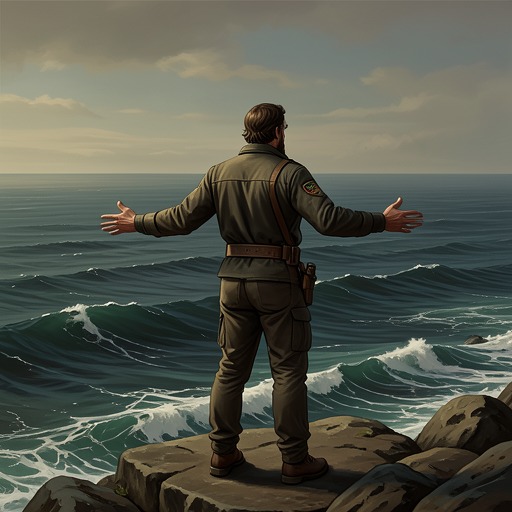
The phrase’s promise is tested as soon as the emigrants reach Karlshamn. After the long wagon ride, they face water with no land visible on the other side. The sea is not the open, ownerless freedom Robert once imagined; it is an obstacle to be crossed, and the emigrants have only just arrived at its edge. The contrast between the land road, where Robert can turn left or right, and the ocean crossing makes mobility less certain: beyond the harbor, progress depends on a vessel, its route, and the conditions around it.
Aboard the Charlotta, Robert and Arvid measure the ship at forty paces long and eight wide. The scale is startling in light of the number of people who must live, sleep, and eat aboard it. Their inspection replaces the open-road image with a confined space and questions about what would happen if the small vessel encountered trouble. The emigrants have chosen to leave, but choice does not give them control over the conditions of passage.
Contrary winds and fog extend the crossing until the emigrants measure distance in days rather than miles. The voyage seems to have carried them thousands of miles from the second week in April, yet both the homeland behind them and the new homes ahead feel remote. Some begin to suspect that they were misled about how far North America lies; many wish they could put a foot on firm land again. The wrong road has led out of the parish, but it has not delivered the travelers promptly to freedom or settled life. Its decisive meaning lies in the irreversible choice to leave familiar ground, and in the uncertain passage that choice sets in motion.