Three Shovelfuls of Swedish Earth
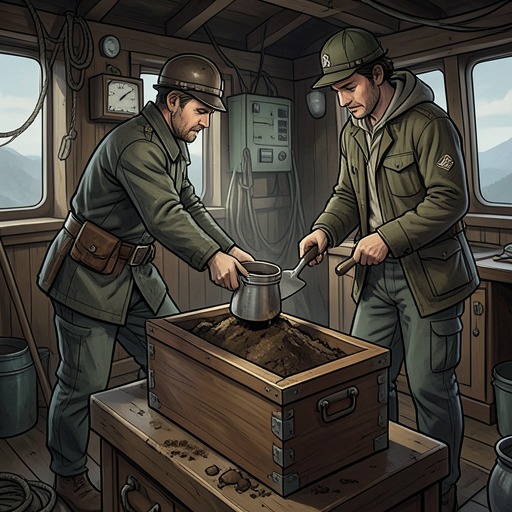
The EmigrantsThree Shovelfuls of Swedish Earth is the sea-burial ritual Captain Lorentz prepares for emigrants who die aboard the Charlotta. He brings a bushel of Swedish soil aboard so that, before a body is lowered into the ocean, the dead can receive three shovelfuls of the land they left. The gesture carries the homeland onto the ship, but cannot keep the dead from the water: as the soil is scattered, some of it slips overboard ahead of the body it was meant to accompany.
Origin and Purpose
Captain Lorentz’s decision grows from the duties and losses of emigrant voyages. He believes he can bring the Charlotta safely to port, but knows that passengers may die before the ship reaches New York. On an earlier voyage, he had to conduct sea funerals without earth and used galley ashes instead. That experience gives the absence of soil a practical and ceremonial weight: a burial at sea cannot reproduce a grave in a churchyard, but a measure of familiar earth can mark the difference between a death far from home and a death wholly severed from it.
Lorentz therefore begins carrying a bushel of Swedish earth for future burials. He understands the emigrants as people bound to the soil they have worked and left behind, and imagines that they would want some of that earth with them in death. The provision is made without the passengers’ knowledge. It is not part of the ship’s ordinary stores or a service they requested; it is the captain’s response to the prospect of deaths for which his navigation cannot protect them.
The Soil Aboard the Charlotta
The soil first exists as a modest quantity in a wooden bushel measure, with a small scoop stuck into it. Its scale matters: the captain has not brought a grave’s worth of land, but enough for a brief act at sea. The soil travels as part of the Charlotta’s unannounced care for its passengers, alongside the formal duties of a captain who must sometimes conduct funerals as well as command a ship.
The image gathers force from the emigrants’ larger departure. They have left communities where plots are small and food is scarce for a reported land across the ocean, where fertile soil may be available to those willing to cultivate it. In that movement, earth is both what they leave and what they hope to find again in a new country. The bushel aboard the ship preserves a physical connection to the old home during the crossing, even as the emigrants travel toward a life organized around new land.
The Burial and Its Meaning
At the burial, Lorentz takes the scoop and casts soil over the dead body three times. The repeated gesture gives the title its literal meaning and makes the soil part of the funeral rather than merely a keepsake in the ship’s stores. The captain’s words about returning to dust join the act to the ritual’s account of death and resurrection; the earth is not presented as protection from death, but as a tangible element in acknowledging it.
The burial also reveals the limits of the gesture. The soil settles on the canvas covering the body in three small mounds, but lighter grains separate and trickle down its side. As the bier leans toward the rail, some of the Swedish earth crosses into the sea before the body is committed to it. The scene makes the ritual’s tenderness inseparable from its failure to hold the homeland intact: the soil accompanies the dead, yet it too is carried away by the ocean.
A Recurring Image of Home and Loss
Three Shovelfuls of Swedish Earth links the emigrants’ attachment to land with the risks of leaving it. Their migration begins amid rumors of fertile ground elsewhere and the pressures of crowded, food-scarce home communities; the sea crossing, however, places them in a confined and vulnerable interval between old and new homes. Lorentz’s small reserve of earth gives this interval a material trace of Sweden, but its use confirms that not everyone will reach the destination toward which the ship is sailing.
The soil is therefore both a practical provision and a concentrated image of departure. It can be carried across the sea, divided into three measured offerings, and laid on a body, but it cannot restore the dead to a churchyard or turn the ocean into land. When grains spill into the water, the ritual’s central contrast becomes visible: the emigrants’ lives have been shaped by the earth, while their passage and their sea burials are governed by the sea. The three shovelfuls offer a final connection to home precisely where that connection can no longer bring anyone back.