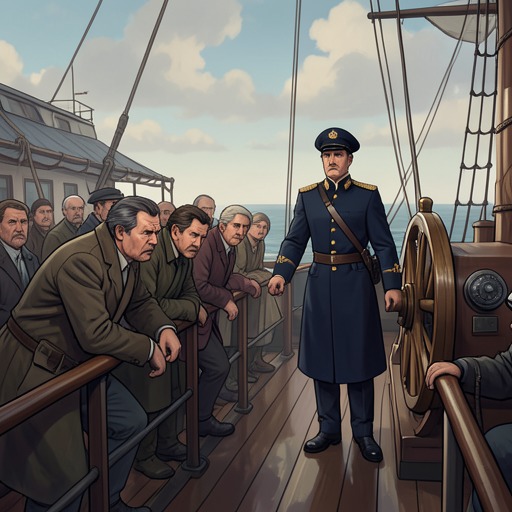
the Finn
The EmigrantsThe Finn, the Charlotta’s second mate, serves as both a working authority on the emigrant voyage and an interpreter of the unfamiliar world the passengers approach. He has crossed to North America on every one of the ship’s voyages, and his matter-of-fact explanations give the emigrants concrete knowledge even as they expose the gap between their hopes and what they actually encounter.
Identity and Work Aboard the Charlotta
The Finn is identified as the second mate and as an experienced participant in the Charlotta’s North American voyages. His role puts him close to the practical demands of the passage and gives him knowledge the emigrants lack. The narrative presents him less through personal history than through these functions: he is a member of the ship’s working crew, a guide at the threshold of landfall, and a source of information about places the passengers have only imagined.
That authority is not abstract. During Kristina’s dangerous bleeding, Karl Oskar goes to the captain for help, and the Finn’s earlier reprimand of Karl Oskar has already shaped how the captain regards the farmer. The captain recalls the Finn’s report that Karl Oskar was a smart-aleck passenger and that the mate had been forced to tell him off. In the crisis, however, the captain sets aside his irritation and asks how long Kristina has been bleeding. The Finn’s connection to the earlier conflict remains part of the shipboard hierarchy through which the family seeks aid.
The Finn as Interpreter of New York
As the Charlotta reaches New York, the Finn stands in the prow beside Robert and Arvid. He explains that the land before them is a large island formerly called Manna-Hata, and recounts what he has heard about the name and the god associated with it. His account mixes geographical orientation with a story whose uncertainty he openly acknowledges: he does not know which god, if any, now lives there, since he has never visited a church in port.
The emigrants’ first view of the harbor includes Castle Garden, a large, round, yellow-gray building with a tower. Robert wonders whether it is a prison, and the Finn answers that a kastell is the same as a prison. That explanation briefly confirms Robert’s expectation that the first American building he recognizes might be a place of confinement. The Finn then corrects the impression: Castle Garden is no longer a prison but a saloon, where people eat, drink, and spend Sundays in crowded company. The change in the building’s use unsettles the emigrants’ ready assumptions about a country imagined as free of evil and crime. The Finn’s firsthand familiarity with the saloon lends his account practical credibility, while its vivid, rough description makes the new city less like an abstract promise and more like a place with its own unruly public life.
Practical Presence and Karl Oskar’s Fear
During Kristina’s illness, the Finn’s role is not shown through a detailed account of treatment but through Karl Oskar’s fearful anticipation of his arrival. Keeping watch beside his wife through the night, Karl Oskar imagines that the Finn will come in the morning with a piece of canvas and try to examine her. He fears that this ordinary intervention will confirm that Kristina is dying, and the approaching morning becomes something he wishes to delay.
The Finn is therefore made emotionally present even while Karl Oskar waits for him. In the farmer’s exhausted thoughts, the second mate’s expected appearance gathers the terror of the voyage, his own guilt over bringing his family aboard, and the immediate possibility of losing his wife. When daylight comes, it is Johan—not the Finn—who reaches Karl Oskar and reports that his mother has stopped bleeding. The episode ends with relief arriving through the child’s voice before the feared morning encounter takes place.
Narrative Role
The Finn’s recurring function is to mediate between shipboard experience and the passengers’ limited understanding. At New York, he converts a strange name and an imposing building into explanations, but those explanations complicate rather than simply reassure: the island’s history comes as hearsay, and the apparent prison proves to be a crowded drinking place. During Kristina’s crisis, his practical authority is refracted through Karl Oskar’s fear, making the prospect of medical attention feel inseparable from the danger it might reveal.
This contrast gives the second mate a sharply defined but not one-dimensional presence. He is an experienced guide whose knowledge can orient the emigrants, yet he also belongs to a world of shipboard authority that Karl Oskar has previously resisted. The Finn’s significance lies in that double position: he helps the passengers approach the new land, while his anticipated intervention marks how little control they have over the dangers of the crossing.