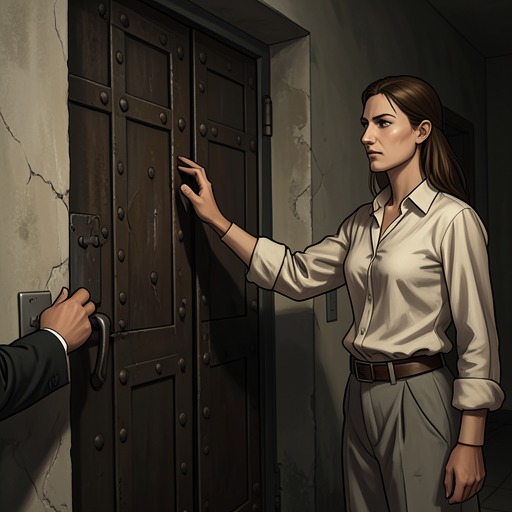
“You’ll be back.”
The ExceptionThe expression You’ll be back is Decker’s recurring prediction that Jada Stanley will return to him after leaving their marriage. It begins as a final, dismissive assurance before Jada leaves Boston, then reappears in variations during their later confrontation. Its significance lies in the conflict between Decker’s confidence that he can define Jada’s future and her growing determination to make her own choices.
The Prediction and Its Origins
Decker’s words emerge from a marriage in which Jada has learned to expect abrupt shifts between ordinary companionship and intimidation. He could bring home takeout and share a movie with her, then become angry and verbally abusive. The unpredictability left her confused and afraid, while his changing behavior repeatedly unsettled her resolve to leave.
His prediction that she would return was connected to a broader effort to make departure seem impossible. Decker emphasized that Jada would be starting over with almost nothing, questioned whether she wanted to discard what they had built, and invoked her hopes of having a family and the promises she had made when they married. These appeals worked on concerns he knew could make her reconsider leaving. The expression thus carried more than confidence about reconciliation: it reinforced his message that she could not manage a life apart from him.
Separation and Repetition
Jada’s decision to leave followed the discovery that Decker had been unfaithful. Although she had suspected the affair, witnessing it made the betrayal undeniable and ended the cycle of reconsideration. After Decker went to work, she moved her belongings to her friend Mandi’s home. She chose it in part because Mandi’s husband, Mason, was a professional fighter and she felt safer there, though Decker had never hit her and she could not predict how he would react.
His response sustained the same instability that had characterized the marriage. He alternated between begging Jada to return and cursing her. During a drunken episode, he appeared at Mandi’s door; afterward, he did not return, but continued to complicate Jada’s life by contesting the divorce. His later insistence that she could not make it alone and would come back restated the original prediction in more explicit terms. The repetition makes the phrase part of an ongoing attempt to discredit her ability to live independently, rather than a single remark about a possible reunion.
The Confrontation
In a later phone exchange, Decker again suggests that Jada might return when she tires of living with her sister, and predicts that he may still consider taking her back. Jada challenges the premise instead of treating reconciliation as the expected outcome. She recalls the fear she felt at home, the repeated infidelity, and the way she had tolerated behavior in the hope of preserving the marriage. Speaking openly about what happened marks a change: she says she had not felt free to defend herself before, and recognizes that Decker’s treatment had made her feel worthless.
Decker responds by denying her account and insisting that she will always belong to him. Jada counters that they are no longer married or in a relationship and points to the divorce as proof that his claim has no legal standing. He again predicts that she will crawl back and frames her independent decisions and bills as evidence that she will fail. The exchange exposes the gap between his certainty and her position: his words try to make return sound inevitable, while Jada directly rejects his authority to determine what happens next.
Meaning and Narrative Function
The expression connects Jada’s memories of the marriage to the conflict that continues after she leaves. Her nightmares bring back Decker’s voice and the fear associated with their life together, even as she sits in Kari’s warm Phoenix home, far from him. Distance has changed her circumstances, but the remembered prediction shows how his judgments continue to intrude on her sense of safety.
The phrase’s force diminishes as Jada speaks back. Decker’s earlier control depended partly on making her doubt that she could start over; in the confrontation, she names what she endured and asserts the reality of the divorce. The scene does not establish that every effect of the relationship has disappeared. Instead, it shows a decisive shift in who gets to describe Jada’s future: Decker repeats his forecast, but Jada no longer accepts it as a fact.