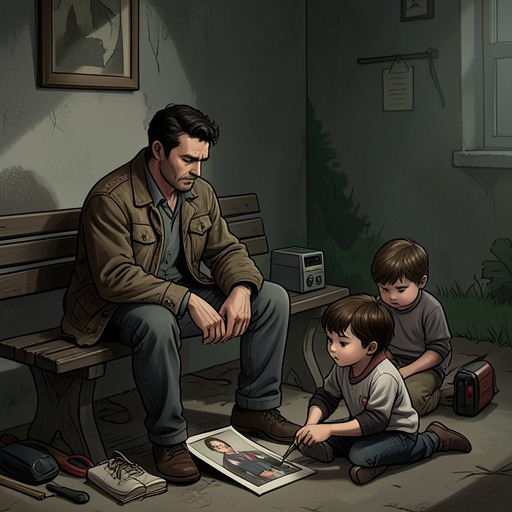
Cane Alexander and Grandpa Ben
The ExceptionCane Alexander’s relationship with Grandpa Ben emerges through remembered time in the desert and the family stories Cane shares with Jada. Ben was not only the grandfather who looked after him while his parents’ lives pulled apart; he also passed down a way of understanding the Alexander name as a call to grow stronger when circumstances became difficult. Their bond joins childhood companionship to a lasting inheritance of family identity.
Care During a Divided Childhood
Cane recalls that his father worked long hours trying to build an independent business and provide a good life for the family. His mother resented how much work took him away and believed he should accept a modest job from Cane’s grandfather instead. Cane connects that conflict to his mother’s departure. With his father occupied and his mother gone, there was no one available to watch him, so Grandpa Ben took on that responsibility. The account presents their closeness as something formed through sustained, ordinary care: Ben became the adult who spent time with Cane when his immediate family circumstances left a gap.
That care is described without turning Ben into a figure who controlled or directed every part of Cane’s childhood. Cane remembers the two of them going out together, with Ben walking while Cane ranged through the landscape in search of things that caught his interest. The recollection gives their relationship a relaxed, companionable quality. Ben’s presence made room for the boy’s curiosity, and the desert became the setting in which their time together accumulated into a private history.
The Desert as Shared Memory
As an adult, Cane takes Jada to a place he considers sacred. He tells her that he had never brought a woman there before, because he did not want to spoil its meaning. When she asks about Grandpa Ben, he explains that they spent a great deal of time in that landscape while he was growing up. His disclosure connects the place’s significance not to an abstract idea of romance but to a particular relationship and a long-established set of memories.
Cane’s childhood excursions had the open-ended pattern of a boy exploring rather than following a fixed itinerary. He searched for gold, snakes, and interesting rocks; Ben, by contrast, simply walked around with him. Cane remembers having covered nearly every part of the desert at some point. The difference in their activities does not separate them: it shows how their companionship could accommodate Cane’s energetic searching and Ben’s quieter presence. In adulthood, Cane’s willingness to bring Jada there marks the place as a boundary he is choosing to open. Sharing the story lets her see a part of his past that he had previously kept apart from romantic relationships.
One feature of the landscape carries another story that Cane leaves unfinished. He points out a rock ledge and suggests that Jada ask Max about it, but says that account is not his to tell. He promises only that it is amusing. The moment establishes that Cane and Max share memories from their younger years in the same terrain, while keeping the details of that particular incident undisclosed. It also shows Cane treating the place as a storehouse of several histories, not solely his own and Ben’s.
A Family Name and Its Inheritance
Cane’s memories of Ben become especially explicit when he talks about family. He acknowledges that he sometimes wishes he still had his family around and recalls the security he associated with his father’s love: the sense that someone would love him despite his mistakes. He contrasts that lost safety net, grounded in blood ties, with the possibility of having a family of his own someday. His recollection of Grandpa Ben sits within that larger longing, giving the older generation a continuing presence in how Cane imagines family and belonging.
Cane says it would be a shame not to carry on the Alexander name, then playfully raises his fist and repeats the family declaration, “We are Alexanders!” He explains that Ben used to say it and taught him that the surname means strength in Greek. In Ben’s telling, the name was a namesake: when hardship came, the family should take it as a time to grow stronger and add to the name. Cane laughs at the grandness of the old saying, but his amusement does not erase its importance. The phrase preserves Ben’s voice and turns a family name into a compact lesson about how to meet adversity.
Continuing Significance
Cane’s account makes Grandpa Ben a formative presence through specific remembered practices rather than a long biography. Ben watched over him when family circumstances made that necessary, walked the desert with him, and gave him a phrase for understanding strength as something tested and developed. The story also places Cane’s later sense of isolation beside evidence that he once experienced dependable care and a family identity strong enough to be repeated as a joke and a rallying cry.
The scene with Jada brings those strands together. Cane identifies the desert as sacred, recounts the childhood companionship that shaped its meaning, and shares the family saying attached to Ben. These disclosures make his memories legible as more than nostalgia: they show the roots of his attachment to family and the inheritance he still carries, even as he contemplates building a family of his own. The bond with Grandpa Ben therefore persists in Cane’s sense of place, in the story he chooses to tell, and in the language of resilience he attributes to his grandfather.