Happily-ever-after is a choice
The Exception“Happily-ever-after is a choice” is the expression through which Jada frames the start of her future: not as a fairy-tale ending delivered to her, but as a life she must choose and build. Its decisive contrast joins romantic hope to agency, and the scene immediately grounds that idea in the ordinary work still ahead.
Meaning and Form
The expression rejects the idea that a happily-ever-after is simply a perfect ending. Jada’s formulation sets the fairy tale against choice: fulfillment may be possible, but it is not automatic. The wording gives the conclusion an affirmative charge without pretending that every difficulty has vanished; its emphasis falls on the beginning of a chosen future, not on a guarantee of effortless happiness.
The Closing Scene
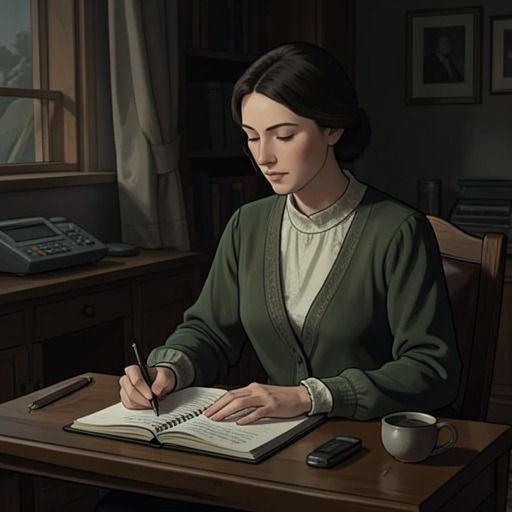
After laughing and returning to her room, Jada notices a red plastic cup on the table, an object that warms her heart. That small, concrete reminder precedes her realization: “My happily-ever-after starts now. It’s not a fairy tale. It’s a choice.” The sequence makes the expression part of a lived moment rather than a detached maxim: an ordinary object prompts recognition, and recognition becomes a decision about what comes next.
Choice Made Practical
Jada begins gathering her belongings and putting them back into her suitcase. Her thoughts turn to returning home, finding an apartment, being honest with her father, and thanking Nick Parker, whose identity she still does not know. These plans give the expression its practical dimension. A new beginning requires decisions and unfinished conversations; the promise of happiness lies in choosing to face those tasks, rather than in escaping them.