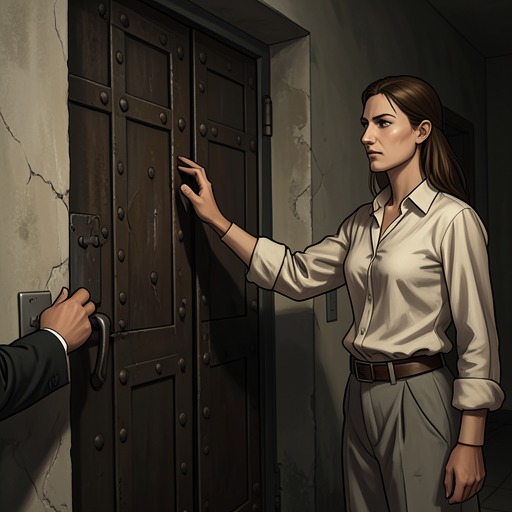
Jada and Decker's Phone Confrontation
The ExceptionJada and Decker's Phone Confrontation is the moment Jada stops yielding ground in a conversation with her estranged husband. As she walks away from Kari's home and into a park, Decker tries to recast their marriage as something she needlessly abandoned; Jada answers by naming the fear and betrayal she had endured. The call ends not in reconciliation but in a practical boundary: she hangs up and requests a new phone number.
Causes and Background
The exchange takes place against a marriage Jada had kept largely hidden from the people around her. She worries that Kari might overhear the call, and reflects that her friends did not know what she had really lived through. Jada herself had struggled to explain why she remained: Decker's conduct could shift from attentiveness to anger, while appeals to their shared life, her financial uncertainty, and the family they had discussed made leaving harder. The changing terms of the relationship left her doubting her own judgment and repeatedly reconsidering her decision to go.
The rupture came when Jada found Decker with their neighbor, Sarah. Though she had suspected his infidelity, witnessing it made the betrayal undeniable. She called her friend Mandi and moved her belongings to Mandi's home that night, while Mandi's husband, Mason, offered a place Jada regarded as safer. Decker later appeared at their door during a drunken episode; after that, he did not return there, but continued to contest the divorce from a distance. His alternating pleas for Jada to come back and angry denunciations formed the immediate emotional history behind the call.
Jada's distress has not vanished simply because she left. Before this conversation, a nightmare brought back Decker's voice and the fear associated with their marriage. The memory makes the call's importance more than a matter of winning an argument: Jada is speaking from within the aftermath of a relationship that had left her braced for his anger and unsure whether she could trust her own reasons for leaving.
The Call and Its Turning Point
Jada begins by asking how Decker is, then tells him that the marriage was not a happy part of her life and that he should know as much. Decker challenges her recollection, insisting that they could have worked things out and that she did not give him a chance. His accusation recalls an earlier version of Jada, who might have retreated from confrontation or searched for a way to ease it. This time, she recognizes that she is no longer responding as she once did.
When Decker says she did not want the marriage to succeed, Jada counters with what she says she had endured: nights spent afraid he would arrive angry, and repeated infidelity before she discovered him with Sarah. She describes how much she had tolerated in the name of making the relationship work and how that endurance left her feeling made a fool of. Her anger is direct, but its significance lies in the change of position: rather than accepting Decker's account of the marriage, she supplies her own and refuses to let him interrupt her defense.
Decker then tells Jada she should have left sooner. His remark accompanies a further attempt to diminish her decision, presenting her departure as a temporary crisis and predicting that she will return. Jada does not accept either the prediction or the premise that he still has authority over her. When he warns her, she challenges him to explain what power he now has over her and distinguishes their present separation from their former marriage. His insistence that she will always be his meets her reference to the paper that says otherwise. The exchange makes the central conflict plain: Decker speaks as if possession survived the marriage, while Jada asserts that their relationship no longer grants him a claim on her.
Ending the Conversation
The argument takes place as Jada walks through a park. She notices two girls playing on the grass and feels a longing to be happy, joyful, and alive. The passing scene does not resolve her history, but it gives her a point of contrast: the future she wants cannot be built by allowing Decker's accusations to dictate her emotional life.
Jada's final response is to tell Decker to return to the pursuits she associates with him and to lose her number. She then ends the call and puts the phone away. The act is immediate and concrete. Rather than waiting for Decker to accept the separation, she limits his ability to reach her. Her reflection that he now has only a box of photographs and her phone number underscores what remains between them—and what she can still take back.
Aftermath and Significance
As Jada heads back to Kari's, she turns her phone on and calls to request a number change. This step follows her declaration rather than replacing it: the conversation establishes the boundary in words, and the change makes it harder for Decker to disregard. The passage does not say that this single decision erases her distress. Jada recognizes that reclaiming happiness will be more difficult than reclaiming her contact information, but she also understands that allowing Decker to rob her of happiness would give him continued influence over her life.
The confrontation therefore marks progress without presenting recovery as complete. Earlier, Decker's reversals and appeals had repeatedly drawn Jada back into uncertainty; during the call, she identifies that pattern, holds to the reasons she left, and refuses his claim that she belongs to him. The scene's movement—from private fear, through spoken resistance, to changing her number—turns separation into an action Jada chooses and carries through.