Old Photos Decker Sent
The ExceptionOld Photos Decker Sent is a parcel of pictures from Jada Stanley’s life with Decker, sent after she has left their marriage behind. Its importance lies in the distance between what the photographs preserve and what Jada now knows: scenes that once seemed to record a shared, happy past cannot be separated from the betrayal and uncertainty that followed. The box turns private keepsakes into an unwelcome encounter with a history she is trying to leave, and Jada’s response makes clear that remembering the marriage does not mean returning to it.
The Parcel and Its Contents
The package arrives at Kari’s home on a day when Kari has finished work early and is making spaghetti. She mentions that a box came for Jada, who is surprised because she has ordered nothing. The parcel has no sender’s name; it is larger than a shoebox and entirely nondescript. Its plain exterior offers no explanation for its arrival, leaving Jada to discover its connection to Decker only after she opens it at the table.
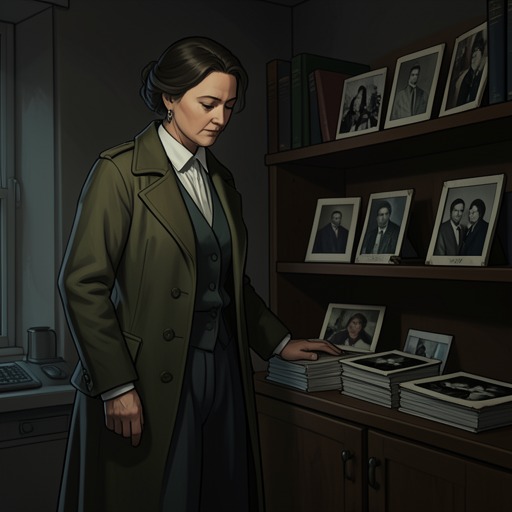
Inside are the pictures Jada had left in the back of Decker’s closet. Their return makes the box more than a collection of old images: it brings back objects she had already left behind, without her having asked for them. The photographs appear one after another, and Kari recognizes the likely sender before Jada can establish why they have been sent. Kari’s concern is immediate, but the parcel itself provides no clear account of Decker’s purpose.
The box also contains a folded sheet of paper. Kari asks whether Decker has called recently, and Jada says he has not. She and Kari consider why he might send the pictures now, but Jada can only offer possibilities: perhaps he has been drinking and reminiscing, or perhaps he wants someone to make dinner. These are guesses, not established explanations. Her uncertainty is consistent with the way she describes Decker: his behavior is difficult to predict, and the parcel does not resolve that uncertainty.
Images of a Shared Past
Among the photographs is one of Jada and Decker at the Tempe Town Lake Marina when they were in college. Decker is smiling at Jada, while she smiles toward the camera. The image gives Jada a specific point from which to reconsider how their relationship changed: she wonders when the dynamic represented by the picture stopped being true. It does not answer her question, but it makes the distance between the photographed moment and the marriage’s later reality visible.
Another photograph shows their small wedding ceremony. Taken by one of Decker’s friends, it is slightly torn at the edges. Its damage is a physical detail, not an explanation of the marriage, but it accompanies Jada’s uncertainty about what the images mean. She leafs through the collection and asks herself whether the memories they represent were real. The question is not whether the pictures record events; it is whether the happiness they seem to show can still be trusted as a description of the life those events began.
The collection also includes a picture of the couple’s first house in Boston. Jada remembers seeing the house with Decker on a rainy summer day and falling in love with it immediately. She had been proud of the home. In the photograph, a shared decision and an important possession remain visible, but their earlier meaning has been altered by what she later experienced. The images thus gather distinct parts of a life together—courtship, wedding, and home—without restoring the confidence Jada once attached to them.
Memory Under Suspicion
As she studies the photographs, Jada cannot simply receive their apparent warmth. She wonders whether Decker’s smile in the college picture meant that he was happy with her, or whether he was already thinking about taking another woman to Columbus under the pretense of a work trip. The thought is framed as a question, not a new certainty established by the photograph. Its force comes from the knowledge Jada brings to the box: she had already learned that Decker was unfaithful, and the images now sit beside that knowledge rather than apart from it.
The past therefore becomes difficult to read as a sequence of uncomplicated good moments. Jada says the memories have been tainted, as if a cloud has settled over each picture. That reaction connects the parcel to the larger history of the marriage. Decker could be attentive and decent and then suddenly become volatile; he also used Jada’s insecurities and hopes about their shared future to make leaving harder. The shifting pattern left her unsure what to expect and repeatedly reconsidering whether to go. The photographs do not reproduce those experiences, but their return makes it impossible for her to view the marriage solely through its happier-looking scenes.
This is why the pictures do not function as proof that reconciliation would restore something intact. Their surface offers recognizable evidence of a life once shared, while Jada’s present knowledge complicates every image. Even the house she remembers loving and the ceremony captured by Decker’s friend cannot settle whether the happiness she sees was secure, lasting, or as mutual as she once believed. The box preserves appearances; it cannot provide the certainty those appearances have lost.
Jada’s Response
The folded paper extends the encounter beyond the photographs. Jada reads it, then recognizes in its movement from an almost sweet opening to a harsher ending the same confusing mixture she associates with Decker. The precise contents are not disclosed here, but Jada’s reaction is clear: she is no longer willing to live in the uncertainty that characterized their marriage. She compares that instability with the greater ease she has experienced with Cane Alexander, where she has had a taste of being able to anticipate what the next day might bring.
When Kari asks how the package makes her feel, Jada names annoyance, frustration, and some sadness, while making clear that the sadness is not enough to change her course. That combination matters. The photographs have not erased her attachment to the past or made it painless to revisit; neither do those feelings become an invitation to resume the marriage. Kari crumples the note, and Jada turns from the contents of the box toward a practical way to end the encounter.
Jada notices the photographs again and asks for a lighter or matches. Kari finds a box of matches, and Jada proposes a fire on the patio, with Jada supplying the kindling and Kari bringing the matches. The evidence establishes this intention and preparation, rather than the fire itself. Even so, the proposed disposal reverses the parcel’s premise: Decker has returned the images to make the past present again, while Jada chooses not to preserve them as keepsakes. The box’s final significance is not that it restores their shared history, but that it makes visible the boundary Jada now draws between remembering that history and going back to it.