Turning from the Past Toward the Future
The ExceptionTurning from the Past Toward the Future is a principle of emotional change articulated by Cane and tested in Jada’s struggle to separate her future from her marriage to Decker. Its force lies not in forgetting, but in refusing to let a partial or painful account of the past dictate what the present can become. Cane states the principle plainly; Jada encounters its difficulty through photographs, a letter, and an unwanted phone call, before Cane’s support gives her a steadier point of orientation.
A Principle of Looking Ahead
Cane describes his orientation toward the future while discussing a woman he says he is no longer capable of loving. He insists that she no longer exists for him and explains, “The secret of moving on is to focus your energy on the future and not on the past. She’s the past. And I’m too busy looking ahead to remember her.” The statement frames moving on as an allocation of attention: the past remains part of a person’s history, but need not retain authority over present choices.
The scene also complicates the self-sufficiency of Cane’s maxim. He has just disclosed family history he ordinarily avoids discussing, then admits that he worries about how readily he talks when Jada is around. As he speaks, he picks up his napkin and wads it into a ball. His vulnerability suggests that looking ahead does not mean becoming untouched by what came before. Rather, the principle describes a direction he is trying to maintain even as intimacy draws old material into conversation.
Photographs and a Revised Past
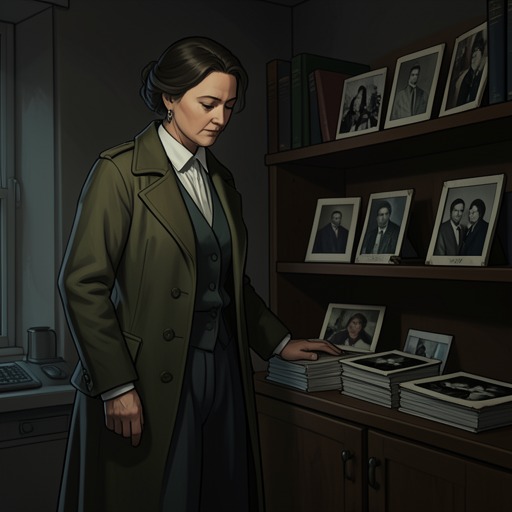
Jada’s encounter with Decker’s past arrives in the form of an unexplained parcel at the table. Inside are the photographs she had left in the back of his closet: a picture of the two of them at the Tempe Town Lake Marina during college, a blurry image of their small wedding ceremony, and a photograph of their first house in Boston. Each image carries a memory she once cherished, including the pride she felt in the house she and Decker had chosen on a rainy summer day.
The photographs do not restore those memories to uncomplicated happiness. Instead, they prompt Jada to question whether the apparent happiness was real. Looking at Decker smiling at her, she wonders whether he was genuinely happy in that moment or thinking of the woman he intended to take to Columbus under the pretense of work. The suspicion darkens the images: she sees a cloud around every memory in the box. Their return makes the past physically present, but cannot settle what it meant.
The letter accompanying the pictures adds another version of the same instability. Jada describes it as sweet at the beginning before Decker’s “true colors” emerge at the end, leaving a confusing mixture of tenderness and bitterness. That pattern recalls the uncertainty she says marked life with him: she could not relax or know what the next day would bring. By contrast, her experience with Cane has given her a taste of steadiness she does not want to lose. The comparison makes the future more than an abstract hope; it is tied to a different experience of what a relationship can feel like.
Memory in Context
Jada admits that she left the photographs because she wanted to forget that period of her life. Kari, acting as her sister rather than as a detached adviser, challenges the idea that the pictures can be read as simple records of happiness. The happiness they depict, she argues, existed within a false reality; knowing what Decker had been doing would have changed Jada’s experience of those moments.
Kari’s analogy makes the interpretive turn concrete: seeing half of a picture can make it look beautiful, while adding the other half can transform the meaning of the whole. Jada laughs at the comparison but recognizes its point. The photographs are not necessarily fabrications; what changes is the context through which she sees them. The scene therefore resists both easy nostalgia and the assumption that every past moment can be cleanly discarded. Jada and Kari sit with the box, but no revelation arrives from it. Understanding comes instead through the difficult recognition that new knowledge can alter the emotional meaning of old evidence.
Refusing the Past’s Claim
Decker’s subsequent phone call turns that inward reconsideration into an explicit confrontation. He tells Jada that she will end up back with him and urges her to stop fighting it and come home. She answers that their divorce should make clear she never wants to see him again. When he blames Cane for supposedly filling her head with ideas, Jada rejects the comparison: Cane shows her who he is rather than needing to tell her. She ends the call, then watches Decker’s name appear again on her phone and turns the device off.
The exchange reveals a practical consequence of looking forward: Jada must refuse Decker’s assumption that her return is inevitable. Her decision is not presented as a sudden cure for the memories or uncertainty that preceded it. Instead, she names the boundary she wants and supports it by ending the conversation. Kari’s approval recognizes the act as a difficult success, while her presence also gives Jada immediate support as she considers how to stop the calls.
Support Without Erasure
After Decker leaves, Jada’s body registers the encounter as distress: her chest tightens, she bends over with her hands on her knees, and she struggles to breathe and calm herself. Cane approaches slowly, wraps her in his arms, and tells her, “You will never be on your own.” He follows this reassurance with the image of knowing who stands behind a person, promising that he will always be there.
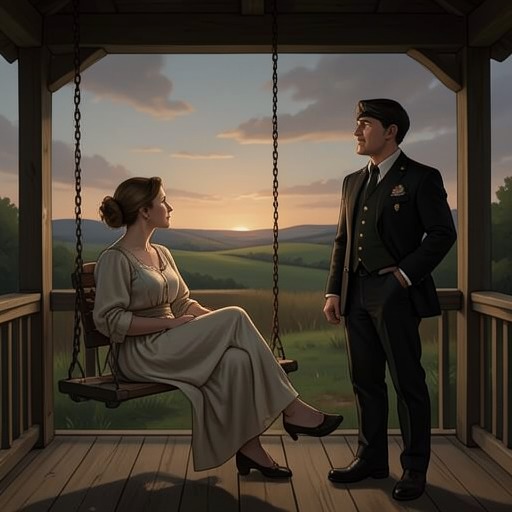
The ending gives the concept a relational dimension. Moving toward the future is not Jada’s solitary act of suppressing the past; Cane’s presence offers support while the effects of Decker’s visit remain visible. Set beside Cane’s earlier insistence on looking ahead, Jada’s experiences show both the aspiration and its cost: a person can choose not to return to an old life without being able to make its memories or consequences vanish. The future becomes credible through changed context, chosen boundaries, and the presence of someone who stays.