
The Word and the Picture
The ExecutionersCady's demand that Bowden understand his suffering, and Bowden's gradual grasp of the murderous grid behind the phrase.
increasing Bearing strength in each event
 decreasing
Bearing strength in each eventdecreasingCady's Phrase Introduced
Cady's Phrase Introduced
Context
Cady tells Sam that he never had the word and never saw the picture. The phrase becomes a motif for the entire novel.
Significance
The word and the picture are Cady's way of demanding empathy. He believes that if Bowden understood thirteen years of prison, he would see the revenge as justice.
Aftermath
Sam repeats the phrase to Carol, unable to shake it. Cady has planted a riddle that will only become clear through violence.
The Ex-Wife's Story
The Ex-Wife's Story
Context
Cady tells Sam in graphic detail how he kidnapped, raped, and humiliated his ex-wife after his release. He calls it part of the picture.
Significance
The story is Cady's proof of what he can do. It also shows Sam that Cady sees women as spoils and children as leverage, filling in the word with a horrifying image.
Aftermath
Sam understands that Cady is not bluffing. The picture now includes the Bowden family in the roles Cady has already rehearsed with Mary.
Bessie's Six Deaths
Bessie's Six Deaths
Context
Bessie McGowan reports that Cady said he would kill Lieutenant Bowden six times and make him last. She cannot grasp the meaning.
Significance
Sam decodes the phrase immediately: a wife, three children, a dog, and Sam himself. The picture is at last complete, and the word is murder.
Aftermath
Bessie refuses to testify, but her information sharpens Sam's defensive strategy. He now knows the full inventory of Cady's intended victims.
Sam Reads the Grid
Sam Reads the Grid
Context
After the assaults on the dog, Jamie, the station wagon, and Carol, Sam can finally read the whole picture Cady has been drawing: each target destroyed in order, with Sam made to watch.
Significance
The grid explains the sequence of the summer. Cady was not improvising; he was following a murderous score, and only his death at the final target stopped the performance.
Aftermath
Sam's understanding comes too late to save Kersek, but it lets him see his own killing of Cady as the only possible conclusion to the pattern.
Cady's Last Silence
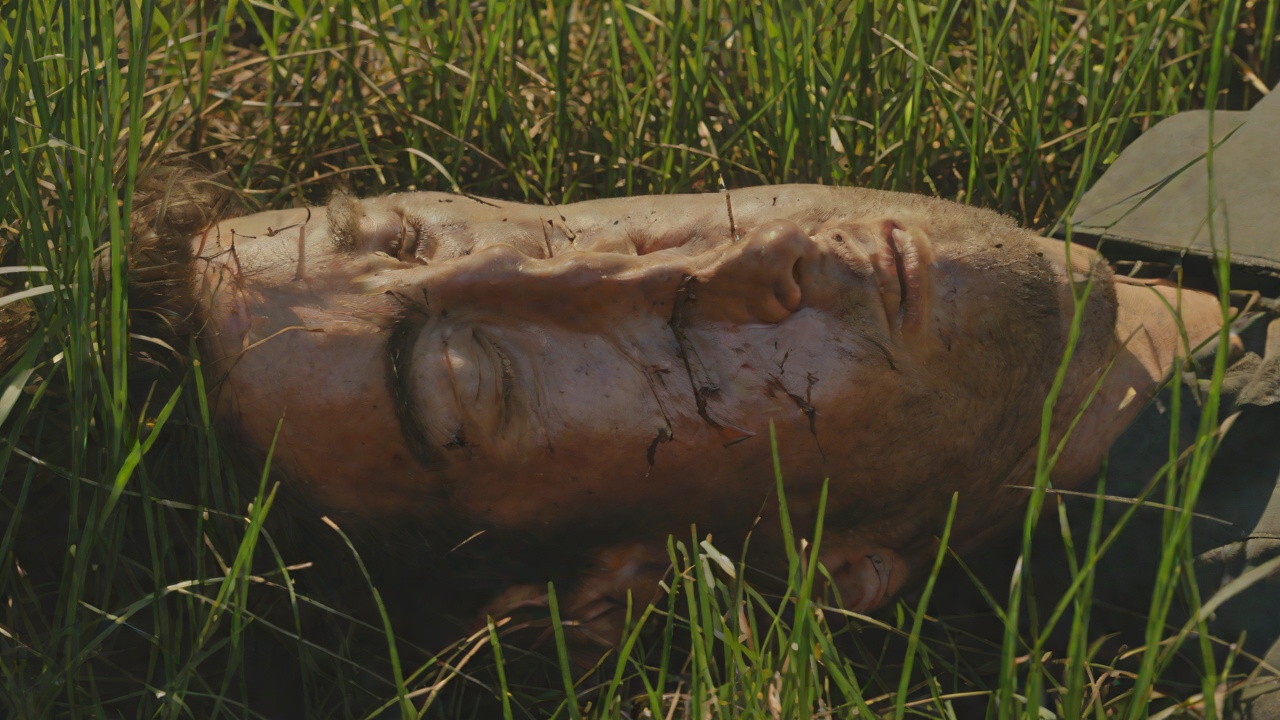
Cady's Last Silence
Context
Cady's body lies on a makeshift litter, a blade of grass pasted to his lips. He cannot deliver the word or show the picture anymore.
Significance
Death is the final answer to Cady's demand for empathy. Sam looks at the body and finds not guilt but exultation, suggesting he has joined Cady's world far enough to feel its savage satisfactions.
Aftermath
Sam thanks the troopers and walks back to the house. The word is finished, but its echoes will remain in the family for the rest of their lives.
Thursday in the parking lot
boat-yard confrontation
Thursday evening before Cady's release
after the night attack, when he understands the six targets
dawn when the troopers bring down the body
