Carol Bowden's breakdown
The ExecutionersCarol Bowden's breakdown is the psychological collapse of Sam Bowden's wife under the sustained siege of Max Cady's campaign of terror, a state that marks the turning point of the novel's domestic drama. Triggered by Cady's shooting of her young son Jamie and the family's car accident, Carol's hysteria reveals the fragility beneath the Bowdens' carefully maintained middle-class composure, and her eventual confession of her childhood merry-go-round terror becomes the emotional core of the story. Her breakdown forces Sam to confront his own moral crisis, leading to the decision to take direct action against Cady, and ultimately transforms Carol's worldview from an infantile trust in happiness to a hard-won awareness of life's precariousness.
The Collapse on the Road
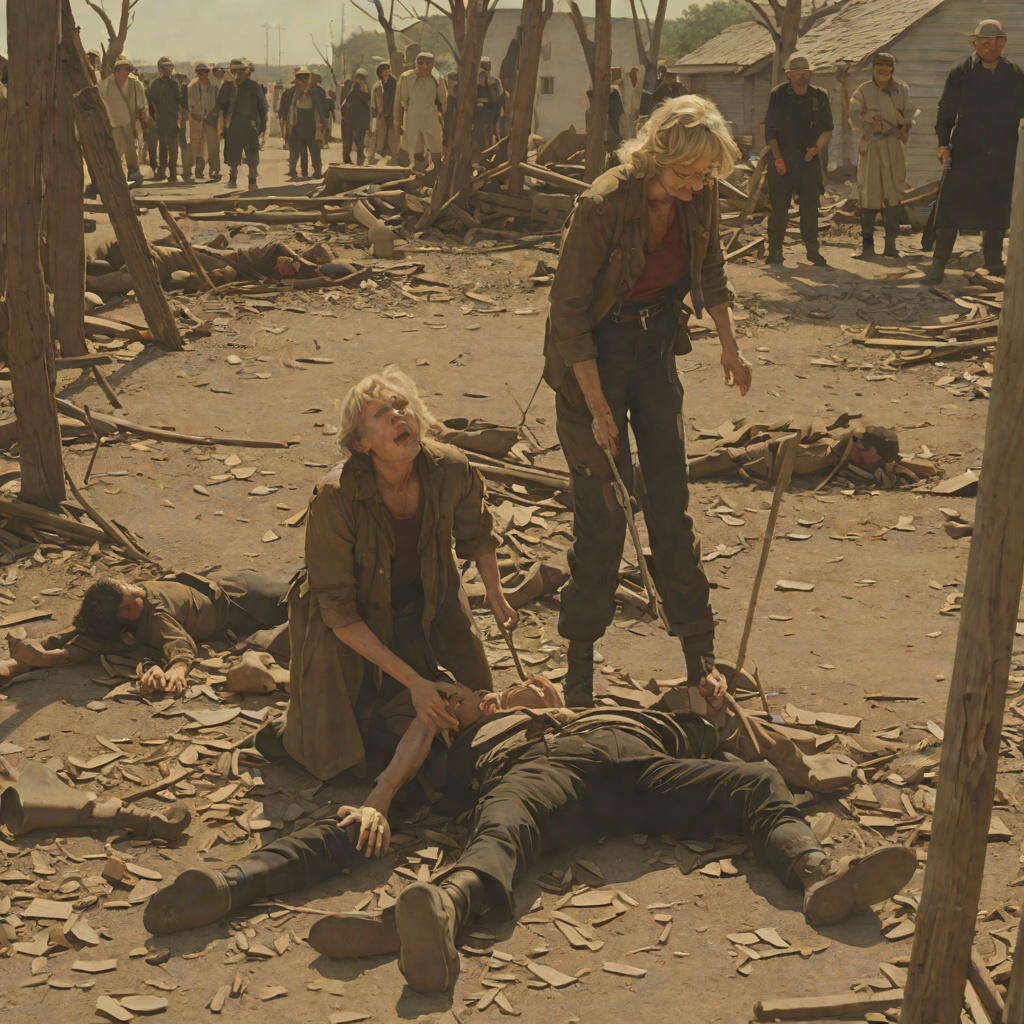
The breakdown erupts not in the privacy of the Bowden home but on a public road, in the immediate aftermath of a car accident that follows Cady's shooting of Jamie. When the family's station wagon tips over, Carol's mouth is bleeding and Bucky has a lump like a half walnut on his forehead, while Jamie seems unhurt. Yet it is Carol who has gone to pieces completely, her hysteria so alarming to the children that it seems more frightening than the accident itself. Sam is unable to calm her. When a small farm truck comes rattling down the road and Sam runs out to hail it, the small, elderly, bitter-looking driver looks directly ahead, jaw clamped shut, mouth working, and Sam has to jump out of the way or be run down. He stands in the road, shaking with rage, yelling curses at the receding vehicle. The next car to stop is a dusty sedan with a back full of tools, and two big men in work clothes get out in a leisurely way, by which time Carol has exhausted herself and lies on her side, holding Sam's handkerchief to her mouth.
The Doctor's Diagnosis
The family doctor, Biscoe, who has checked Jamie's bullet wound to see if the stitches held, speaks to Sam with a soldier's bluntness, sensing the undercurrents. He tells Sam that were it his wife, he would take steps to see the strain is ended soon, comparing Carol's state to combat: she has committed all of her reserves, she is totally in action, and she could be broken. Biscoe describes Carol as intelligent, sensitive, and imaginative, but frightened out of her wits, and he gives her a mild sedative, prescribing a refill for Sam to get filled. Of her mouth, he notes that it is not enough of a split to try a stitch, that the bleeding has stopped, and that it will be puffed out for a few days, while the small one, Bucky, is pleased with his bump and admires it in the mirror. After Sam gets the prescription filled, he returns to find Carol resting with the shades drawn, her eyes shut but not sleeping, spatters of dried blood on her blouse. She smiles weakly, and when he sits on the edge of the bed and takes her hand, she says, "I guess all my sawdust ran out." When Sam replies that it was about time, she confesses her shame, insisting that it was not the tipping over of the car but Jamie, ever since it happened, a little boy like that, trying to kill him with a gun, trying to shoot him to death like killing a little animal.
The Merry-Go-Round Confession
In the aftermath, Carol reveals the deep source of her terror in a memory from childhood. She recalls being about seven years old, when her mother was still alive, and going to a carnival with her father, who lifted her up onto a big white horse on a merry-go-round. It was wonderful for a while, she says, as she held the brass pole and the horse went up and down, not knowing until later that her father had paid the man to make it a long, long ride. After a while the faces of the people began to blur and the music seemed to get louder; when she looked out all she could see was streaks, and she wanted it to stop. When she shut her eyes she felt she was going to fall off, and nobody could hear her yell. She had the feeling it was going faster and faster, the music getting louder and louder, and she was going to be hurled off. Now, in the present, she pleads with Sam, "I want it to stop, Sam. I want it to stop going around and around. I want to stop being scared." She looks at him with naked plea, and Sam has never felt so helpless in his life, or loved her so much. The merry-go-round becomes the governing metaphor for her breakdown: the relentless, accelerating, inescapable cycle of terror that Cady has set in motion, from which she cannot dismount.
The Retreat and Sam's Resolution
The Bowdens retreat to The West Wind, where the crickety little man clucks at the damage to the car, at Carol's swollen lip, and at Ducky's forehead lump, while Jamie has been given firm and explicit orders about talking about his dramatic wound, looking as though he would pop open from the effort of restraining himself. At the lake they swim in sunlight, in a heavy rain, and once by moonlight, eating hugely and sleeping long hours. Slowly, hour by hour, the resolution grows in Sam's mind, a concept so alien to his nature as to revolt him, meaning a reversal of all his values, of all the things he lives by. He knows this inner combat makes visible changes in his manner, and several times he sees Carol looking at him speculatively, knowing he seems moody and absentminded. In midmorning on Monday, on an oppressively hot day, he takes Carol away from her tennis game and rows her out in one of the yellow rowboats to the middle of the mile-long lake, the sky in the east having a coppery and ominous look. He boats the dripping oars, lights two cigarettes, and hands one to her, preparing to tell her what he has decided to do. When they discuss returning, Carol insists they go that very day, saying, "Today, darling. Please. Let's go today and get it started and then it will be over." They leave after lunch, discussing whether Nancy has completely accepted the lie they told her, making slow time in constant heavy rain and wind that has brought branches down onto the road. Nancy has been grave and conscientious about her responsibility to the younger ones, and has tried to tell them she does not think it is very smart to go back and get the police to make a greater effort to pick Cady up, thinking it unwise to try to stay at home, suggesting they stay at a hotel in New Essex, and wishing both of them would not leave, but if that is the way they want to do it, she can certainly take care of Jamie and Bucky and keep them out of trouble.
The Aftermath and Changed Worldview
Carol's breakdown does not end with the accident; it recurs and deepens. After the night attack on the house, when Cady kills Andy Kersek, the doctor treats the deep scratches on Carol's back, and as soon as she is in her own bed, he gives her a shot of Demerol that puts her into a deep sleep in thirty seconds. The physical wounds are treated, but the psychological transformation is lasting. In the novel's closing conversation, Carol tells Sam there is a change in her, that she is not such an idiot about herself and her tight little world. She had thought it was her absolute right, her unalterable heritage, to be happy and raise her kids and eventually shoo them out of the nest and spend a dignified old age with him, knowing she would die some day and be a little old lady, white-haired and smelling of lavender, dying in her bed with her grandchildren around her, and that Sam would linger on a few years to give him a good chance to miss her, and then join her. She calls this an enormous and infantile trust that this world was made for her to be happy in. Now she knows that everything they have is balanced on such a delicate web of incidence and coincidence, and she tells Sam, "I think maybe I'm stronger and braver. I hope I am." She has learned that all over the world, right now, people are dying, or their hearts are breaking, or their bodies are being broken, and while it is happening they have a feeling of complete incredulity, thinking this cannot be happening to them, that this is not the way it was meant to be. Her breakdown, and her recovery from it, strips away the fool's paradise she had inhabited, replacing her unexamined confidence with a fragile, hard-won courage.
The Fragile Paradise Before the Fall
Carol's breakdown is best understood against the backdrop of the life she believed she had secured. Before Cady's return, the Bowden marriage was "of the very best variety," everybody was healthy, and Sam had been a partner in the law firm since 1948. Their house, just outside the village of Harper, thirteen miles from New Essex, was more house than he should have purchased, but he consoled himself with the constantly increasing value of the ten acres of land. They had no savings to speak of, a very few shares of pale blue-chip stocks, but his hefty insurance program gave him a feeling of security. Carol herself had once described their state as a "nice little fool's paradise," and after the first attack on the family, she had spoken of "the untouchables," those who believe themselves beyond harm, and of how something had come in out of the darkness and struck one of them down, the charm no longer working. Her breakdown is the collapse of that charm, the moment when the protective fiction of suburban invulnerability gives way to the reality of precarity. It is also the culmination of a longer pattern of strain: Carol had earlier resented being overprotected, telling Sam, "I'm not a child and I'm not a fool and I resent being... overprotected," when she learned he had known of Cady's presence and said nothing. Her breakdown, then, is not merely a response to a single traumatic event but the accumulated weight of a siege she was never allowed to fully see or prepare for, and her eventual confession of the merry-go-round memory reveals that the terror Cady awakened was not new but ancient, a childhood fear of being trapped on a ride that would not stop.