Red Setter
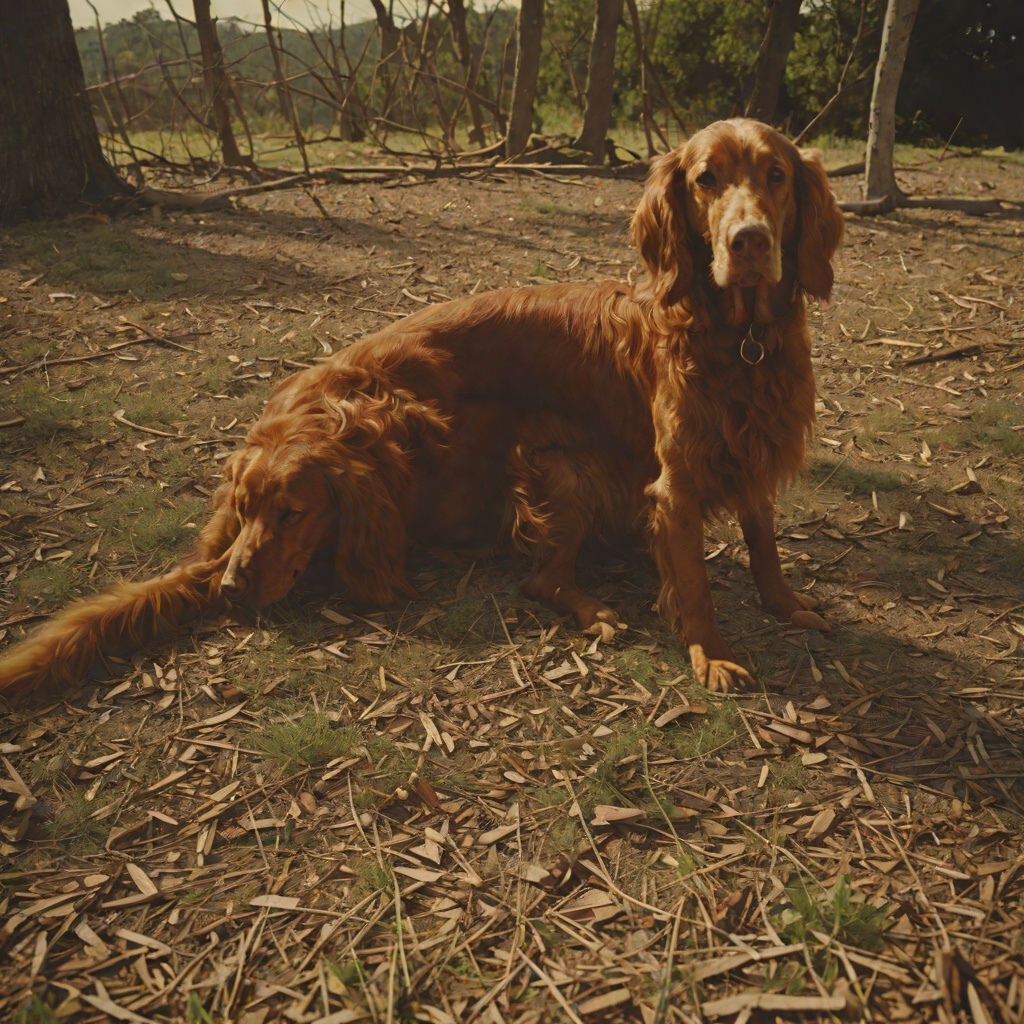
The ExecutionersMarilyn, the Bowden family's spayed red setter, is a creature of pure, uncomplicated affection whose death becomes the novel's first casualty in the war Max Cady wages against Sam Bowden's household. She is introduced as a dog of beautiful coat and good lines, a sweet-natured animal who, despite lacking bravery, churns through the water after swimming children, yipping with spasms of joy and excitement. Her poisoning is not merely the loss of a pet; it is the first tangible, violent intrusion of Cady's menace into the Bowdens' carefully constructed world, transforming an abstract threat into a concrete, heartbreaking reality and forcing the family to confront the fact that their charm is no longer working.
Identity and Place in the Bowden Household
Marilyn is established as a gentle, loving presence within the Bowden home, a stark contrast to the violence that will claim her. She is a spayed red setter with a beautiful coat and good lines, a detail that marks her as a well-cared-for member of the family rather than a mere working animal. Her temperament is sweet rather than brave, a quality that endears her to the family but also foreshadows her vulnerability. She is so much a part of the household that she can climb the wall ladder to the children's upstairs area in the converted barn, though she must always be carried down, her tail furled and eyes rolling in alarm. This small, endearing ritual underscores her dependence on the family's care and the safe, predictable world they have built around her.
The family's attachment to Marilyn is evident in their defense of her. When Sam Bowden, in a moment of frustration, suggests they ought to get a better dog, Carol immediately rebukes him, insisting that they don't make better dogs and pointing out that Marilyn, while not exactly brave, is sweet. This exchange reveals that Marilyn's value to the Bowdens lies not in her utility or ferocity but in her capacity for affection, making her an emblem of the domestic tenderness that Cady's cruelty is about to violate.
The Poisoning and Its Immediate Aftermath
The poisoning of Marilyn is the pivotal event that shifts the Bowden family's perception of Cady from a distant, legal nuisance to an immediate, lethal threat. The method is chillingly deliberate: Cady uses strychnine-poisoned meat bait, a hunter's tool for killing vermin, to strike at the family through their beloved pet. The act is not random violence but a calculated message, a demonstration that Cady can reach into the Bowdens' most intimate spaces and take what they love. Carol's reaction is one of raw fury and fear, as she confronts Sam with the horrifying realization that Cady can roam around at will, poison their dog, and work his way up to the children. The death of Marilyn is thus framed not as an isolated cruelty but as the first step in a campaign of escalation.
The emotional weight of the loss is compounded by the community's response. Jake Barnes, the boat-yard owner who provides the glue for the dog's broken top, offers a grim perspective on the kind of man who would do such a thing. He recalls a fisherman from his father's time who would take live fish from the bait well, scale them, and fillet them while they were still wiggling, seemingly getting a kick out of it, until they ran him off the place. This anecdote serves as a dark parallel to Cady's cruelty, suggesting that the Bowdens are dealing with a man who derives pleasure from the suffering of living things. Jake's offer of a replacement puppy from Don Langly's setter bitch is a kind but inadequate gesture, and Sam's polite refusal reflects the family's need to mourn rather than immediately replace their loss.
The Symbolic Death of Innocence
The poisoning of Marilyn functions as a symbolic rupture in the Bowden family's sense of security, marking the end of what Carol later calls their fool's paradise. Before the attack, Sam had reassured himself that everything was under control, that the marriage was of the very best variety, that everybody was healthy, and that his hefty insurance program gave him a feeling of security. The family's life was one of carefully managed comfort: a farmhouse on ten acres of land, a boat for expeditions to the island, and the predictable rhythms of suburban life. Marilyn's death is the first crack in this facade, the moment when the darkness that Cady represents breaks through the carefully maintained surface of their lives.
Carol's response to the poisoning reveals the depth of the psychological wound. She articulates the family's new vulnerability with painful clarity, describing themselves as the untouchables whose charm is no longer working now that something has come in out of the darkness and struck one of them down. The death of the dog is thus not just a personal loss but a collective trauma, a sign that the Bowdens' privileged isolation from violence has been permanently breached. Sam's philosophical response, that the business of living is a very precarious occupation, offers little comfort to Carol, who clings to her ridiculous little superstitions as a way of making sense of the senseless cruelty that has invaded their home.
A Harbinger of the Siege to Come
Marilyn's death is the first in a series of escalating attacks that constitute the Bowden family's siege, and her loss sets the emotional tone for the ordeal that follows. The poisoning establishes Cady's methods: indirect, cruel, and designed to inflict maximum psychological damage while maintaining his own safety. It also forces the Bowdens to recognize that the children are within the orbit of the threat, a realization that deepens Sam's resolve and Carol's anxiety. The family's subsequent decisions, including their discussions about whether to leave home and seek refuge, are all colored by the memory of what Cady has already done to their beloved pet.
The attack on Marilyn also serves to characterize Cady more fully, revealing him as a man who understands the power of psychological warfare. His choice to poison the dog rather than confront the family directly demonstrates a calculating cruelty that is more terrifying than outright violence. It is a message that he can reach them anywhere, that nothing they love is safe, and that he is willing to destroy innocent life to make his point. The death of the Red Setter thus stands as a grim prologue to the novel's central conflict, a warning of the depths of Cady's malice and the lengths to which he will go to exact his revenge on Sam Bowden and his family.