Shadow Hill
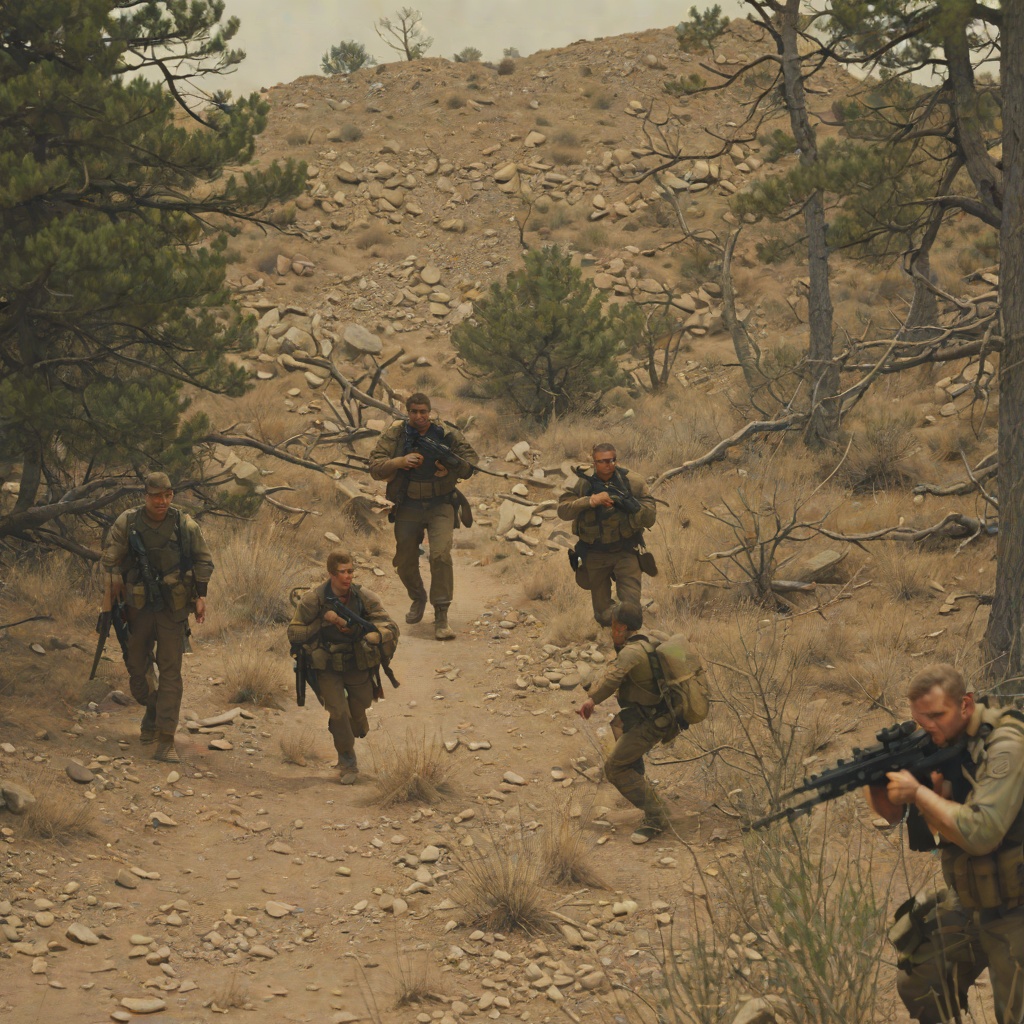
The ExecutionersShadow Hill is the heavily wooded rise that stands behind the Bowden family home in New Essex, and it is the landscape that gives the novel its geography of terror. It is the place from which Max Cady, lying prone on a rock ledge about thirty feet from a back road, takes aim at Jamie Bowden with a scoped rifle and fires a shot that nearly kills the boy. It is also the place where Cady, bleeding from a torn artery, climbs three hundred feet before collapsing and dying. The hill thus brackets the novel's central violence: it is the vantage point from which the predator watches the family, and the ground on which the predator finally falls.
The Vantage Point of the Predator
The hill first enters the story as a place of surveillance and threat. After the shooting at the camp, Sheriff Mark Dutton explains to Sam Bowden that the range was about seven hundred yards, downhill, and that a good rifle, a good scope, and a knowledgeable man could make the shot without much difficulty. The sheriff notes that the boy's arm was close to his side, the wind was gusty from the south, and the boy was facing east, so one of those gusts likely drifted the slug a few inches. If the bullet had landed two and a half inches further to the right, the boy would have been dead before he could fall. The shot missed, but it put two holes in a shack, which gave the investigators a line of sight up the side of a knoll the children call Shady Hill. Deputy Ronnie Gideon, a good woodsman who can read track, was left to find where the man with the gun had taken aim.
The Evidence Left Behind
The investigation of the hill yields a single, telling piece of evidence. Deputy Gideon finds a rock ledge in a prone position, about thirty feet from the road, where the shooter had matted the moss on the rock; it was still springing back up. There were no car tracks and no empty cartridge case, but there was a chewed cigar butt that had been rubbed out on the rock, its mouth end still soggy. The sheriff remarks that if the man had killed the boy, they would send the butt to the lab to try to get a type on the saliva, but as it stands, it does not do much good. The cigar butt becomes a signature of Cady's presence, a physical trace of the predator's patience and care, and a reminder of how close the family came to losing their son.
The Hill as a Zone of Dread
The hill's menace extends beyond the single shooting. Sam Bowden, returning home with Carol after the attack, finds himself hurrying across the lawn with his shoulders hunched, trying to stay between Carol and the hill that rose behind the barn. He feels relief only when they reach the comparative safety of the front porch. He knows it is absurd to imagine Cady sprawled up there on the wet hill, cheek against the stock, finger on the trigger, tracking them with the telescopic sight, but he also knows it is equally absurd to assume that Cady would not be ready. Before dark, Sam goes up to the attic window in the rear of the house and carefully searches the hillside with his binoculars, wishing it were not so heavily wooded, that there were not so many huge gray boulders and dead falls. The hill becomes the family's permanent blind spot, the place where the ordinary world of the suburb gives way to the possibility of a rifle shot at any moment.
The Climax on the Hillside
The novel's climax unfolds on the hill itself. After Cady breaks into the house and attacks Carol, Sam pursues him up the slope. The night is utterly black, with misty rain on Sam's face, and he feels as though he is trying to run in chest-deep water. His right foot flops uselessly after he injures his ankle on the stairs, and each time he comes down on it, he feels as though it lands in white-hot coals. He falls on the front steps, struggles up, and finds the door locked, with no key, and realizes he must find his way around the house to where Cady broke in. He hears a sound from a man's throat that is utterly unlike any human sound, a snarling, roaring sound full of anger and madness and bestial frenzy, followed by the deep, resonant bang of a weapon heavier than the Woodsman pistol. Sam fires his own revolver, and one of his last two shots hits Cady, tearing his right arm on the inside just below the armpit and opening an artery.
The Death on the Hill
The next morning, the troopers bring Cady's body down the hill. They had chosen an easier path, the one that came down from the improvised range, past Marilyn's grave, and came out behind the barn. Four troopers struggle with an improvised litter made from two saplings cut and trimmed and threaded through the arms of two uniform tunics. When they reach the flats, they put the litter down clumsily, and Cady, lying on his back, tumbles over the side and turns slowly and ponderously to lie face down in the damp grass. His blunt face has a strangely shrunken look and is the color of soiled dough; his half-open eyes are slits of opaque blue glass. Sam, who has seen several bodies in his lifetime, notes that not one of the others had looked as dead. Trooper Ricardo explains that they started finding blood halfway up the hill, a lot of it, and that Cady climbed another three hundred feet before he ran out of blood. He made it halfway to the car. Sam looks at the body as they roll it back onto the stretcher, a blade of grass pasted to the lips, and says tonelessly, "Thanks."
The Hill's Narrative Significance
The hill is more than a setting; it is the novel's symbolic geography of the threat that cannot be seen. It is the place where the gothic intrudes into the suburban home, where the familiar landscape of woods and boulders becomes the hiding place of a predator. The hill is also the place where Sam Bowden, the lawyer who wanted to throw his head back and yell at the sky, who wanted to dance around the body and chant of the defeat of the enemy, instead stands in silence and says only "Thanks." The hill thus contains both the terror and the resolution of the novel, the place where the family's siege ends and where the cost of that ending is measured in the dead body of the man who had made their lives a nightmare.