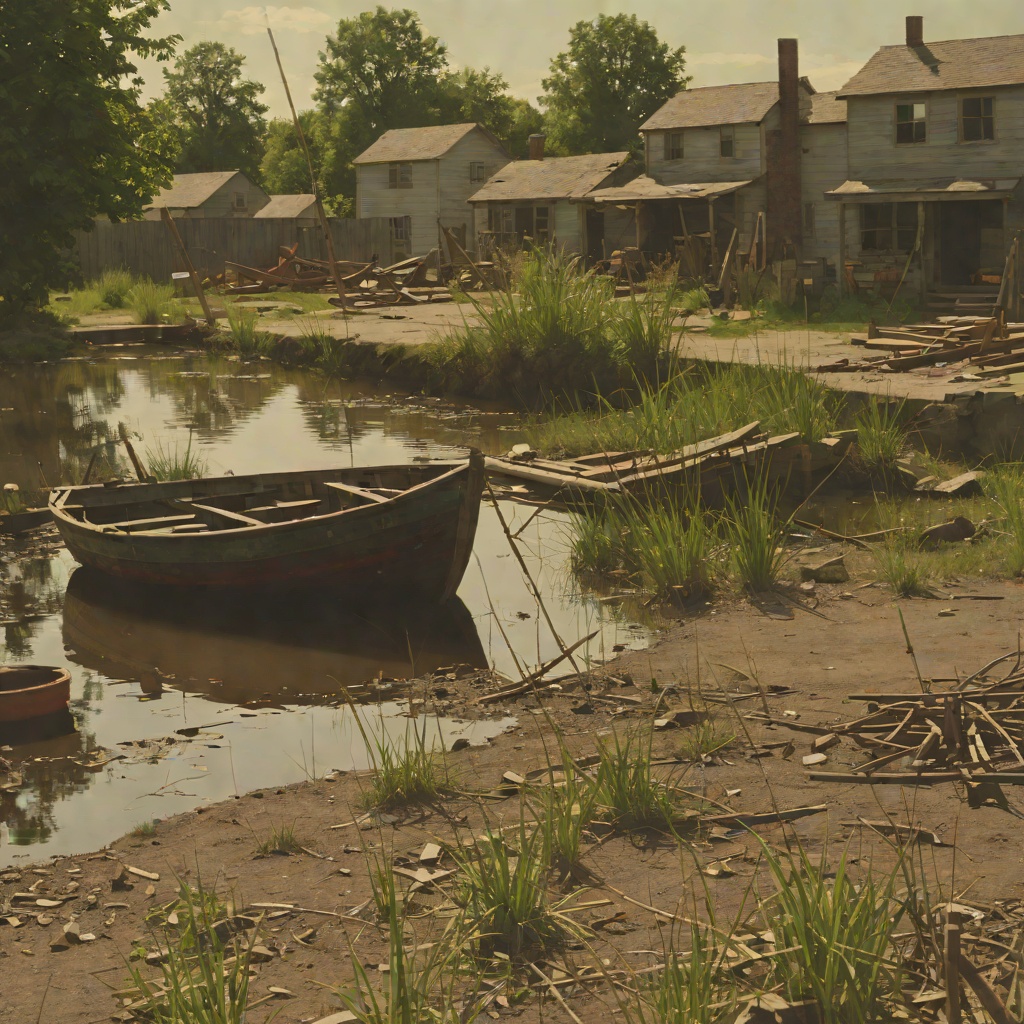
Sweet Sioux III
The ExecutionersThe Sweet Sioux III is the Bowden family's boat, a cranky twenty-six-foot day cruiser about sixteen years old, converted from a lifeboat taken off an obsolete lake ferry. It is the vessel on which the family makes its traditional trips to the island, a ridiculously small, unnamed island twelve miles out into the lake, northwest of New Essex, which they have visited every year since 1950, the year before Bucky was born. The boat is moored a hundred feet down the curve of the beach on the island, her bow ten feet off the sand, and it is on her foredeck that Nancy Bowden and her guest, a fifteen-year-old boy named Pike Foster, lie baking in the sun with a portable radio turned to the odd offerings of a progressive disk jockey, the music barely audible. The Sweet Sioux III is thus the fixed point of the family's summer ritual, the setting for the novel's opening scene of precarious peace and its closing scene of hard-won calm.
A Boat Out of Place
The Sweet Sioux III is defined as much by what it is not as by what it is. After Sam and Carol Bowden graduated from the Sweet Sioux II, they joined the New Essex Yacht Club, four miles east of the city, with its ample yacht basin, dock space, its own breakwater, and a long club building with terraces, bars, and ballroom. The club is expensive, and the dues are high, and the social schedule is intensive. The Sweet Sioux III, no matter how fresh her current paint and varnish job, never looks at ease tied up in the middle of all that teak, brass, chrome, and mahogany. She has a beamy and disreputable look, like a dressed-up washer-woman at the opera. She seems actively to resent her new environment: on each departure she tries to swing and bash one of the grand craft tied up near her. She has a single screw and a sixty-five horsepower marine engine of a make few people have ever heard of. The engine is stolid, reliable, and unaccountably quiet, and it can push the Sweet Sioux along at a waddling ten knots. But at the New Essex Yacht Club the engine also revolts: twice it quits in the middle of the basin as they are headed in, and twice they have to accept a tow. After that, Sam keeps a five-horse outboard motor wrapped in a tarp stowed forward. The boat's stubborn, shabby character is a perfect emblem of the Bowdens' own place in the world: they are respectable, but not wealthy, and their membership in the club is a stretch they eventually give up willingly, each pleased and surprised to find how readily the other would surrender it.
The Island Ritual and the Family's Happiness
The Sweet Sioux III is the vehicle of the family's most cherished ritual: the trips to the island. On the novel's opening Saturday, Sam Bowden lies on his back under a high sun, eyes closed, right hand clasping the fading chill of half a can of beer, aware of the nearness of Carol, while Jamie and Bucky thrash around in the brush on the small hill behind the little beach. Sam tries, almost with desperation, to tell himself that all is right with his particular world. Everything is fine, he insists: the marriage is of the very best variety, everybody is healthy, he has been a partner in the law firm since 1948, and their house just outside the village of Harper, thirteen miles from New Essex, is more house than he should have purchased, though he consoles himself with the constantly increasing value of the ten acres of land. He tells himself there is absolutely no need to fret, no point in getting hysterical, that this is just another problem that can be taken care of neatly, quietly, with dispatch and efficiency. The boat is the stage for this performance of normalcy, the place where the family's happiness is supposed to be most secure. On Labor Day, the Bowden family, with Tommy Kent as the special guest, takes the traditional last trip of the year on the Sweet Sioux to the island. It is a warm day with a fresh wind across the lake. They eat at noon; at two o'clock the kids are swimming; Sam sits on a blanket in his swimming trunks, arms resting on his upraised knees, can of beer and cigarette in hand, while Carol lies on her back beside him, her arm across her eyes. The boat frames both the beginning and the end of the family's ordeal, the before and after of Cady's intrusion.
The Boat as Witness to the Siege
The Sweet Sioux III is not merely a setting but a silent witness to the family's disintegration and recovery. The boat is present when the family's fragile peace is first disturbed, and it is the means by which they attempt to escape. After the family decides to leave the island to return home, they discuss whether Nancy has completely accepted the lie they have told her. They make slow time in a constant heavy rain, in wind that has brought branches down onto the road. Nancy has been very grave and conscientious about her responsibility to the younger ones, and she has tried to tell them that she does not think it is very smart to go back and get the police to make a greater effort to pick Cady up; she thinks it unwise to try to stay at home, and suggests they should stay at a hotel in New Essex. She wishes both of them would not leave, but if that is the way they want to do it, she can certainly take care of Jamie and Bucky and keep them out of trouble. The boat carries the family into the danger and out of it, its waddling ten knots a painfully slow pace for a family trying to flee a predator. The boat's shabbiness, its out-of-place quality, mirrors the family's own vulnerability: they are not grand or protected, but ordinary people exposed to a threat they cannot control.
The Boat and the Family's Transformation
The Sweet Sioux III is also the site of the family's most explicit acknowledgment of its own fragility and change. On the Labor Day trip, Carol tells Sam, "There is a change," and explains that she is not such an idiot about herself and her tight little world anymore. She thought it was her absolute right, her unalterable heritage, to be happy and raise her kids and eventually shoo them out of the nest and spend a dignified old age with him. She knew she was going to die some day, and would be a little old lady, white-haired and smelling of lavender, dying in her bed with her grandchildren around her, and he would linger on a few years, to give him a good chance to miss her, and then he would join her. That was what was in her mind: an enormous and infantile trust that this world was made for her to be happy in. Now she knows that happiness comes only with luck, only with the greatest of good fortune, because there are black things loose in the world. Cady was one of them; a patch of ice on a curve can be one of them; a germ can be one of them. The boat, the very emblem of the family's summer idyll, is where this disillusionment is spoken aloud, where the fool's paradise is finally acknowledged to have been a fool's paradise all along. The Sweet Sioux III thus carries not only the family's bodies but their illusions, and it returns them to shore changed, having learned that the charm is not working anymore.