pots-and-pans stairway alarm
The ExecutionersThe pots-and-pans stairway alarm is a crude, improvised security device that Sam Bowden constructs in his family home during the climactic days of the siege by Max Cady. It is a Rube Goldberg trap of pans and string, a homemade warning system designed to alert the family if Cady breaks in during the night. The alarm represents the Bowdens' desperate, last-ditch attempt to defend their home with whatever materials they have at hand, a stark contrast to the professional law enforcement that has proven unable to stop Cady. Its eventual failure, when Cady crashes through it with terrifying force, marks the moment when the family's fragile sense of security is shattered completely.
Construction and Purpose
The alarm is assembled on the night of Monday, August 5, after Sam and Carol return home from a brief respite at a lake. Sam has spent the day searching the hillside behind the house with binoculars, wishing the terrain were not so heavily wooded and littered with huge gray boulders and dead falls. He and Carol go through the house together before dark, deciding which areas are safe to use. They conclude it would be unwise to use the kitchen at night, and that Carol could use the study and Nancy's room. After dark, Sam risks going outside to make certain he cannot see into either of these two lighted rooms from outside, circling the house with his revolver in hand, moving with caution, stopping where the night shadows are most black to wait and listen.
When he goes back into the house, he finds he has spent too long outside. Carol holds him tightly and he feels her body tremble. He locks the house with great care, checking every door and window. They sleep in their own room, with Carol going to sleep in his bed, his arms around her, and the gun under the pillow, the bedroom door locked, and the Rube Goldberg trap of pans and string blocking both stairways. The alarm is thus part of a layered defense: the locked doors, the gun under the pillow, and the noisy trap that would announce any intruder's approach.
The Night of the Attack
The alarm's moment of crisis comes on the night of the attack, after Sam has spent an agonizing day waiting in the barn. He had watched the shadows change and lengthen, and at six the sun went behind a bank of dull clouds in the west behind the house, and night came earlier than usual. Carol made her last signal at ten o'clock and her light was out shortly afterward. Sam fell into a fogged dream in a deep sleep, a dream interrupted by the morning alarm clock. He groped for the clock that was not there, and suddenly sat up in absolute darkness, his reactions so blurred by heavy sleep that for long and precious seconds he did not know where he was, nor why his heart should be hammering so heavily.
When shrill realization came, he rolled off the cot and tried to scoop up the gun and flashlight. His body was clumsy with sleep and he pawed the flashlight away from him and then found it in the darkness. He lowered himself hastily through the trap door, found the rungs of the ladder with his toes. He had not anticipated how awkward it would be to try to climb down in complete darkness carrying a gun and flashlight. His foot slipped and when he tried to catch himself, his hand slipped. He fell and landed with his right foot on something uneven. It was an eight-foot drop and he landed with his entire weight on the right ankle. It felt as though a white flare had exploded inside his ankle.
Despite his injury, Sam struggled toward the house. He fell on the front steps, struggled up and found the door and knew in despair that it was locked and that he had no key and it would take him an eternity to find his way around the house and find where Cady had broken in. That was another thing they had not considered. Another tragic oversight. But where was Kersek? Just at that moment he heard a sound that must have come from a man's throat, but it was utterly unlike any human sound he had ever heard. It was a snarling, roaring sound, full of anger and madness and a bestial frenzy. And there was the deep, resonant bang of a weapon heavier than the Woodsman, a sound that rattled the windows.
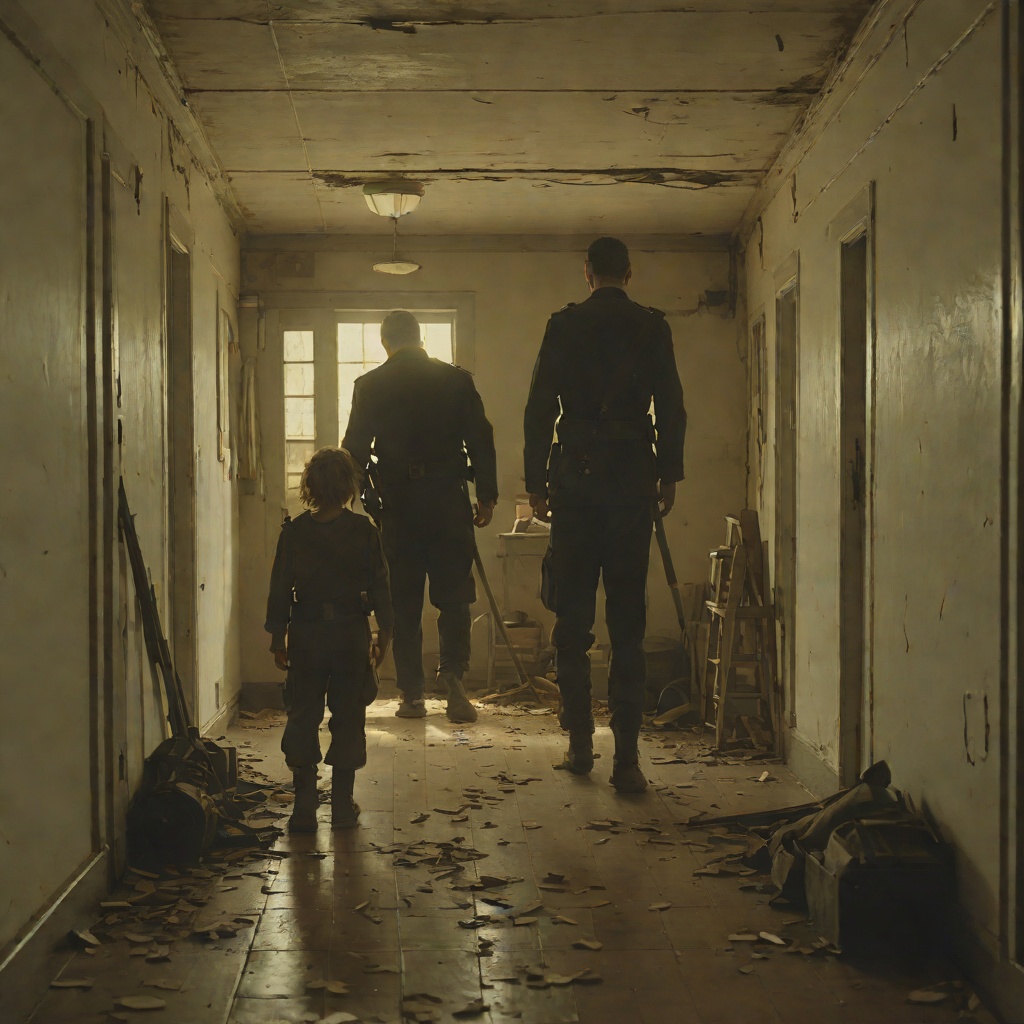
Then came the alarm's final, futile moment. There was an enormous crashing and clanging and thudding of something running or falling down the front stairs, bringing Carol's alarm system of pots and pans and string with it. And a jar that shook the house. Before Sam could move, the locked front door burst open and a half-seen figure, wide and hard and stocky and incredibly quick, came plunging out and smashed into him and drove him back. There was a sick sense of floating as he sailed backward over the steps, and then he landed flat on his back on the wet grass with a great jar that knocked the wind out of him. He had managed to hold on to the revolver. He rolled up onto his knees, gagging for breath, and heard the pound of running feet on the turf, saw something running toward the corner of the house. He fired three times at it, snap shooting taking no aim. He got up and wobbled to the corner of the house. He was still sobbing for breath, but he managed to hold his breath and listen. He heard something that moved with frantic haste, crashing up through the brush on the hillside behind the house. He fired twice at the sound and listened again, heard it recede, become fainter, and disappear.
Symbolism and Significance
The alarm's failure is not merely a mechanical breakdown but a symbolic one. It represents the limits of the Bowdens' homemade defenses against a force that is beyond their control. The trap of pans and string, so carefully constructed to give warning, instead becomes the soundtrack of Cady's escape, the clanging and crashing marking his passage through the house and out into the night. The alarm's noise, meant to protect the family, is heard only after the damage is done, a bitter irony that underscores the family's helplessness.
The alarm also stands in contrast to the other, more sinister homemade device in the novel: the strychnine-poisoned meat bait that Cady uses to kill the family dog. Both are improvised traps, but one is built to protect and the other to destroy. The parallel highlights the asymmetry of the conflict: the Bowdens are defending, Cady is attacking, and the defensive tools are always one step behind.
Context of Desperation
The construction of the alarm comes at the end of a long period of escalating fear and psychological strain. Carol has described her anxiety as a terrifying merry-go-round ride from her childhood, a carnival memory where her father paid the man to make the ride go on and on, the faces of the people blurring, the music getting louder, and she felt she was going to be hurled off. She tells Sam, "I want it to stop, Sam. I want it to stop going around and around. I want to stop being scared." The alarm is Sam's practical answer to this plea, a concrete attempt to make the fear stop by making the house safe.
Sam's decision to build the alarm is also part of his broader moral crisis. He finds it almost impossible to face the concept of taking direct, violent action against Cady, a reversal of all his values, of all the things he lived by. He knows that this inner combat made visible changes in his manner, and several times he saw Carol looking at him speculatively. The alarm is a middle ground, a way to protect his family without crossing the line into the violence that Cady represents. Its failure forces him to confront the fact that such half-measures are not enough.
The alarm is also a marker of the family's isolation. The Bowdens have been told by the authorities that there is little they can do, that Cady has not yet committed a crime that warrants arrest. The family is left to defend itself, and the alarm is a symbol of that abandonment. It is a homemade device for a homemade war, a war that the state has declined to fight on the family's behalf. The fact that it fails, and that Sam is left to fire his revolver into the darkness at a fleeing figure, underscores the novel's grim message about the limits of law and the necessity of individual action.
In the aftermath, the alarm's destruction is part of the larger wreckage of the night. The family's survival is owed not to their defenses but to Sam's desperate, improvised gunfire. The pots-and-pans stairway alarm, so carefully constructed and so utterly useless, remains a haunting image of the Bowdens' vulnerability and the fragility of their domestic peace.