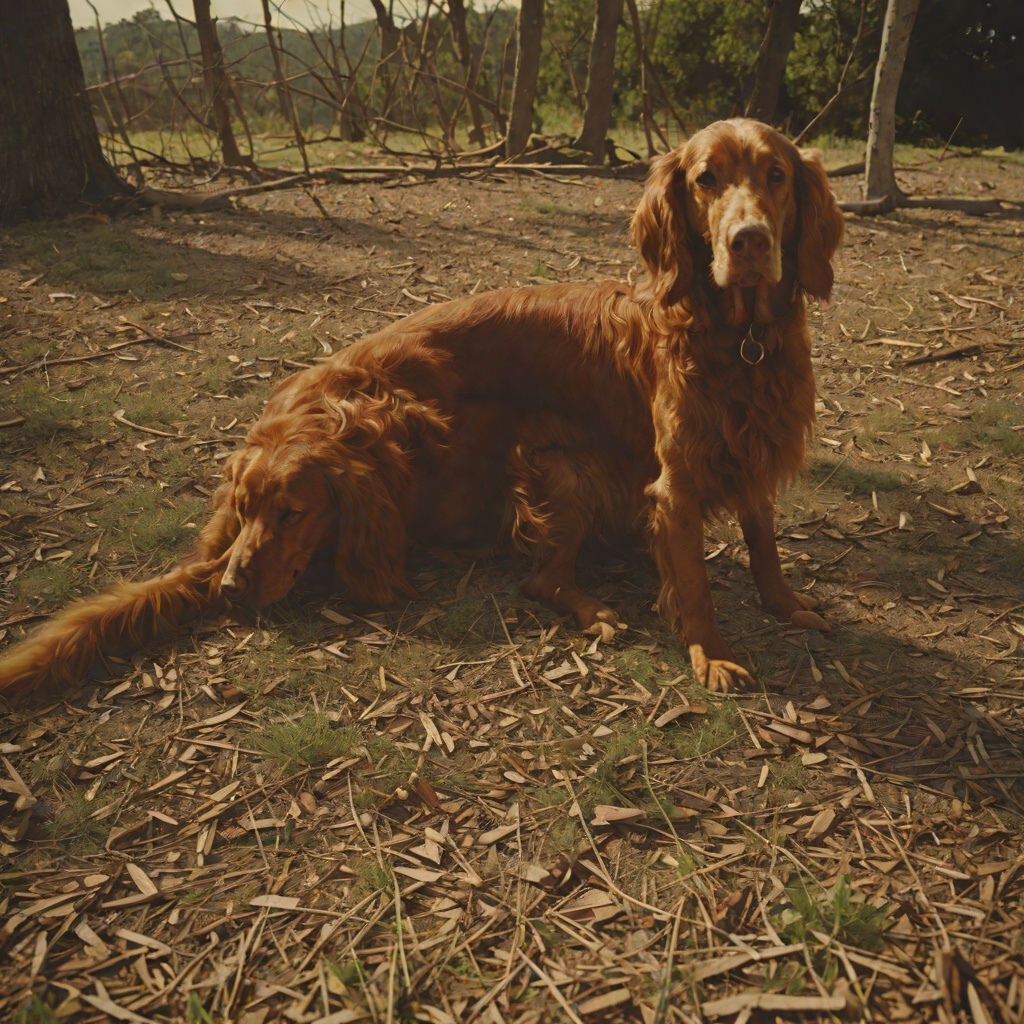
strychnine-poisoned meat bait
The ExecutionersThe strychnine-poisoned meat bait is the instrument of a deliberate act of cruelty that shatters the Bowden family's sense of safety and marks a decisive escalation in Max Cady's campaign of psychological terror. It is a simple, almost primitive weapon — a piece of raw meat slit open and stuffed with a walloping big dose of strychnine crystals — yet its deployment against the family's beloved red setter, Marilyn, transforms the abstract menace of Cady's presence into a visceral, intimate violation of the home itself. The bait is not merely a means of killing a dog; it is a message, a demonstration that Cady can reach into the most personal corners of the Bowdens' lives with impunity, and it forces Sam Bowden to confront the horrifying inadequacy of the legal system he has trusted.
The Weapon and Its Deployment
The poisoned bait is described by Dr. Lowney, the veterinarian who examines Marilyn's body, as raw meat into which a slit was cut and strychnine crystals were stuffed. The sheer quantity of poison — a walloping big dose — indicates an intent not merely to harm but to kill with certainty and to inflict maximum suffering. The choice of raw meat is significant: it is an irresistible lure for a dog, and Marilyn, described as prancing over to meet the children as she always does, is an easy target. The bait is placed in the front yard of the Bowden home, a space associated with family life and the children's arrival from school, making the attack feel like an invasion of the most ordinary domestic routines.
The timing of the poisoning is as calculated as the method. Marilyn is discovered gobbling something down just as the school bus stops and pulls away, meaning the children — Nancy, Jamie, and the youngest — are present to witness the dog's agonizing death. The sequence unfolds with terrible precision: Marilyn begins to whine, runs in circles, bites herself in the side, and then goes into a convulsion. The children watch, unable to be moved away, as their pet rolls and writhes, making the most awful screaming noise a dog can make. The attack is thus not just an act of animal cruelty but a spectacle designed to traumatize the Bowden children and to demonstrate Cady's power over their emotional lives.
A Message of Terror
The poisoning of Marilyn is the first physical act of violence Cady commits against the Bowden family, and it serves as a brutal announcement of his intentions. Sam Bowden, who had already warned his wife Carol that he believed Cady was not sane, recognizes the attack as a direct escalation. The bait is not hidden or disguised; it is placed in the open, in the front yard, where it is certain to be found. This is a deliberate act of psychological warfare, designed to make the Bowdens feel that nowhere is safe, that even their own home and their children's play area can be violated at will.
The choice of the dog as a target is particularly cruel. Marilyn is not a threat to Cady; she is a beloved family pet, a source of comfort and joy. By killing her in the most painful way possible, Cady demonstrates that he will destroy anything the Bowdens love, and that he takes pleasure in their suffering. The attack also serves as a warning: if Cady can reach the dog in the front yard, he can reach the children, and he can reach Carol. The message is clear — no one and nothing is beyond his reach.
The Limits of the Law
The poisoning of Marilyn exposes the fundamental helplessness of the Bowden family in the face of Cady's campaign. Sam Bowden, a lawyer, has placed his faith in the legal system, but the law offers no recourse for a poisoned dog. There is no proof linking Cady to the bait, no witness, no evidence that would stand up in court. The attack is a perfect crime, one that the police cannot investigate and the courts cannot punish. Sam is left with the bitter knowledge that Cady can continue his campaign of terror with impunity, and that the law he has dedicated his life to is powerless to protect his family.
This realization deepens Sam's moral crisis. He has already begun to contemplate actions that are alien to his nature, and the poisoning of Marilyn pushes him further down this path. The attack confirms what Sievers, the private investigator, has told him about Cady's psychopathic personality — that Cady is one of the wild ones, incapable of understanding right and wrong, and that he will continue his campaign until he is stopped by force. The poisoned bait is thus a turning point, forcing Sam to accept that the law cannot save him and that he may have to take matters into his own hands.
The Aftermath and the Siege
The immediate aftermath of the poisoning is a scene of chaos and grief. Carol Bowden, who witnessed the dog's death, is distraught, and the children are traumatized. The family's sense of security is shattered, and the home that was once a refuge now feels like a prison under siege. The attack on Marilyn is followed by a series of escalating incidents — the loosening of the station wagon's wheel lugs, the night attack on Carol, and ultimately the shooting of Jamie — each one a further violation of the family's safety.
The poisoned bait also has a profound effect on Carol Bowden's psychological state. Her breakdown, which culminates in the haunting merry-go-round metaphor she shares with Sam, can be traced back to this moment of helplessness and terror. The image of the carnival ride, spinning faster and faster with no way to stop, captures the feeling of being trapped in a nightmare of Cady's making. The poisoning of Marilyn is the first turn of that ride, the moment when the family's ordinary life begins to spiral out of control.
A Symbol of Cady's Psychopathy
The strychnine-poisoned meat bait is a perfect emblem of Max Cady's psychopathic nature. It is a weapon of pure malice, designed to inflict maximum suffering with minimum risk to the perpetrator. Cady does not confront the Bowdens directly; he strikes from the shadows, using a method that is both cowardly and cruel. The bait reveals his understanding of human psychology — he knows that the death of a beloved pet will cause more anguish than a direct threat, and he exploits this knowledge with cold precision.
Cady's psychopathy is further underscored by the contrast between his calculated cruelty and the normal human responses of those around him. Sam Bowden is sickened by the dog's death, and even the hardened private investigator Sievers is disturbed by what he learns about Cady's family history. Yet Cady himself feels nothing but satisfaction. The poisoned bait is not just a weapon; it is a reflection of the man who wielded it, a man who, as Sievers explains, has no comprehension of right and wrong and whose only thought is whether he will be caught. The bait is the first concrete proof of the threat that Sam has been trying to articulate — that Cady is not merely a criminal but a predator, and that the Bowden family is his prey.