Exhaustion-induced loss of consciousness
The Executive Assistant: A female CEO·male assistant workplace romanceAlison Firth’s exhaustion-induced loss of consciousness is the moment her unsustainable work routine becomes an immediate bodily crisis. After a breakup leaves her struggling to care for herself, she pushes through fatigue and poor nutrition at the Firth Marketing office until dizziness, nausea, and failing vision precede a collapse. The hospital visit gives her condition a medical explanation and, briefly, moves work out of the center of her attention.
Conditions Before the Collapse
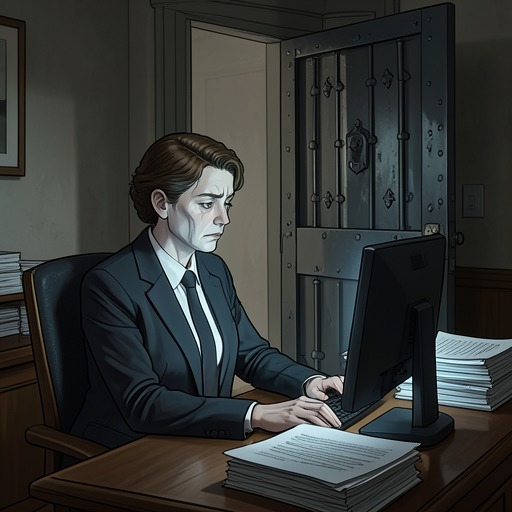
Alison’s collapse follows a period of deliberate overwork rather than a sudden, unexplained illness. When Cameron Holmes visits her office, she tells him she will finish soon and claims to have only a little more work to do, though she recognizes both assurances as lies. Her plan is to work until she is tired to her bones, then go home and fall asleep without having to think. Work becomes both an obligation and a way to avoid the thoughts associated with her breakup.
The strain is already visible to Alison before she loses consciousness. After Cameron leaves, she sees herself reflected in the office window: her ponytail is limp and disheveled, her face pale and thin, and dark circles show beneath her eyes. When she presses her fingers to her cheek, she notices that it no longer feels as plump and round as it used to. She has been sleeping poorly and eating less often, and links this neglect to the loss of happiness and motivation that followed the breakup. Although she knows she works too much, the routine still feels normal to her.
Her immediate choices show how that sense of normality overrides her body’s warnings. She turns back toward documents, progress reports, and other tasks, even as yawning and heaviness make a nap on the office couch appealing. She refuses to rest because she fears sleeping through the night, deciding instead that she must stay awake and finish more work before going home. The alternative is another cup of coffee, whose taste she is already growing tired of. The collapse arrives within this familiar cycle of postponing rest, not after she has made a serious attempt to recover.
The Collapse at the Office
When Alison stands from her desk, her head spins and nausea rises; she closes her eyes briefly until she regains her balance. She interprets the episode as a sign that she must be very tired and walks toward the office kitchen. The symptoms then intensify: black dots appear in her vision, her head feels suddenly light, and the hallway spins. Her legs give out, she hits the ground, and darkness takes hold.
The fall is both abrupt and preceded by warnings. Alison has time to notice dizziness, nausea, and visual disturbance, but each is absorbed into her existing explanation that she is simply tired. Her intention to fetch coffee makes the ordinary scale of the moment especially clear: she is not setting out to seek help, but trying to continue the workday. In the hospital, she later learns that her knees hit first and that she also has pain in her left shoulder. The nurse says the way she fell spared her a head injury; there is no indication of serious pain or head trauma.
Hospital Findings and Cameron’s Response
Alison awakens to a heart-rate monitor, a small television, and the blurry shapes of a hospital room coming into focus. Brooke Collins and Emilia Park are there, visibly worried. Brooke explains that Alison passed out at work and that the doctor attributed it to exhaustion. Emilia adds that Cameron found Alison unconscious in the hallway, called an ambulance, and contacted the two friends while riding with Alison in the ambulance. Alison had not realized he was still in the building. His actions make the collapse a moment of practical dependence on others, even as Alison recognizes how fortunate she was not to have fallen in a way that caused a serious injury.
Dr. Adams’s examination adds medical detail to the friends’ account. Alison’s vital signs look good, and the nurse has found no serious pain or head trauma, but a blood panel indicates that her immune system is compromised. Asked about stress, Alison acknowledges that she works a lot and has recently gone through a breakup. Dr. Adams also tells her that Cameron described her as someone who overworks and has not been eating or sleeping much. Alison confirms that she buries herself in work both at the office and at home.
The doctor presents the episode as the consequence of that pattern: overwork and exhaustion, compounded by stress, have severely compromised her immune system. He tells her to rest and find balance, warning that her way of living is not sustainable and may lead to further health problems if it continues. He keeps her in the hospital overnight for observation, with plans to check her vital signs the next morning and hopefully send her home. The account therefore moves from Alison’s private rationalizations to an assessment she cannot dismiss as merely a feeling of tiredness.
Consequences and Significance
The collapse changes Alison’s attention, if not yet her habits. After Dr. Adams leaves, she reflects that she is not near death but has felt as though she glimpsed it: weak, tired, sick, and pale. She does not want that condition for herself. For once, she says, work is the last thing on her mind, a sharp reversal of the choice to keep working rather than nap, eat, or go home.
That shift is not presented as a completed recovery. The next morning Alison is eager to leave the hospital because she has things she wants to do and people she wants to talk to; being there reminds her of mistakes she has made. Her distinction between mistakes and failures signals a changed way of framing what has happened, but the episode does not establish that her work habits are already repaired. Instead, the collapse makes their consequences concrete: the body that she had treated as something to push past becomes the reason she must stop. Cameron’s discovery and call for help, her friends’ presence, and the doctor’s warning all expose how much her self-neglect has exceeded what she can safely manage alone.