Madeline Usher being buried alive
The Fall of the House of UsherMadeline Usher being buried alive is the decisive reversal in the story’s account of her illness and presumed death: a temporary entombment arranged as a precaution becomes a confinement from which she returns, with fatal consequences for herself and Roderick Usher. The episode rests on uncertainty about her condition, and on the dreadful gap between the signs her observers interpret and what is actually happening.
Illness and the decision to entomb
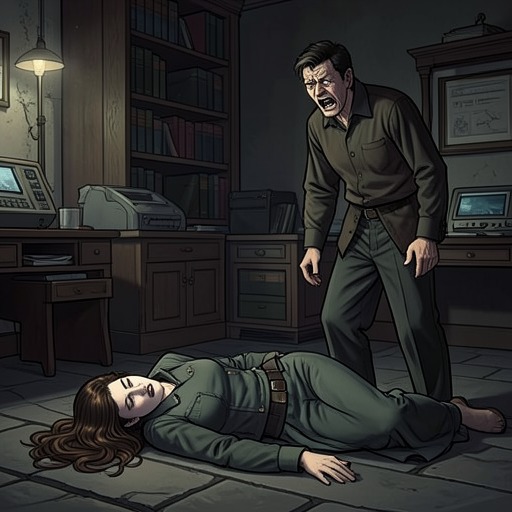
Madeline’s physicians had long been unable to resolve her illness. The narrator records a combination of apathy, gradual wasting, and intermittent cataleptic episodes; until the evening of his arrival, she had continued to resist being confined to bed. When she then succumbed, Roderick told the narrator that she was dead and said he intended to keep her body for a fortnight before final burial.
Roderick gave practical reasons for delaying burial and keeping her within the house: the unusual nature of her illness, what he described as intrusive inquiries from her doctors, and the remote, exposed location of the family burial ground. The narrator, unsettled by the physician he had encountered in the house, did not object. At this point, the arrangement appears to the narrator to be a defensible precaution, even as the account’s emphasis on catalepsy leaves the supposed death uncertain.
The temporary entombment
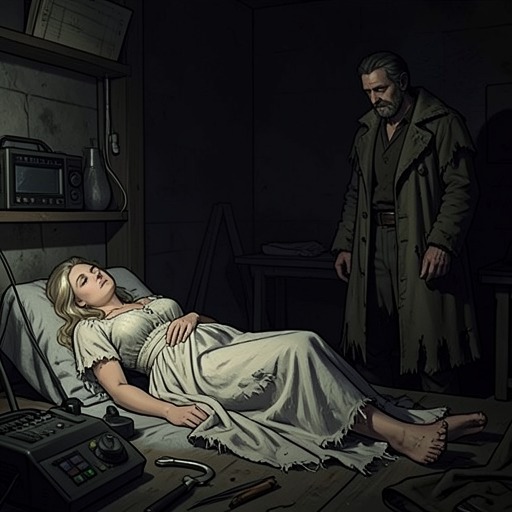
At Roderick’s request, the narrator helped him carry Madeline’s coffin to a vault deep beneath the part of the house where the narrator slept. The vault was small, damp, and without light; its long-unused state made it difficult to inspect. Its history as a place of confinement, and its later use for storing powder or another combustible substance, are reflected in copper sheathing on the floor, archway, and massive iron door. The door’s great weight made it difficult to move.
Before securing the coffin, the two men looked at Madeline’s face. The narrator noticed for the first time how strongly she resembled her brother. Roderick then disclosed that they were twins and that a powerful, difficult-to-explain sympathy had always connected them. Her appearance did not settle the question of death: the cataleptic illness had left signs that could be read as lingering life, but the men replaced the coffin lid and secured the vault door. The narrator’s participation turns the mistaken judgment into a shared act, though he does not yet know that Madeline is alive.
The disclosure and return
Much later, as the narrator reads aloud from a romance, sounds from elsewhere in the house begin to echo details in the story. Roderick finally tells him that he has heard Madeline moving in the coffin and within the vault for days, but was too afraid to speak. His confession changes the meaning of the earlier entombment: the signs attributed to death had concealed a living person, and the vault had not been a temporary resting place.
Madeline appears at the chamber door and falls upon her brother. Both die in the encounter. The narrator flees the house; from outside, he sees the fissure in the building widen and the structure collapse into the tarn. Her return therefore ends not in rescue but in the deaths of the twins and the destruction of the house that had enclosed them.
Narrative significance
The episode makes diagnostic uncertainty consequential. Catalepsy is named as the condition behind Madeline’s symptoms, but neither the physicians’ earlier assessment nor the men’s observation at the coffin establishes that she is dead. Roderick’s concern about her illness and the burial arrangements leads to an action that proves irreversible once the iron door is shut. The story’s later revelation forces the narrator—and the reader—to reinterpret the apparently completed burial as a grave error.
The confinement also sharpens the connection between the twins and their home. Madeline and Roderick are bound by their twin relationship and by the vault beneath the house; her return brings their shared history into the room where the narrator has been trying to sustain Roderick through his grief. The burial is thus both a specific consequence of uncertain judgment and the turning point that drives the narrative toward its ending.