Madeline Usher’s cataleptic illness
The Fall of the House of UsherMadeline Usher’s cataleptic illness is marked by a prolonged decline and episodes that make the boundary between life and apparent death dangerously uncertain. The physicians cannot explain her condition, and that uncertainty governs the decisions surrounding her supposed death: she is placed temporarily in a vault, where she later emerges alive, before dying alongside Roderick Usher.
Symptoms and Course
The illness has baffled Madeline’s physicians. The narrator reports a settled apathy, gradual wasting, and frequent but transient episodes of a partially cataleptic character. Despite the pressure of the disease, Madeline had continued to bear it without finally taking to her bed. On the evening of the narrator’s arrival, however, Roderick tells him that she has succumbed to the illness and will probably not be seen alive again. The narrator’s account thus distinguishes what he observes from what he learns: he glimpses Madeline only briefly, while the description of her decline and collapse comes chiefly through Roderick and the earlier medical diagnosis.
Diagnosis and Uncertainty
The narrative gives symptoms and a physicians’ diagnosis, but no settled explanation for the illness. Its cataleptic episodes become consequential because they make Madeline’s condition difficult to distinguish from death. When Roderick later reports that she has died, he cites the unusual nature of the malady as one reason for delaying her final burial. The doctors’ eager inquiries also contribute to his decision, although the account does not specify what they suspect or what further examination they intend.
The narrator encounters the signs of uncertainty again when he and Roderick view Madeline after placing her in the coffin. Her appearance retains a faint suggestion of life, which he connects to the cataleptic nature of her illness. This observation unsettles the apparent certainty of the death report, but it does not lead either man to reopen the question before securing the vault.
Temporary Entombment
Roderick decides to preserve Madeline’s body for a fortnight before final interment. He explains that the unusual illness, the physicians’ inquiries, and the family burial ground’s remote and exposed location have led him to this precaution. The narrator does not oppose him: recalling the sinister-looking person he had met on the staircase, he regards the arrangement as a potentially harmless safeguard.
At Roderick’s request, the narrator helps carry the coffin into a small, damp, lightless vault deep beneath the part of the house where the narrator sleeps. The chamber lies within the building’s main walls and has a massive iron door. There, the two men look at Madeline’s face, notice for the first time how strongly she resembles her brother, and learn from him that they were twins and had shared an unusually close sympathy. They close the coffin and secure the door, treating the entombment as temporary while the illness’s ambiguous signs remain unresolved.
Return and Consequences
Days later, during a storm, Roderick tells the narrator that he heard faint movements in the coffin many days earlier but lacked the courage to speak. He interprets the sounds around them as signs that Madeline is approaching and has escaped the vault. His confession retrospectively changes the meaning of the earlier diagnosis and burial: the temporary precaution became a confinement from which Madeline had to return on her own.
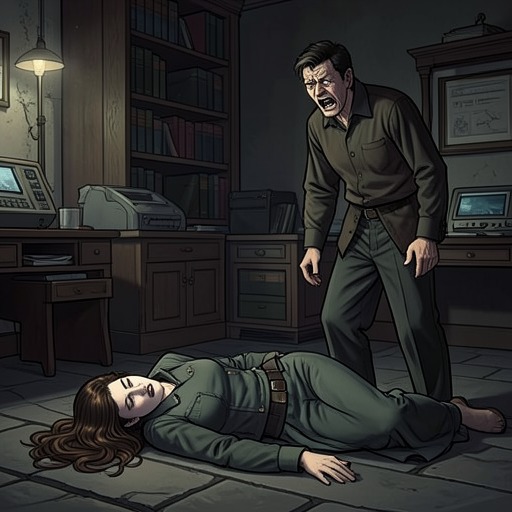
Madeline appears at the chamber door and falls against Roderick. Her final death carries him to the floor, and the narrator flees the house. The account does not establish a more precise medical explanation for the episodes; instead, it makes the failure to recognize life within an apparently lifeless state the illness’s decisive consequence. Catalepsy is both a reported clinical condition and the source of the story’s central uncertainty about whether Madeline has died.