Madeline Usher’s return and the deaths of the Usher twins
The Fall of the House of UsherMadeline Usher’s return and the deaths of the Usher twins transform a guarded burial into the story’s decisive revelation: Madeline was alive when her brother and the narrator placed her in the vault, and her emergence ends both twins’ lives. The sequence makes the sounds of a tale being read aloud correspond, one by one, to events unfolding within the House of Usher, until Roderick Usher’s concealed knowledge can no longer remain unspoken.
Illness and the Decision to Entomb
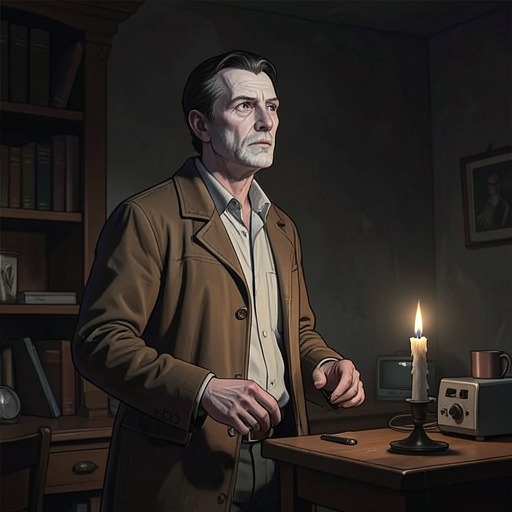
Madeline’s long illness had baffled her physicians. The narrator reports a settled apathy, progressive wasting, and recurring but temporary cataleptic episodes. On the evening of his arrival, Roderick told him that Madeline had succumbed to her illness and would not be seen again alive. The narrator, who had glimpsed her passing through a distant part of the room, accepted that account at the time; the diagnosis and the appearance of death would later prove unreliable guides to her condition.
After some days, Roderick announced that he intended to keep Madeline’s body for a fortnight in a vault inside the mansion before her final burial. He gave practical reasons: the unusual nature of her illness, questions from her physicians, and the exposed location of the family burial ground. The narrator had reservations, recalling the family physician’s uneasy manner, but judged the plan a precaution and did not oppose it. That combination of medical uncertainty and deference to Roderick’s explanation enables the mistake at the center of the event.
The Vault and the Mistaken Death
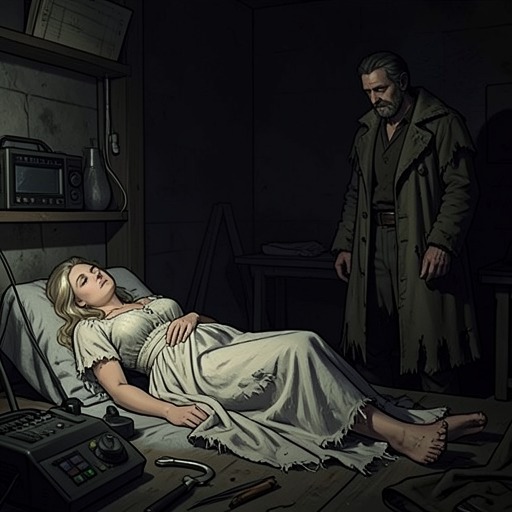
At Roderick’s request, the narrator helped him carry Madeline’s coffin to a small, damp vault deep beneath the part of the mansion where the narrator slept. The chamber had no natural light and had reportedly served as a place of confinement in feudal times; its floor, passage, and heavy iron door were lined with copper. The pair placed the coffin inside and partly opened its still-unscrewed lid to look at Madeline.
The narrator then noticed how closely the twins resembled one another. Roderick disclosed that he and Madeline were twins and that an unusually powerful sympathy had always connected them. Her face retained signs that, in retrospect, sharpen the uncertainty surrounding the supposed death: a faint flush and a lingering smile. The lid was screwed down, the iron door secured, and the two men returned upstairs. What they treated as a temporary burial had become a living confinement.
Sounds from the Vault
Days later, Roderick’s behavior changed markedly. His usual activities fell away; he paced without purpose, appeared more pallid, and spoke with a persistent tremor of fear. The narrator could not determine whether Roderick was struggling to disclose a secret or simply giving way to madness. The narrative makes that uncertainty consequential: Roderick’s later confession identifies the secret as something he had known for days but had been afraid to tell.
On a stormy night, the narrator tried to steady him by reading from The Mad Trist. The story describes a hero forcing a door, striking down a dragon, and approaching a shield. As the narrator reads, he hears distant sounds that seem to match those actions: first a cracking noise, then a harsh cry, and finally a hollow metallic reverberation. The sounds move from apparent coincidence toward evidence. Roderick faces the chamber door, trembles, and rocks in his chair while the narrator continues reading; the staged correspondence between the book and the unseen events makes the approaching truth audible before it is visible.
Confession and Return
Roderick finally admits that he has heard Madeline’s movements in the coffin, and later in the vault, for many days. He says he recognized the sounds accompanying the reading as the breaking of her coffin, the movement of the iron door, and her efforts to leave the chamber. His confession revises the meaning of the earlier entombment: the narrator and Roderick did not merely misjudge a baffling illness; Roderick had become aware that his sister was alive and had remained silent.
Roderick then declares that Madeline is standing outside the door. The panels open, and she appears there, exhausted from her struggle. She falls onto Roderick, and both die. The return fulfills the sequence of sounds that had been shadowing the reading and brings Roderick’s anticipated terror to its fatal conclusion. Madeline’s reappearance is at once proof of the mistaken burial and the last encounter between the twins.
Aftermath and Significance
The narrator flees the chamber and the House of Usher. From the causeway, he sees the fissure previously noted in the mansion’s facade widen; the walls divide, and the building’s fragments sink into the tarn beside the Usher house. The twins’ deaths are thus followed immediately by the destruction of their home, joining a private catastrophe to the end of the family’s ancestral seat.
The event’s effect depends on the gap between appearance and knowledge. Madeline’s cataleptic symptoms, the cautious decision to preserve her body, and the narrator’s observations of her face all acquire new significance after Roderick’s confession. Meanwhile, the reading scene turns sound into a delayed disclosure: each apparent echo connects the story within the story to Madeline’s real struggle, until the sealed vault and Roderick’s silence can no longer contain what has happened.