Premature burial
The Fall of the House of UsherPremature burial is the governing horror of Madeline Usher’s fate: a condition that makes death difficult to distinguish from life leads to her being sealed in a vault while still alive. The story develops the possibility gradually, first through uncertain symptoms and a precautionary decision, then through the narrator’s belated understanding of what the entombment meant. Its force lies not only in the final discovery, but in the chain of reasonable-seeming judgments and silences that makes the discovery possible.
Illness and Uncertainty
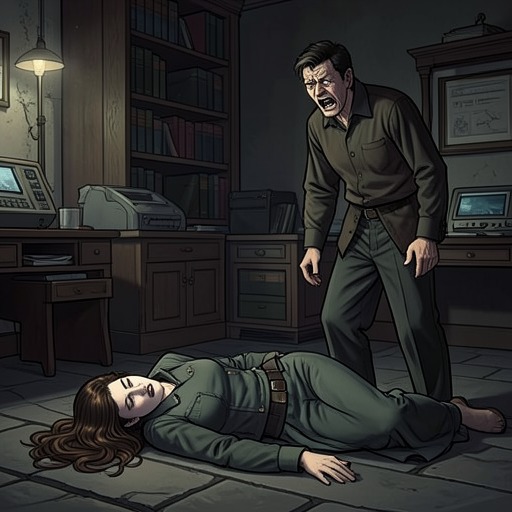
Madeline Usher’s illness has long resisted the skill of her physicians. The narrator describes a settled apathy, gradual wasting, and recurring but temporary episodes of a partly cataleptic character. She had continued to endure the illness without finally taking to bed; on the evening of the narrator’s arrival, however, she succumbs to what Roderick Usher describes as the disease’s destructive power. He tells the narrator that the glimpse of his sister may be the last he will have of her alive. At this stage, the account presents a serious illness and an apparent death, but not a reliable means of distinguishing the two.
That uncertainty matters because the story offers symptoms rather than an authoritative explanation of what happened. The narrator reports the physicians’ puzzlement and Roderick’s account of Madeline’s decline; he does not supply a definitive medical diagnosis. Later, when the coffin is opened before it is sealed, the narrator notices that her appearance retains traces that seem inconsistent with complete certainty about death. Those signs do not establish, at that moment, that she is alive. They do, however, make the entombment retrospectively legible as a disastrous decision made in the presence of unresolved doubt.
The Decision to Entomb
Several days after Madeline’s death is announced, Roderick tells the narrator that he intends to keep her corpse for a fortnight in a vault within the House of Usher before final interment. He gives practical reasons: the unusual character of her illness, the eager inquiries of her medical men, and the remote, exposed location of the family burial ground. The narrator does not feel entitled to dispute the explanation. He also remembers the troubling appearance of someone encountered on the staircase, which makes him more willing to accept the plan as a harmless precaution.
The narrator does more than witness the choice; at Roderick’s request, he helps carry it out. The two men alone bear the coffin to a small, damp vault deep beneath the part of the house where the narrator sleeps. The room has no means of admitting light. Its setting bears traces of earlier uses: it seems to have served as a prison in remote feudal times and later as a store for gunpowder or another combustible substance. Copper covers part of the floor and the interior of the long passage leading to it; the massive iron door makes a sharp grating sound as it moves. These concrete details make the burial both a practical act and a descent into a confined, sealed space.
Before closing the coffin, the men look upon Madeline. The narrator notices a strong likeness between brother and sister, and Roderick reveals that they are twins who have always shared an unusually close sympathy. The narrator also sees the faint signs that complicate the appearance of death, but the men replace and screw down the lid, secure the iron door, and return upstairs. The narrative does not present the narrator as having certainty that Madeline is alive; it presents him as participating in an irreversible act despite unease and incomplete knowledge.
Delayed Recognition
After the entombment, the narrator observes a marked change in Roderick. His familiar manner and ordinary activities disappear; he moves restlessly through the house, and terror increasingly shapes his speech. The narrator suspects that Roderick is struggling with a secret, but sometimes explains his behavior as madness. This delay in understanding is central to the burial motif: the act is complete before either man openly acknowledges its possible consequence, and the narrator has no clear explanation for Roderick’s growing agitation.
The decisive account comes during the final night. Roderick tells the narrator that he has heard faint movements from inside the coffin for many days, but has not dared to speak. He identifies the sounds he now hears in the house with Madeline’s attempts to escape the vault. His admission changes the meaning of the earlier precautions: the fortnight’s temporary entombment has not simply postponed burial but has confined Madeline while she was alive. The narrator receives this knowledge from Roderick, whose terror and deteriorating condition shape the confession, but the events that follow make the danger more than a private suspicion.
Return and Consequences
Madeline appears at the chamber door, visibly exhausted by the ordeal, and falls upon Roderick. She dies in the encounter, and Roderick dies with her, overcome by the terror he had anticipated. The return confirms the central fact that the earlier scene left uncertain: Madeline had been entombed alive. It also makes the burial’s consequence inseparable from the twins’ deaths. The narrator flees the House of Usher, and, as he crosses the causeway, a fissure in the building widens until the structure breaks apart and sinks into the tarn.
The episode turns a precaution against uncertain death into the cause of a final catastrophe. Medical uncertainty, Roderick’s decision, the narrator’s assistance, and the failure to respond to what Roderick later says he heard all belong to the same sequence. The story does not resolve the illness into a medical explanation; instead, it makes the limits of diagnosis and observation part of its suspense. Premature burial is therefore both a literal event and the mechanism of delayed recognition: what the characters treat as a completed death proves to be an unfinished crisis, returning only when escape and rescue have become impossible.