The Haunted Palace
The Fall of the House of UsherThe Haunted Palace is a ballad improvised by Roderick Usher that turns the history of a splendid dwelling into an image of ruin. Its movement from a fair, inhabited palace to a place haunted by strange forms gives shape to the dread surrounding Roderick and the House of Usher. The narrator recognizes the song as more than an ornate performance: beneath its fantastic imagery, he senses Roderick’s awareness that his reason is tottering. The ballad’s later connection to Roderick’s theory of the house’s influence makes it a compact, unsettling counterpart to the story’s larger movement toward catastrophe.
Composition and Performance
Roderick performs The Haunted Palace during the narrator’s stay, as part of the musical improvisations that fill their time together. His nervous disorder sharply limits what he can tolerate: most sounds inspire horror, while certain effects of stringed instruments remain bearable. The guitar therefore provides a narrow channel for expression, but the narrator does not reduce the performance to that limitation. He finds that the force and facility of Roderick’s improvisations exceed any simple explanation based on the instrument’s restricted range. Roderick accompanies the music with improvised words, and the ballad is one such composition, remembered by the narrator from their shared hours in the House of Usher.
The narrator recalls the song retrospectively, emphasizing both the impression it made and the uncertainty of exact recollection. He presents its verses as substantially remembered rather than as a documentary transcript. That qualification suits the ballad’s role: it matters not as a detachable literary ornament but as a performance heard within the intimacy of Roderick’s illness. The narrator’s attention shifts from the song’s fantastic surface to the state of mind he believes it discloses.
From Splendor to Disturbance
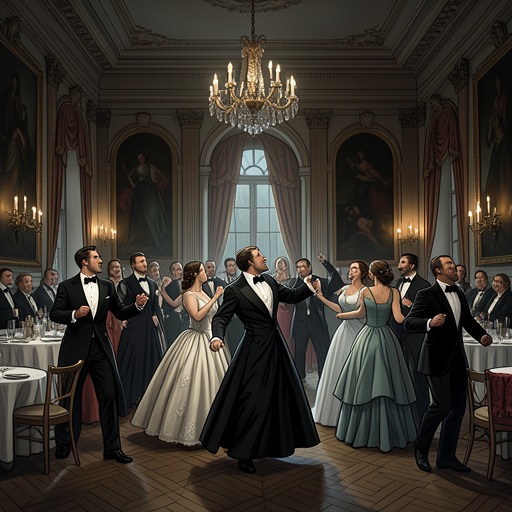
The surviving images establish a sharp reversal. The poem begins in a green valley, with a fair and stately palace associated with good angels. Its earlier world is ordered around a monarch whose court possesses wit and wisdom. The dwelling is not introduced as a ruin but as a place of beauty, rule, and apparent security. That remembered order gives the later assault its force: evil approaches not an empty structure but a high estate that has already had a flourishing life.
The ballad then turns toward loss. Evil things attack the monarch’s position, and the poem marks the change as one that cannot be undone. In its later vision, travellers look through red-lit windows and see vast forms moving strangely within. A hideous throng emerges, laughing but no longer able to smile. The palace’s windows, once openings onto a stately interior, become frames through which outsiders glimpse a world deformed from within. The poem’s progression thus makes inward collapse visible: the building remains recognizable, but what it contains has become alien and frightening.
Roderick’s Interpretation and the House
The narrator hears in this transition a personal meaning. He says the song’s hidden current suggests, for the first time, a full consciousness in Roderick that his reason is losing its stability. The ballad does not explain that condition directly, and the narrator does not claim that Roderick offers a plain confession through verse. Instead, the palace’s decline gives imaginative form to a perception that Roderick cannot or does not state in ordinary terms. The song’s controlled sequence—from established order to an interior overtaken by strange forces—contrasts with the disorder that increasingly governs his life.
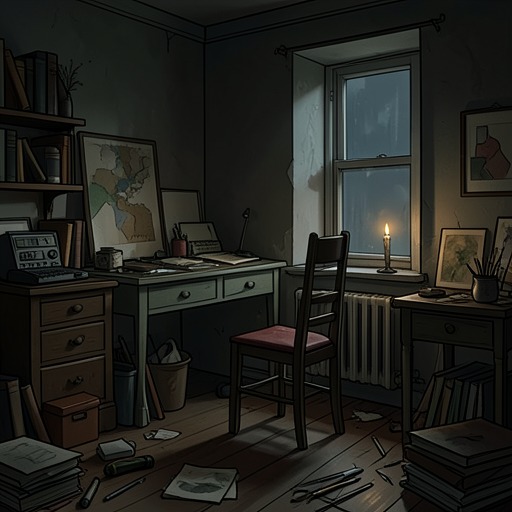
After the performance, the narrator and Roderick discuss the suggestions raised by the ballad. Roderick maintains that all vegetable things possess sentience, then extends the possibility, under certain conditions, into what is not ordinarily considered living. His conviction centers on the House of Usher. He attributes significance to the arrangement of its gray stones, the fungi spread across them, the decayed trees nearby, and the long persistence of the whole formation. The tarn beside the Usher house repeats that arrangement in its still waters. Roderick believes that these conditions have gradually produced an atmosphere of their own around the walls and water, and that this influence has shaped the family’s fate as well as his present condition.
The ballad’s palace and Roderick’s theory are therefore linked by more than their shared architecture. In the song, a once-ordered dwelling becomes the setting and apparent expression of a hidden disturbance. In his theory, the physical arrangement of the family home exerts a persistent influence that reaches into human life. The narrator leaves Roderick’s belief without endorsement, but the song has made its emotional logic perceptible: the house is imagined not as a neutral setting but as a force bound to the family’s decline.
Foreshadowing and Narrative Function
The ballad prepares the reader for later events without specifying them. Its movement from a flourishing palace to disturbing apparitions anticipates the story’s widening uncertainty about what is happening inside the House of Usher. It also gives the narrator an early sign that Roderick’s fear is not merely an abstract theory. Much later, during the storm, the narrator reads The Mad Trist aloud, and the sounds in that tale seem to find counterparts in the house. Roderick then reveals that he has heard signs of movement from the place where Madeline Usher was confined and believes she was buried alive. The ballad does not narrate that revelation, but its earlier vision of a troubled interior makes the later entanglement of literary image, sound, and event part of a sustained pattern.
That pattern also preserves a distinction between what the narrator perceives and what he can establish. He interprets the song as evidence of Roderick’s inward knowledge, yet the song remains a work of improvisation whose meaning is partly indirect. Likewise, Roderick’s theory of the house is presented as his conviction, not as a confirmed explanation of the family’s fate. The Haunted Palace consequently operates at once as a composition, a portrait of its performer’s fear, and a symbolic structure through which the story makes the House of Usher’s apparent agency imaginable. Its decisive effect lies in that ambiguity: the palace may be a figure for a failing mind, for a family and dwelling caught in a shared decline, or for the terrifying possibility that the dwelling itself participates in that decline.