The House of Usher as family and mansion
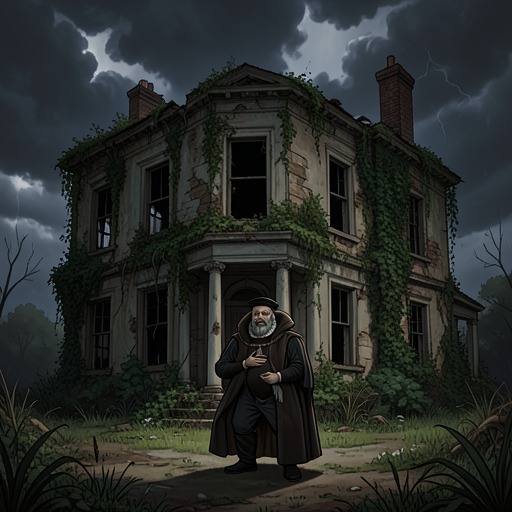
The Fall of the House of UsherThe House of Usher as family and mansion is the story’s defining double meaning: it refers both to an ancient lineage and to the residence that bears its name. The narrator links the two through inheritance, long continuity, and the apparent convergence of family history with the fate of the building. By the end, the deaths of Roderick Usher and Madeline Usher coincide with the mansion’s destruction, giving that connection a final, literal consequence.
Identity and Inheritance
The narrator describes the Ushers as an ancient family whose members had long been known for unusual sensitivity of temperament. Their inheritance included a history of artistic achievement, more recent acts of generous but unobtrusive charity, and an intense interest in the intricacies of music. These family traits establish a lineage with a distinctive cultural identity, not merely a name attached to a property.
The family’s structure is equally important. The narrator reports that its line had produced no enduring collateral branch: succession had remained, with only slight and temporary variation, in the direct line. He reasons that the repeated transmission of the patrimony and the family name from one generation to the next may have made family and estate seem inseparable. This is presented as his interpretation of the connection, rather than as a separate account of inheritance law or a confirmed explanation of the family’s history.
The name used by the local peasantry expresses that inseparability. In their usage, the House of Usher includes both the family and its mansion. The designation therefore does more than identify a building or a household; it gathers lineage, property, and residence into one social name. The narrator observes that the original title of the estate had, in effect, merged with this broader appellation.
Mansion and Family Influence
The narrator considers whether the mansion may have influenced the people who lived in it, just as the family’s long history may have shaped the character attributed to the premises. His suggestion is speculative, but the story gives it weight through Roderick’s own belief. Roderick is bound by superstitious impressions concerning the dwelling, from which he says he has not ventured for many years. He attributes an influence over his spirit to the mansion’s form and substance, including its gray walls and turrets and the tarn beside it.
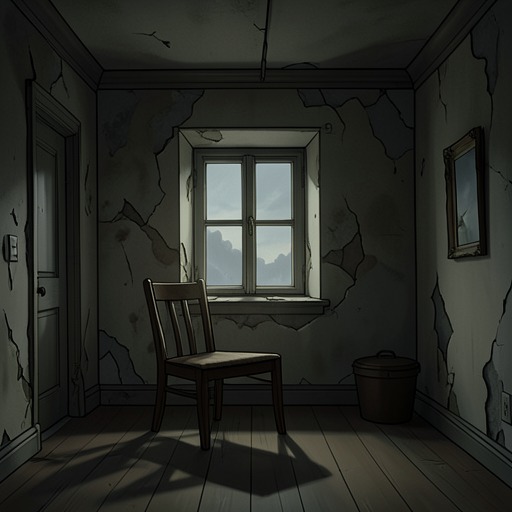
That belief belongs to Roderick’s account of his condition; it does not establish that the house possesses supernatural power. The narrator also considers the family’s circumstances and the setting as possible sources of the oppressive atmosphere he perceives. Still, the mansion is not a neutral backdrop in the Ushers’ story. Its enclosed spaces shape what can be seen and done: Madeline Usher’s body is placed in a vault within its walls, and the vault lies beneath the part of the building where the narrator sleeps. The dwelling thus contains both the family’s domestic life and the place where its crisis is temporarily concealed.
The Last Generation
The bond between house and lineage becomes most precarious in the final generation. Roderick describes Madeline, his twin sister and his only remaining relative, as both his sole companion and the person whose death would leave him the last of the ancient family. Her illness has resisted her physicians’ efforts, and the narrator’s brief sight of her is followed by Roderick’s report that she has succumbed. Her reported death makes the family’s extinction seem imminent, while the decision to keep her body in a vault postpones its final interment.
The burial episode intensifies the story’s uncertainty about what the family name encompasses. When Roderick and the narrator look upon Madeline after placing her in the coffin, the narrator notices a striking resemblance between the twins. Roderick then discloses that they are twins and that they have long shared sympathies he cannot readily explain. Their relationship joins the family’s continuity to a particularly close bond between its last two members; the apparent death of one leaves the other isolated at the point when the lineage is already at risk of ending.
Later, Roderick reveals that he heard movements from the coffin over a period of days but did not speak. Madeline returns to the chamber and, in her final moments, falls upon Roderick; both die. The event overturns the earlier assumption that Madeline’s death had already occurred and leaves no surviving member of the family. The concealed vault, situated inside the mansion, has held the crisis rather than resolved it: the family’s last separation ends in a shared death within the house.
Collapse and Significance
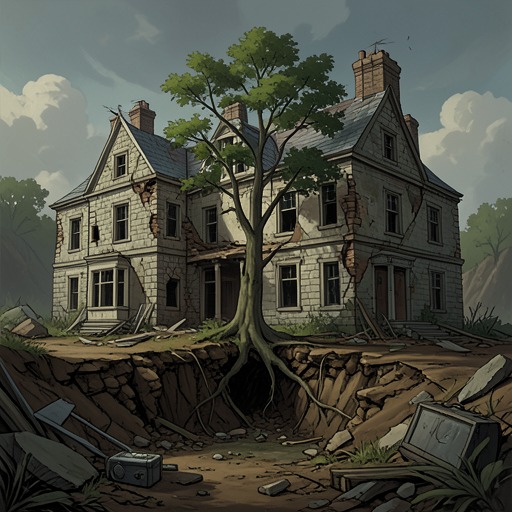
After fleeing the mansion, the narrator sees the fissure that had extended from its roof toward its base widen. The walls split apart, and the structure sinks into the tarn. The account places this destruction immediately after the deaths of Roderick and Madeline, so the mansion’s end follows the extinction of the line that gives it its name. The narrative does not provide a practical explanation for why the building collapses at that moment; its sequence instead makes the family and the residence seem bound to a common ending.
The double meaning of the House of Usher thus becomes structural as well as linguistic. Its inherited name gathers family and estate into a single identity; the direct line’s lack of enduring collateral branches makes that identity fragile; and the deaths of the twins coincide with the disappearance of the mansion itself. The narrator’s earlier speculation about mutual influence remains speculation, but the ending gives it a forceful narrative shape: once the last Ushers are gone, the house that has stood for both their household and their lineage is gone too.