The Mad Trist
The Fall of the House of UsherThe Mad Trist is an antique romance whose brief reading aloud becomes the structural and acoustic hinge of the final crisis in the House of Usher. The narrator takes it up in an effort to steady Roderick Usher during a storm; as the romance’s successive sounds seem to recur in the mansion, the reading ceases to be a distraction and becomes the occasion for Roderick to disclose what he has heard from Madeline Usher’s tomb.
The book and its place in the chamber
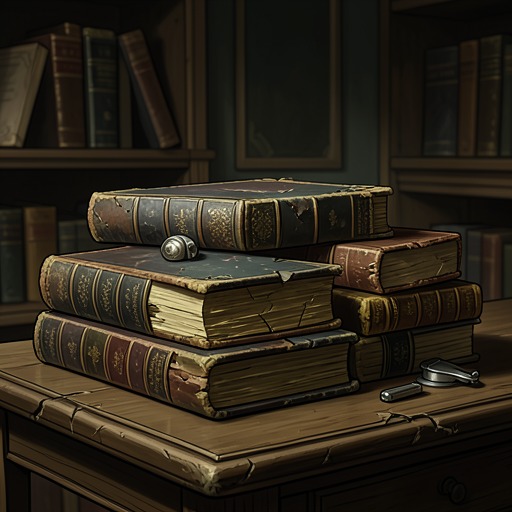
The volume is an antique work attributed to Sir Launcelot Canning. The narrator describes its prose as extended and awkward, and considers it ill suited to Roderick Usher’s elevated, imaginative tastes. It is nevertheless the only book immediately available. The narrator had earlier learned that Roderick’s sensory distress left him able to tolerate only particular sounds, especially those made by stringed instruments; reading is therefore a practical attempt to direct his attention, not a confident choice of literature likely to please him.
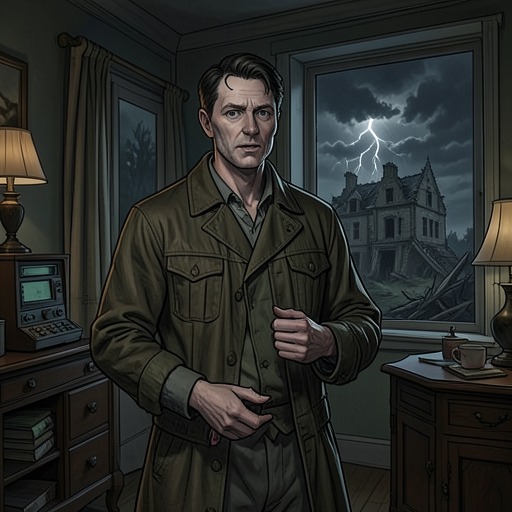
Roderick’s condition has grown more alarming in the days after the reported death of his sister. His customary manner and occupations have fallen away, and he appears persistently agitated. When the narrator sees storm-lit appearances outside the window, he leads Roderick away from it and proposes reading together to pass the night. He presents The Mad Trist as one of Roderick’s favorites in a tone he acknowledges is jesting, then begins to read with the hope that even the romance’s absurdity might occupy his companion’s mind. Roderick listens with an unusually animated air, or seems to; the narrator initially takes this response as possible evidence that the plan is working.
Ethelred’s entrance and the first echo
The selected episode follows Ethelred, the romance’s hero. Unable to gain peaceful admission to a hermit’s dwelling, and fearing the worsening storm, Ethelred uses his mace to break through the wooden door. The narrator reads the passage’s description of the wood cracking and tearing. At its conclusion he pauses: from a remote part of the mansion comes a faint, muffled sound resembling the noise just described. He immediately allows that his excited imagination may have deceived him and attributes his attention to coincidence amid the rattling windows and storm.
The sequence makes the book’s sounds matter before their source is known. The narrator continues reading rather than investigating, and does not tell Roderick about the apparent echo, partly to avoid intensifying his companion’s nervousness. The romance thus supplies a pattern against which noises in the house can be heard, while the narrator’s uncertainty preserves the possibility that the resemblance is only coincidence. The tension depends on that gap between what the sound seems to repeat and what either man can yet establish about it.
The dragon, the shield, and the accumulating sounds
Inside the hermit’s dwelling, Ethelred finds a dragon guarding a palace rather than the hermit he sought. The hero strikes the dragon, whose cry is described in the romance as a harsh, piercing sound. The narrator pauses again when he hears a distant, prolonged noise that seems to match the cry. This time he is sure that a sound has occurred, though he cannot determine its direction. Roderick has turned his chair toward the chamber door; his lips move, his head hangs forward, and he rocks steadily. The narrator notices these changes but resumes the reading.
The next episode brings Ethelred across the palace to a shield hanging on the wall. As he approaches, the shield falls onto the silver floor with a ringing sound. The narrator has scarcely finished reading those words when another noise reaches him: a distinct, hollow metallic reverberation, apparently muffled. The three audible correspondences now form a progression—wood breaking, a harsh cry, and metal striking a floor—each arriving as the corresponding action is read. The book does not merely provide a general atmosphere of romance or terror; its ordered incidents give the storm-night sounds a particular sequence and shape.
Roderick’s disclosure and the book’s narrative function
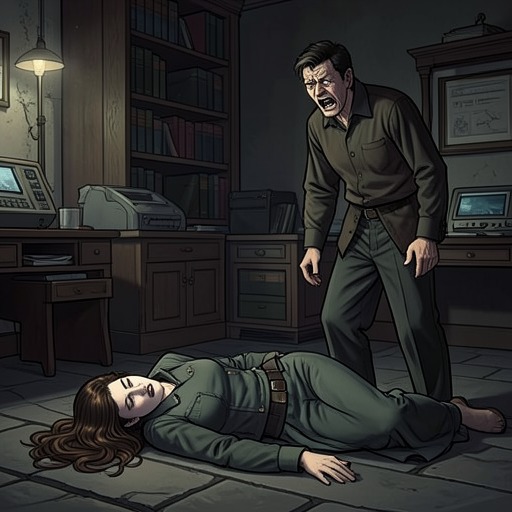
At the final sound, the narrator rises and approaches Roderick. Roderick remains fixed in his chair, then shudders and speaks as though only dimly aware of the narrator. He says that he has heard the noises for many minutes, hours, and days, but has been afraid to speak. He identifies them not as events in the romance but as sounds from the vault: Madeline Usher’s movements in the coffin, the opening of its enclosure, and the iron door of her prison. The book’s three scenes have furnished the immediate parallels through which he voices a truth he had withheld: Madeline was placed in the tomb alive.
The reading therefore works at once as attempted comfort, a timed sequence of acoustic echoes, and the frame for Roderick’s confession. The narrator first treats the sounds as uncertain coincidences; Roderick interprets them as evidence that his sister has been struggling to escape. When Madeline appears at the chamber door and falls upon her brother, the disclosure is followed by the twins’ deaths. The narrator flees, and the House of Usher soon collapses into the tarn. The romance does not cause these events, but its placement lets a tale of forced entry and released enchantment overlap with the hidden events in the family vault. Its function is especially consequential because the narrator’s reading, intended to occupy Roderick through the night, instead gives audible form to the truth Roderick had been unable to confess.