The Usher family tomb
The Fall of the House of UsherThe Usher family tomb is a sealed vault beneath the House of Usher, used to hold Madeline Usher’s body before its intended final burial. The narrator and Roderick Usher carry her there themselves, treating the placement as a temporary precaution. Its depth, darkness, and heavy iron entrance turn the vault into more than a burial place: it becomes the concealed setting of the story’s central uncertainty about whether Madeline is dead, and the route from that uncertainty to the catastrophe that follows.
Location and Construction
The vault lies deep beneath the portion of the House of Usher where the narrator sleeps, bringing the burial chamber into close physical proximity with the rooms occupied above. The narrator describes it as small, damp, and entirely without natural light. Because it had remained unopened for a long time, the torches used during the descent provided little opportunity to inspect it. The obscurity is therefore not only part of the setting; it limits what the two men can see as they carry out the burial.
The chamber’s earlier uses give it a history apart from its current function. It had apparently served in remote feudal times as a donjon-keep, and in later years as a place for storing powder or another highly combustible substance. Copper sheathed part of the floor and the interior of the long arched passage leading to the vault; the massive iron door was protected in the same way. The door’s weight made it produce a sharp grating sound when moved. These details make entry and closure into substantial physical acts, while the copper-lined passage and former storage use distinguish the chamber from an ordinary family grave.
The Temporary Entombment
Roderick tells the narrator that Madeline has died after a long illness that had resisted the efforts of her physicians. Its reported symptoms included gradual wasting, apathy, and transient cataleptic episodes. Roderick proposes keeping her body in the vault for a fortnight before final interment. He gives practical reasons: the unusual character of her illness, inquiries from the medical men, and the remote, exposed position of the family burial ground. The narrator does not challenge the explanation. Remembering the sinister-looking person he had encountered on the staircase, he regards the precaution as harmless rather than opposing it.
At Roderick’s request, the narrator takes part in the arrangements. The two men alone carry the coffin down and set it within the chamber. They partially turn aside its still-unscrewed lid and look at Madeline. Only then does the narrator notice the strong resemblance between the brother and sister. Roderick explains that they were twins and that an unusually close sympathy had always existed between them. The moment links the private family relation to the vault’s role: the place receives one twin’s body, but it cannot sever the story’s insistence on the pair’s connection.
The appearance of Madeline’s face complicates the declaration of death. Her illness has left a faint blush and a lingering expression that the narrator finds unsettling; neither observation establishes that she is alive, but both make the coffin’s occupant difficult to read as simply and unmistakably dead. The men replace and screw down the lid, secure the iron door, and return upstairs. The practical act of sealing the chamber gives the decision a finality that the evidence available to them does not warrant.
Secrecy and Sound from Below
After the burial, Roderick’s behavior changes. He abandons his usual occupations, moves restlessly through the house, and appears increasingly terrified. The narrator can only speculate that Roderick is burdened by a secret; he does not yet know what it is. The vault remains unseen and silent in the account, but its position beneath the narrator’s room gives the later sounds a possible source within the house’s architecture.
During a storm, the narrator reads aloud from a romance in which a hero forces entry through a wooden door, kills a dragon, and approaches a shield that falls with a ringing crash. At successive points in the reading, he hears distant sounds resembling the described damage, a harsh cry, and a metallic reverberation. The correspondences gradually transform the reading from an attempted distraction into an acoustic pattern that seems to connect the narrated adventure with events elsewhere in the mansion. The narrator initially treats the first sound as coincidence and continues reading; he hears the later sounds more distinctly.
Roderick finally tells the narrator that he has heard Madeline moving inside the coffin and struggling in the vault for days, but has been afraid to speak. He interprets the sounds accompanying the reading as the breaking of the coffin, the iron hinges of the prison, and Madeline’s movements in the passage. This is Roderick’s disclosure, not an independent account of what occurred below: the story presents the sounds through the narrator’s hearing and their resemblance to the romance. Yet the later appearance of Madeline at the chamber door confirms the practical consequence of the burial decision. She has reached the upper room after an escape from the vault, and Roderick dies as she falls upon him.
Consequences and Narrative Significance
The vault’s most consequential feature is the gap between a medical judgment of death and the signs that Madeline may have remained alive. Her cataleptic episodes and the unusual course of her illness had already made her condition difficult to assess. Although the medical men’s inquiries contribute to Roderick’s explanation for keeping the body on the premises, the story does not supply a definitive medical diagnosis that would settle the question. Instead, the decision to entomb her is made amid uncertainty, and the closed chamber conceals the consequences until the sounds and Madeline’s return expose them.
The vault also organizes the story’s shift from reported explanation to physical consequence. At first, the narrator accepts a plausible practical account of the temporary burial. Later, Roderick’s account of the sounds revises the meaning of the coffin and the sealed door: what had been presented as protection and temporary storage has become confinement. The sounds’ staged resemblance to the events in the romance delays recognition, allowing the reader and narrator to approach the truth through echoes rather than direct observation.
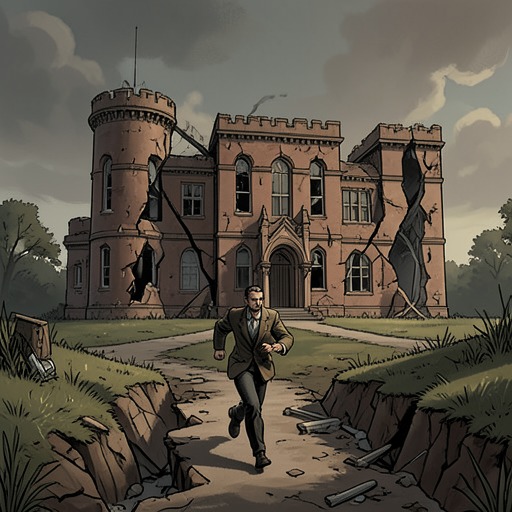
After Madeline’s return, the narrator flees the chamber and the House of Usher. He witnesses the mansion split along a fissure and collapse into the tarn, which closes over its fragments. The vault is not described as a separate structure surviving that destruction; it lies beneath the house that is destroyed. Its narrative work is therefore bound to the fate of the household: the place intended to contain Madeline instead precedes the return that ends Roderick’s life, and the closing catastrophe removes both the family’s remaining members and their ancestral home.