The narrator and Roderick Usher’s friendship
The Fall of the House of UsherThe narrator and Roderick Usher’s friendship is both an old bond and a belated act of care: childhood intimacy prompts the narrator to answer an urgent appeal, but renewed companionship cannot protect Roderick from fear, secrecy, or the catastrophe at the House of Usher. The narrator arrives as the friend Roderick calls his only personal companion, becomes his close attendant during the final crisis, and leaves as the sole surviving witness to its end.
Formation and Distance
As boys, the two had been intimate companions, but many years passed after their last meeting. The narrator admits that he knew little of Roderick even then, since Roderick’s reserve had always been pronounced. Their friendship is therefore founded on remembered closeness without a corresponding depth of knowledge: affection has endured, while familiarity with Roderick’s inner life has not.
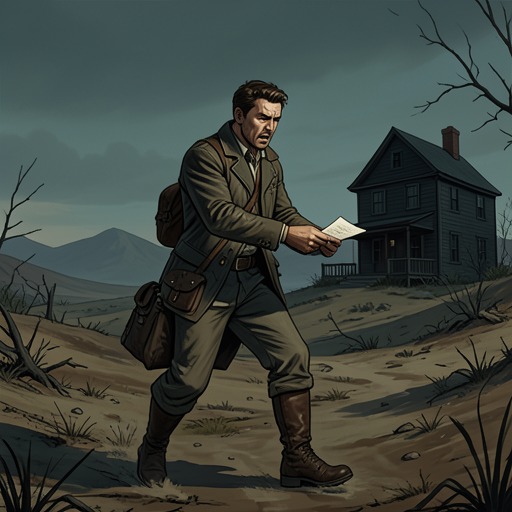
The bond is renewed by a letter sent to the narrator in a distant part of the country. Roderick describes acute physical illness and a mental disorder, and asks to see his old companion, presenting the narrator as his best and only personal friend. The urgent, emotionally earnest appeal leaves the narrator feeling unable to refuse; he travels to the House of Usher to offer the cheerfulness of his company and whatever relief it might bring. His arrival is an act of loyalty, but it also places him inside a household whose history and atmosphere he scarcely understands.
Companionship and the Limits of Consolation
Once reunited, the narrator tries to give their friendship practical form. He paints and reads with Roderick, listens to his improvisations on the guitar, and spends long periods alone with him. Roderick’s musical expression and artistic work become part of their shared life, while the narrator’s willingness to attend to them marks his effort to accompany rather than simply observe his friend.
Roderick explains that his condition is both constitutional and familial, while also trying to dismiss it as a nervous affection that might pass. His senses are intolerably acute: ordinary food, many fabrics and floral odors, and even faint light trouble him, while only certain sounds from stringed instruments do not inspire horror. The narrator listens to this account and remains beside him, but discovers that companionship cannot cheer Roderick out of his pervasive gloom. The more closely the narrator is admitted to his friend’s private world, the more clearly he sees how little his efforts can change it.
The narrator’s care is also shaped by Roderick’s distress over his sister, Madeline Usher, his sole companion for many years and his last surviving relative. When her illness worsens, Roderick tells the narrator that her death would leave him the last of the family line. The narrator witnesses Roderick’s grief and later learns that the physicians had been unable to resolve Madeline’s unusual condition, which included wasting, apathy, and transient cataleptic episodes. Their reunion thus becomes a shared vigil, though the narrator remains an outsider to the most consequential secret in the house.
Aide in the Family Crisis
After Roderick reports that Madeline has died, he decides to keep her body for a fortnight in a vault within the mansion before burial. He gives practical reasons for the arrangement: the unusual nature of her illness, the inquiries of her physicians, and the exposed remoteness of the family burial ground. Remembering a troubling impression from his arrival, the narrator does not oppose the plan. At Roderick’s request, he personally helps prepare the temporary entombment, and the two men carry the coffin together to a small, damp, lightless vault deep below the narrator’s sleeping quarters.
There, the narrator notices for the first time how strongly the twins resemble one another. Roderick tells him that he and Madeline were twins and that a powerful, difficult-to-explain sympathy had long connected them. The narrator’s role as friend therefore brings him into direct contact with a bond even closer and less intelligible than his own: he helps Roderick handle his sister’s body, yet only then receives this essential knowledge of their relationship. The faint signs left by Madeline’s illness unsettle him, but he and Roderick close the coffin and secure the iron door.
Shared Vigil and Delayed Disclosure
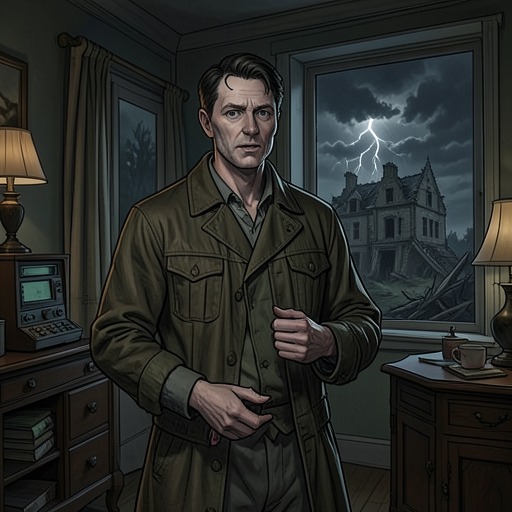
In the days after the entombment, Roderick’s ordinary manner and occupations fall away. The narrator stays with him as his agitation increases, and during a storm tries to steady him by closing a window and reading aloud from The Mad Trist. The scene turns their familiar companionship into a strained act of mutual presence: the narrator reads to occupy Roderick’s attention, while Roderick listens with an intensity that the narrator initially takes as evidence that the distraction is working.
As the narrator reads of a door being broken, a dragon’s cry, and a shield striking a floor, he hears distant sounds that seem to correspond to each episode. He first doubts his own perception and avoids drawing Roderick’s attention to the noises, hoping not to increase his friend’s nervousness. Roderick, however, gradually turns toward the chamber door, trembles, and rocks in his chair. The narrator’s reading has unintentionally supplied a pattern through which the sounds acquire meaning; the shared scene becomes a test of what each man hears and what Roderick has withheld.
Roderick finally tells the narrator that he has heard Madeline moving in the coffin for days but was afraid to speak. He interprets the sounds accompanying the story as the breaking of her coffin, the opening of the vault, and her approach through the house. The narrator is not merely present for a confession: his earlier assistance in the entombment makes the revelation expose the consequence of an action they performed together. Roderick’s appeal for companionship has brought the narrator close enough to receive the truth, but not soon enough to prevent the disaster.
Ending and Significance
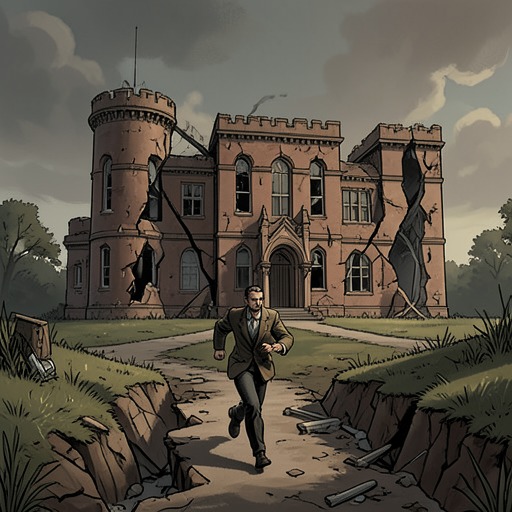
Madeline appears at the chamber door and falls upon her brother; both die. The narrator escapes from the mansion and, from the old causeway, watches a fissure widen until the House of Usher breaks apart and sinks into the tarn. His friendship with Roderick ends not in reconciliation or rescue, but in flight from the scene that the narrator has been drawn into by loyalty.
The relationship gives the tale a human frame for its movement from isolation to catastrophe. The narrator answers Roderick’s plea, offers sustained company, helps with the entombment, and tries to calm him through the storm; each act brings him nearer to Roderick’s crisis without giving him mastery over it. Their old intimacy is real, but its limits are equally consequential: the narrator knows too little of Roderick to recognize the full danger, and Roderick’s fear keeps the truth unspoken until the sounds of the final night force it into the open.