The perceptiveness of the House of Usher
The Fall of the House of UsherThe perceptiveness of the House of Usher is Roderick Usher’s conviction that the ancestral mansion has become more than an inert building: its stones, surroundings, and long endurance seem to exert an influence on the family’s lives. The narrative gives this theory a material setting and an unnerving acoustic pattern, but does not establish that the house literally possesses consciousness. Its force lies in the unresolved boundary between environment, inherited fear, and the sounds its inhabitants interpret.
Roderick’s Theory and Its Setting
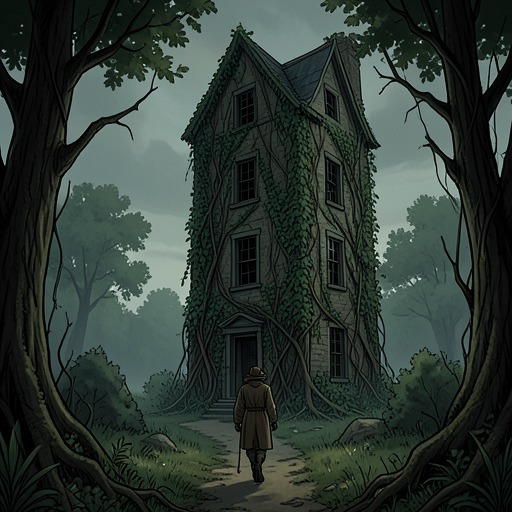
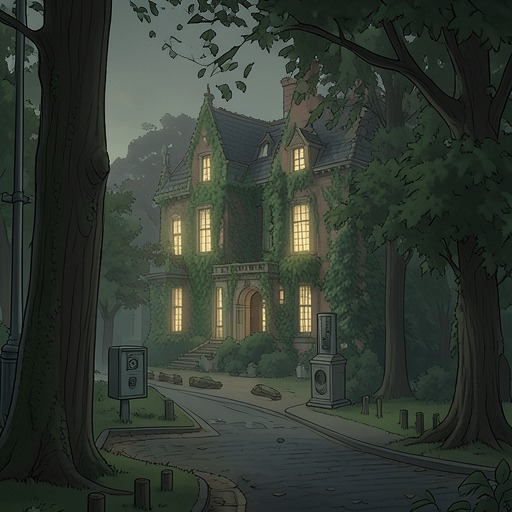
Roderick’s idea grows from a broader belief in the sentience of living things, which he extends, under particular conditions, to what is ordinarily considered inanimate. He imagines those conditions fulfilled at the mansion: in the arrangement of its gray stones, in the fungi spread over them, in the decayed trees around it, and in the long persistence of this arrangement. The still waters of the tarn reproduce the scene, making the house and its surroundings appear to form a closed, enduring system.
In Roderick’s account, this system gathers an atmosphere of its own around the walls and water. That atmosphere, he believes, has exerted a silent but persistent influence over the Usher family’s destiny and has helped make him what he is. The narrator reports the conviction as an expression of Roderick’s disordered imagination rather than as a verified fact; nevertheless, the physical details give the theory a distinctive structure, joining architecture, vegetation, water, and time.
The Family and the Mansion
The theory is bound to the history of the Ushers. Their ancient family had no enduring collateral branch, so its name and estate passed along a narrow line of descent. The narrator observes that this continuity had helped merge the family’s identity with that of its home: the name House of Usher could refer to both the people and the mansion. In Roderick’s theory, the building’s influence is therefore not merely a matter of an oppressive place affecting a visitor. It reaches across generations and becomes entangled with the family’s inherited identity.
Roderick tells the narrator that the dwelling’s form and substance have affected his spirit. For years, he has not ventured beyond it, and he treats the gray walls, turrets, and tarn as sources of a force that bears on his condition. His account coincides with an acute sensitivity to ordinary sensations: food, certain fabrics, flower odors, and even faint light distress him, while only particular sounds from stringed instruments do not inspire horror. He describes his nervous disorder as both constitutional and familial, but also fears that an incident, however trivial, may intensify his agitation. The tale thus places his theory of the house beside bodily vulnerability without resolving whether one causes the other.
Sound, Reading, and Apparent Response
The idea of the mansion’s perceptiveness becomes especially charged through sound. After the narrator and Roderick discuss a ballad, Roderick presents the house’s atmosphere as evidence of a force that has shaped the family. Later, on a stormy night, the narrator reads from The Mad Trist in an attempt to occupy and calm his companion. As the embedded tale describes a door being forced open, the narrator hears a distant sound resembling the described cracking and tearing. When the reading reaches a harsh cry, another distant sound seems to match it; when it describes a shield falling, a muffled metallic reverberation follows.
The sequence turns the narrator’s reading into an apparent pattern of call and response between words and the mansion. At first, he treats the sounds as coincidences and considers ordinary explanations for the storm and the disturbed atmosphere. Roderick, however, has become increasingly agitated, faces the chamber door, and appears to listen. He then says that he has heard sounds from the vault for days and confesses that Madeline Usher was buried alive. The apparent echoes of the fictional door, cry, and falling shield correspond in his account to the breaking of her coffin, the opening of the vault, and her struggle to escape. The sounds therefore acquire a concrete source within the plot, even as their uncanny timing sustains the possibility that the mansion and its inhabitants have become inseparable in perception.
Limits and Consequences
The burial circumstances sharpen the uncertainty. Madeline Usher had suffered a baffling illness that included transient cataleptic episodes. Roderick told the narrator she was dead and arranged to keep her body temporarily in a vault within the mansion, citing the unusual illness, the physicians’ inquiries, and the exposed location of the family burial ground. The narrator assisted with the entombment; only afterward did he notice the twins’ resemblance and learn that a close, difficult-to-explain sympathy had linked them. These circumstances provide a human cause for the later sounds and for Roderick’s terror, without confirming his larger belief about the mansion’s agency.
Madeline Usher eventually appears at the chamber door and falls upon Roderick, who dies in terror. The narrator flees, and the fissure running from the mansion’s roof to its base widens until the building breaks apart and sinks into the tarn. This ending gives the house’s relation to the family an irreversible material form: when the Usher twins die, the mansion that seemed to embody their shared history is destroyed as well. The collapse does not prove that the house was sentient, but it completes the tale’s pattern of mutual implication. The mansion may be understood as an active presence in Roderick’s imagination, as a structure whose sounds and confinement intensify his fear, or as the Gothic form through which the family’s decline becomes visible and audible.