The tarn beside the Usher house
The Fall of the House of UsherThe tarn beside the Usher house is more than a feature of the estate’s landscape: it turns the mansion into a doubled image, gathers the fears that the narrator and Roderick Usher associate with the place, and finally receives the fragments of the collapsing House of Usher. Its still water first offers a distorted reflection of the house; at the end, it becomes the silent cover over the ruined dwelling. Between those moments, the tarn helps bind setting, perception, and family fate into a single enclosing scene.
Setting and First Impressions
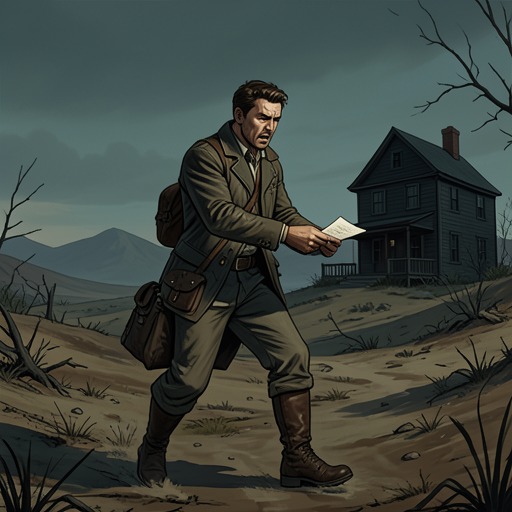
The narrator sees the tarn as evening approaches, after travelling alone through a dreary countryside during a dull autumn day. It lies beside the House of Usher, at the foot of a precipitous bank, its surface unruffled. The mansion’s vacant, eye-like windows, grey walls, rank sedges, and decayed trees already produce an overwhelming gloom. The tarn belongs to this arrangement of ordinary landscape features, but its presence gives the narrator a way to test whether the arrangement itself is responsible for his distress.
He turns his horse toward the water and looks down, expecting that a different arrangement of the scene might weaken its effect. Instead, the reflection intensifies it. In the tarn, the grey sedges, pale trunks, and empty windows appear inverted, and the altered view brings a stronger shudder rather than relief. The surface does not disclose a new cause for his unease; it repeats the same elements in a form that makes the familiar setting feel uncanny.
Reflection, Atmosphere, and Interpretation
After looking into the tarn, the narrator imagines that a peculiar atmosphere hangs over the mansion and its immediate grounds. He pictures it as a sluggish, faintly visible vapour rising from the decayed trees, grey wall, and silent water. He recognizes this impression as a product of his imagination rather than an established physical fact. Even so, the fantasy gives language to the sense that the estate’s features act together, as though the place were enclosed within its own oppressive conditions.
Roderick Usher later gives the relationship between the tarn and the mansion a more elaborate explanation. He believes that the arrangement of the grey stones, the fungi covering them, the decayed trees, and the long persistence of these surroundings have fulfilled conditions under which the inanimate place might possess sentience. The tarn matters especially because the arrangement of walls and trees is repeated in its still water. Roderick takes the atmosphere he believes has condensed around the house and tarn as evidence of an influence that has shaped the family’s destiny and his own condition. This is his conviction, not a confirmed explanation of the setting’s power.
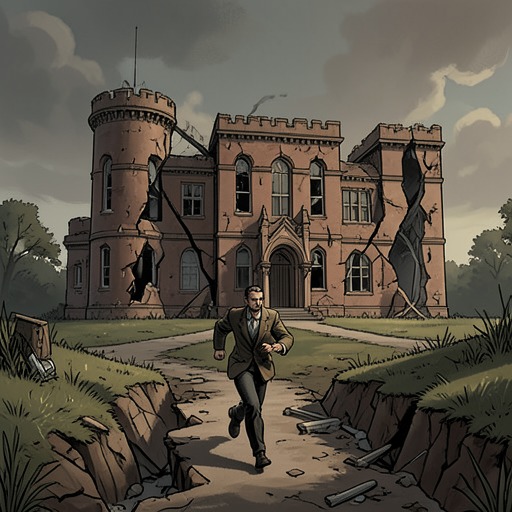
The narrator’s account also connects the estate’s physical structure to the tarn without establishing that the water causes the building’s decay. He notices that the masonry remains assembled even as individual stones crumble, and that a barely perceptible fissure runs in a zigzag from the roof down the wall until it disappears into the tarn. The water thus marks the visible endpoint of a fracture already present in the mansion: a boundary where the narrator can no longer follow the damage by sight.
The Tarn and the House’s Final Night
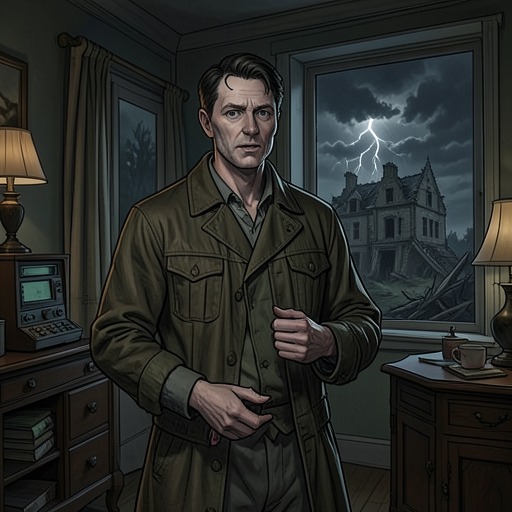
During the final night, the tarn remains part of the threatening setting against which the narrator tries to explain what he sees and hears. As the storm intensifies, he attempts to calm Roderick by suggesting that the strange appearances might be electrical phenomena or might have a natural origin in the tarn’s rank miasma. This is the narrator’s effort to find a rational explanation, not proof that the water produces the events. The sounds that accompany his reading of The Mad Trist eventually lead Roderick to confess that Madeline Usher, whom he believed dead, had been placed alive in the family vault and that he had heard her movements for days.
The confession makes the mansion and its surroundings part of an immediate crisis rather than a distant object of speculation. Madeline returns to the chamber after escaping the vault, and the twins die there. The narrator flees the house and crosses the old causeway in the continuing storm. From beyond the mansion, he sees the blood-red moon through the fissure that had earlier been barely perceptible. The crack widens rapidly from the roof toward the base, turning the earlier detail of the fissure into the visible course of the house’s destruction.
Collapse and Significance
As the narrator watches, the walls rush apart and the House of Usher splits. The deep tarn closes silently over its fragments. The ending completes the visual pattern established at the beginning: first the water holds an inverted image of the standing mansion; finally, it covers the material remains of the actual one. The surface that once duplicated the house now conceals its collapse.
The tarn’s role is therefore both spatial and structural. It anchors the estate’s most memorable image, provides the reflecting surface through which the narrator’s first fear deepens, and forms the endpoint of the fissure that later opens into the mansion’s destruction. Roderick’s theory makes the water part of his account of an inanimate environment exerting influence over the House of Usher, while the narrative leaves that supernatural interpretation unresolved. What the ending establishes plainly is the tarn’s physical relation to the ruin: after the house and the last of the twins are lost, its waters close over the fragments, bringing the estate’s history to a dark and final conclusion.