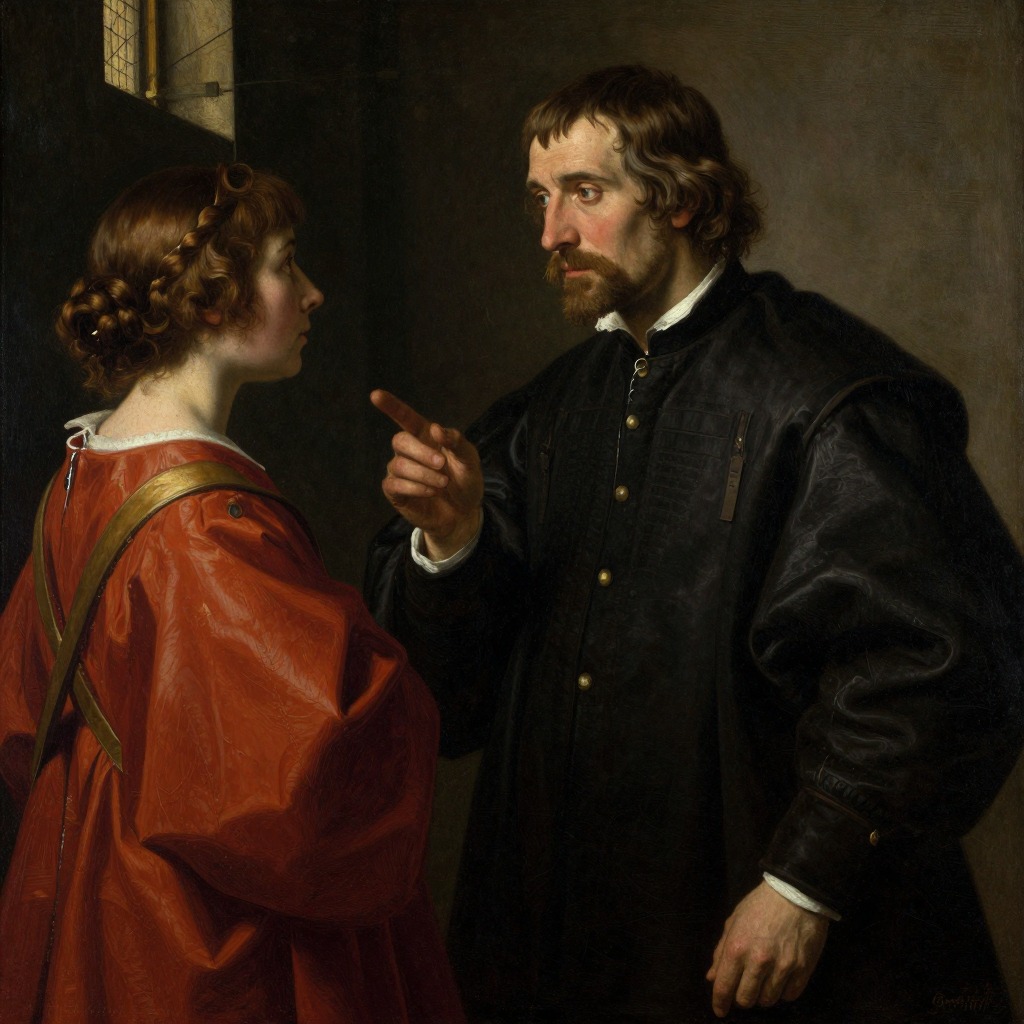
Harboring of The Just Judges
The FallThe Harboring of The Just Judges is the act by which Jean-Baptiste Clamence, the self-styled judge-penitent, comes into possession of the stolen van Eyck panel and keeps it hidden in his Amsterdam room, transforming a famous art theft into a personal emblem of his dominion over judgment and innocence.
Acquisition and the Painting's Provenance
The panel, one of the wings of the van Eyck altarpiece "The Adoration of the Lamb" in St. Bavon Cathedral in Ghent, was stolen in 1934 and never recovered. An excellent copy replaced it in the cathedral. The original found its way to the Mexico City bar in Amsterdam, where a frequenter of the establishment—a man Clamence's interlocutor had glimpsed the other evening—sold it to the ape-like proprietor for a bottle of gin during a drunken evening. Clamence first advised the proprietor to hang the painting in a place of honor, and for a long time, while police searched for it throughout the world, the devout judges on horseback sat enthroned at Mexico City above the drunks and pimps. Later, at Clamence's request, the proprietor put the panel in custody in Clamence's room. The proprietor balked a little at doing so, but got a fright when Clamence explained the matter to him. Above the bar at Mexico City, the empty rectangle where the painting had hung remained as a void.
Reasons for Keeping the Panel
Clamence offers a cascade of justifications for not returning the panel. First, it belongs not to him but to the proprietor of Mexico City, who deserves it as much as the Archbishop of Ghent. Second, among all those who file by "The Adoration of the Lamb" in the cathedral, no one can distinguish the copy from the original, so no one is wronged by his misconduct. Third, by keeping the true judges hidden while false judges are held up to the world's admiration, he alone knows the truth and thus dominates. Fourth, harboring the painting gives him a chance of being sent to prison—an attractive idea in a way. Fifth, those judges on horseback are on their way to meet the Lamb, but there is no more lamb or innocence, and the clever rascal who stole the panel was an instrument of the unknown justice that one ought not to thwart. Finally, everything is in harmony: justice being definitively separated from innocence—the latter on the cross and the former in the cupboard—he has the way clear to work according to his convictions. With a clear conscience he can practice the difficult profession of judge-penitent.
The Painting as a Symbol of Clamence's Philosophy
The harboring of "The Just Judges" is the material anchor of Clamence's entire system. The panel depicts judges on horseback coming to adore the sacred animal, but for Clamence the lamb—innocence—no longer exists. By keeping the true judges locked in his cupboard while the world venerates a copy, he enacts the separation of justice from innocence that he believes defines the human condition. The painting becomes his private throne: false judges are held up to the world's admiration and he alone knows the true ones, and in this way he dominates. The theft itself, committed by a rascal who was an instrument of unknown justice, aligns with Clamence's conviction that every man testifies to the crime of all the others and that the keenest of human torments is to be judged without a law. The painting in his cupboard is the physical proof that justice, once separated from innocence, can be possessed and controlled by a single man.
Connection to Clamence's Past and His Profession
The act of harboring the stolen panel is continuous with Clamence's earlier life as a lawyer who aimed to dominate in all things. His profession had set him above the judge whom he judged in turn, and he had lived with impunity, concerned in no judgment. The harboring of the painting extends this logic: he now possesses the true judges and can judge everybody. The panel also connects to his discovery of sweet dreams of oppression and his desire to be the stronger in the most elementary way. In his practice as judge-penitent at Mexico City, he lies in wait particularly for the straying bourgeois, and the painting—hidden in his room, shown to whoever wants to see it—is part of the apparatus by which he constructs a portrait that is the image of all and of no one, a mask that becomes a mirror for his interlocutors. He hopes that his listener, a Parisian lawyer, will arrest him for the theft, which would be a good beginning; he would be decapitated, saved, and above the gathered crowd his still warm head would be held up so that they could recognize themselves in it and he could again dominate—an exemplar.
The Painting and the Landscape of Judgment
The harboring of "The Just Judges" takes place in Amsterdam, a city whose concentric canals Clamence compares to the circles of hell—the middle-class hell, peopled with bad dreams. He lives on the site of one of the greatest crimes in history, the deportation and assassination of seventy-five thousand Jews, and this helps him understand the ape's distrust. The painting, hidden in his room, is the secret center of this landscape of judgment. The doves that fill the sky of Holland, invisible because of their altitude, wheel above the earth and look down, but there is never a head on which to light. Clamence, sitting enthroned among his bad angels at the summit of the Dutch heaven, watches the multitude of the Last Judgment ascend toward him from the fogs and the water. The stolen panel, with its judges on horseback, is the material emblem of this inverted Last Judgment that takes place every day, where Clamence pities without absolving, understands without forgiving, and feels at last that he is being adored.