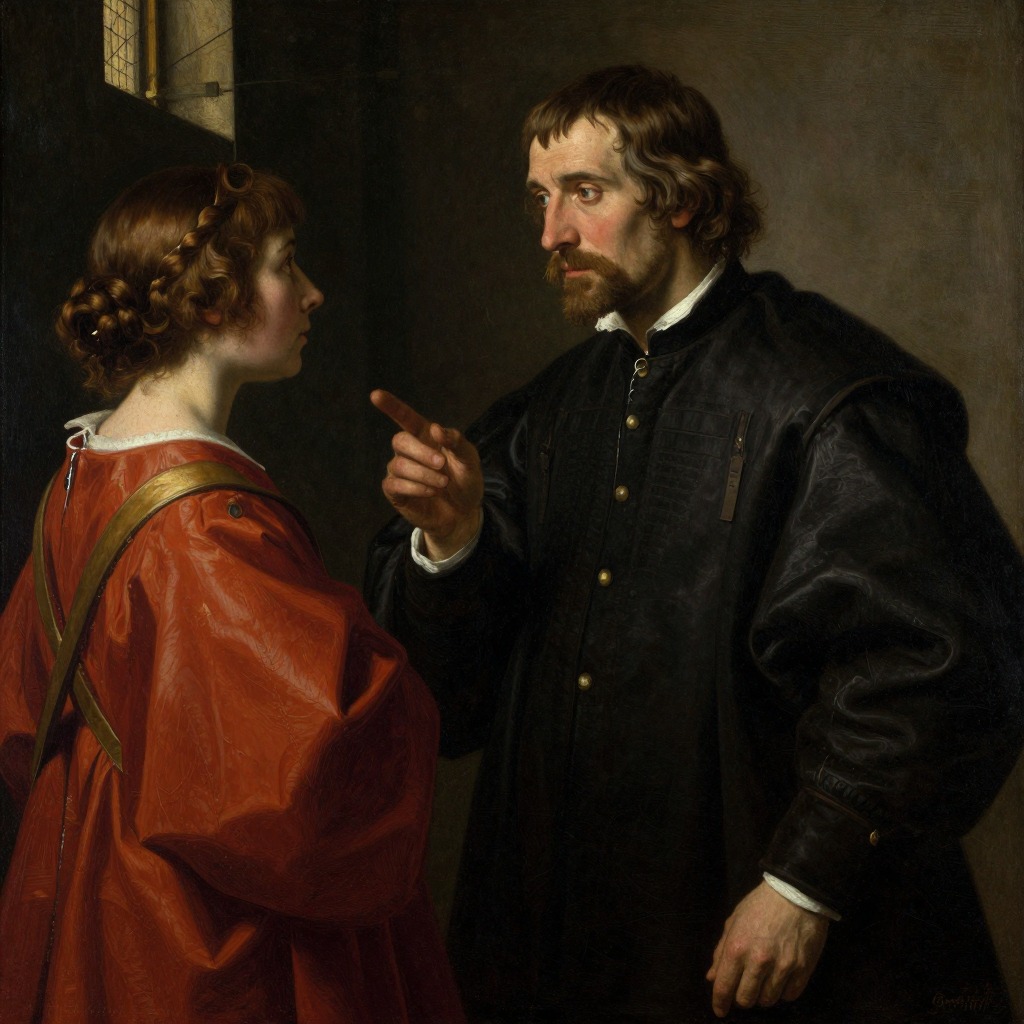
The Just Judges
The FallThe Just Judges is a stolen panel from the van Eyck altarpiece The Adoration of the Lamb, which Jean-Baptiste Clamence keeps hidden in his Amsterdam room and uses as a central prop in his self-appointed role as judge-penitent, symbolizing the separation of justice from innocence and his own claim to dominate through hidden knowledge.
Theft and Provenance
The panel was stolen in 1934 from the St. Bavon Cathedral in Ghent, where it formed part of the famous van Eyck altarpiece. It represented judges on horseback coming to adore the sacred animal. The original was never found and was replaced by an excellent copy. The panel came into Clamence's possession through a frequenter of Mexico City, the Amsterdam bar where Clamence holds court. That man sold it to the bar's proprietor, the ape-like Dutchman, for a bottle during a drunken evening. Clamence first advised the proprietor to hang it in a place of honor, and for a long time, while the panel was being searched for throughout the world, the devout judges sat enthroned at Mexico City above the drunks and pimps. Later, at Clamence's request, the proprietor put it in custody in Clamence's room. The proprietor balked a little at doing so, but got a fright when Clamence explained the matter to him. At Mexico City, above the bar, the empty rectangle where the painting had hung remains as a void.
Reasons for Concealment
Clamence offers a series of reasons for not returning the panel. First, it belongs not to him but to the proprietor of Mexico City, who deserves it as much as the Archbishop of Ghent. Second, among all those who file by The Adoration of the Lamb, no one could distinguish the copy from the original, so no one is wronged by his misconduct. Third, by keeping it, he dominates: false judges are held up to the world's admiration while he alone knows the true ones. Fourth, he thus has a chance of being sent to prison, an attractive idea in a way. Fifth, those judges are on their way to meet the Lamb, but there is no more lamb or innocence, and the clever rascal who stole the panel was an instrument of the unknown justice that one ought not to thwart. Finally, everything is in harmony: justice being definitively separated from innocence—the latter on the cross and the former in the cupboard—he has the way clear to work according to his convictions. With a clear conscience he can practice the difficult profession of judge-penitent.
Symbolic Function and the Hope of Arrest
The panel serves as the material emblem of Clamence's entire philosophical and psychological project. He keeps the true judges hidden while the world venerates a copy, just as he himself operates through a mask that is the image of all and of no one. The separation of justice from innocence—the judges in the cupboard, innocence on the cross—mirrors his own conviction that every man is guilty and that the only way to escape judgment is to extend condemnation to all. Clamence also harbors the hope that his interlocutor will be a policeman and will arrest him for the theft. He has arranged everything so as to make himself an accomplice: he is harboring the painting and showing it to whoever wants to see it. Arrest would be a good beginning; perhaps the rest would be taken care of subsequently. He imagines being decapitated, having no more fear of death, being saved. Above the gathered crowd, they would hold up his still warm head so that they could recognize themselves in it and he could again dominate—an exemplar. He would have brought to a close, unseen and unknown, his career as a false prophet crying in the wilderness and refusing to come forth. But his interlocutor is not a policeman; that would be too easy. The panel remains in the cupboard, and Clamence continues his practice.