The Theft of 'The Just Judges'
The FallThe Theft of 'The Just Judges' is a pivotal event in Jean-Baptiste Clamence's narrative, where a stolen panel from the van Eyck altarpiece, 'The Adoration of the Lamb,' ends up in his possession, serving as a symbol of his usurped authority and his role as a judge-penitent who dominates through hidden knowledge.
The Theft and Its Journey to Mexico City
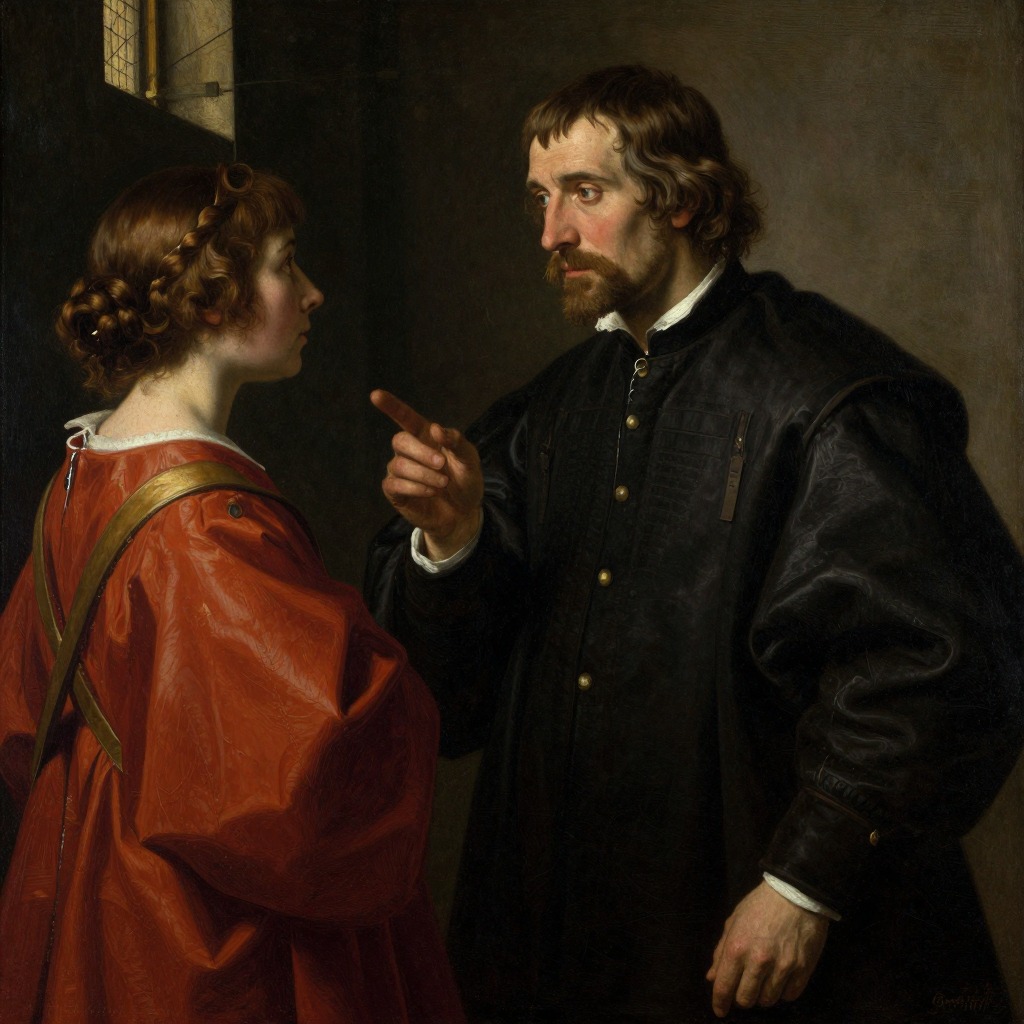
The panel known as 'The Just Judges,' part of the van Eyck altarpiece in St. Bavon Cathedral in Ghent, was stolen in 1934. The original was never recovered, and an excellent copy replaced it in the cathedral. The panel eventually found its way to Amsterdam, where a frequenter of the Mexico City bar—a man Clamence describes as a specialist in the art trade—sold it to the ape-like proprietor for a bottle of gin during a drunken evening. Clamence, who was present, first advised the proprietor to hang the painting in a place of honor at Mexico City. For a long time, while authorities searched for the panel worldwide, the devout judges on horseback, depicted riding to adore the sacred animal, sat enthroned above the drunks and pimps in the bar.
Clamence's Acquisition and Justifications
Later, at Clamence's request, the proprietor put the painting in custody in Clamence's room. The proprietor balked at first, but Clamence explained the matter to him, frightening him into compliance. Above the bar at Mexico City, the empty rectangle where the painting had hung remained as a void. Clamence offers a series of reasons for not returning the panel, each revealing his complex motives. First, he claims it belongs not to him but to the proprietor, who deserves it as much as the Archbishop of Ghent. Second, he argues that among all those who file by 'The Adoration of the Lamb,' no one can distinguish the copy from the original, so no one is wronged by his misconduct. Third, he states that by keeping the true judges hidden while false judges are held up to the world's admiration, he dominates. Fourth, he admits that harboring the painting gives him a chance of being sent to prison, an attractive idea. Fifth, he sees the clever rascal who stole the panel as an instrument of unknown justice that ought not to be thwarted, since there is no more lamb or innocence. Finally, he concludes that this way everything is in harmony: justice being definitively separated from innocence—the latter on the cross and the former in the cupboard—he has the way clear to work according to his convictions.
The Symbolic and Narrative Significance
The painting becomes Clamence's sole company, and he keeps it locked in a cupboard in his bare room. He asks his listener to open the cupboard and look at it, revealing that the estimable magistrates form his only company. The theft and its concealment are central to Clamence's self-appointed role as a judge-penitent. He uses the hidden knowledge of the true judges to dominate, feeling that he alone knows the truth while the world admires a forgery. The event also ties into his desire for judgment and punishment; he hopes his interlocutor might be a policeman who will arrest him for the theft, which would be a good beginning, perhaps leading to his decapitation and salvation. The theft of 'The Just Judges' is thus not merely a crime but a deliberate act of usurpation, allowing Clamence to sit enthroned among his bad angels at the summit of the Dutch heaven, watching the multitude of the Last Judgment ascend toward him.