The cry of the drowning woman
The FallThe cry of the drowning woman is the silent, unending accusation at the heart of Jean-Baptiste Clamence's confession, the single moment that undoes his entire edifice of self-regard and sets him on the path to becoming a judge-penitent. It is not merely a memory but a wound that refuses to heal, a sound that follows him from the Seine to the canals of Amsterdam, from the decks of ocean liners to the fog-bound shores of the Zuider Zee. More than any other event, this cry reveals the abyss between the man Clamence believed himself to be and the man he actually was, and it becomes the obsessive center around which his entire narrative of guilt and judgment revolves.
The Night on the Pont Royal
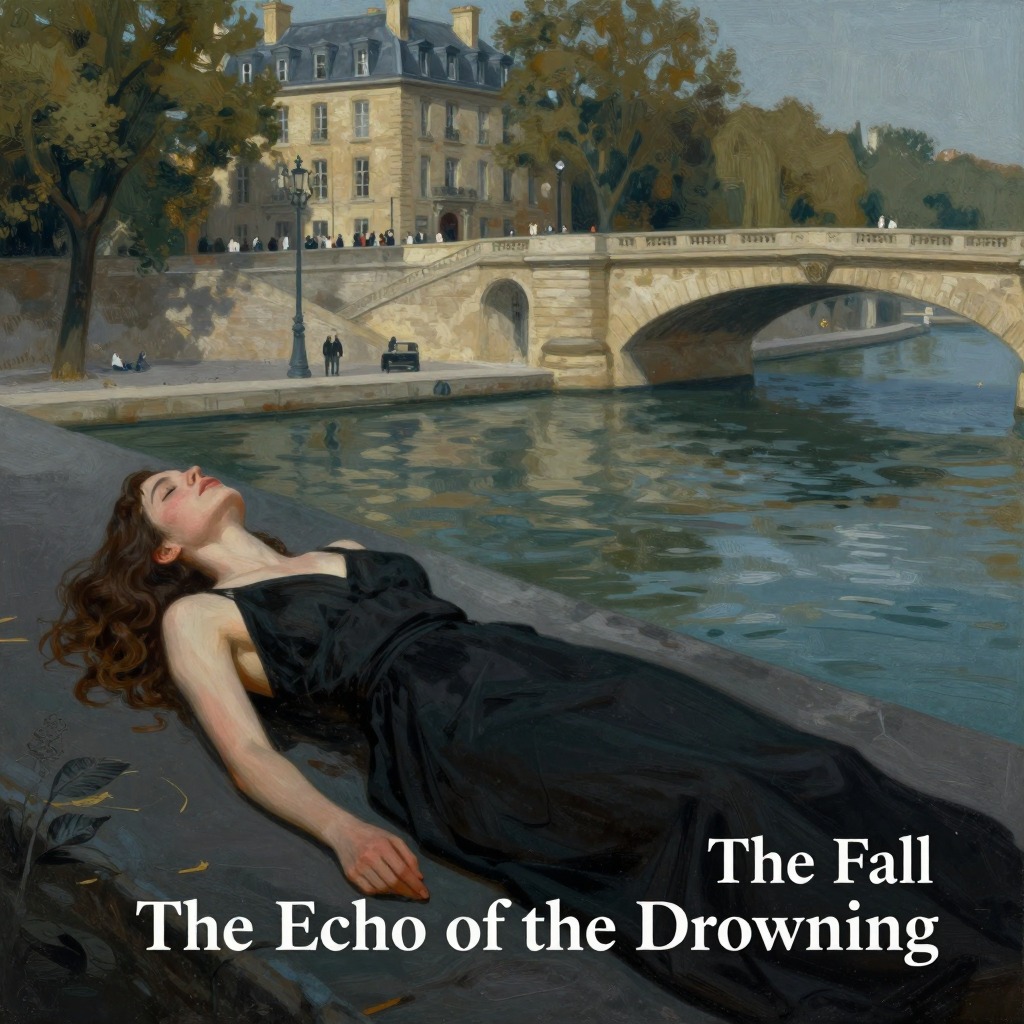
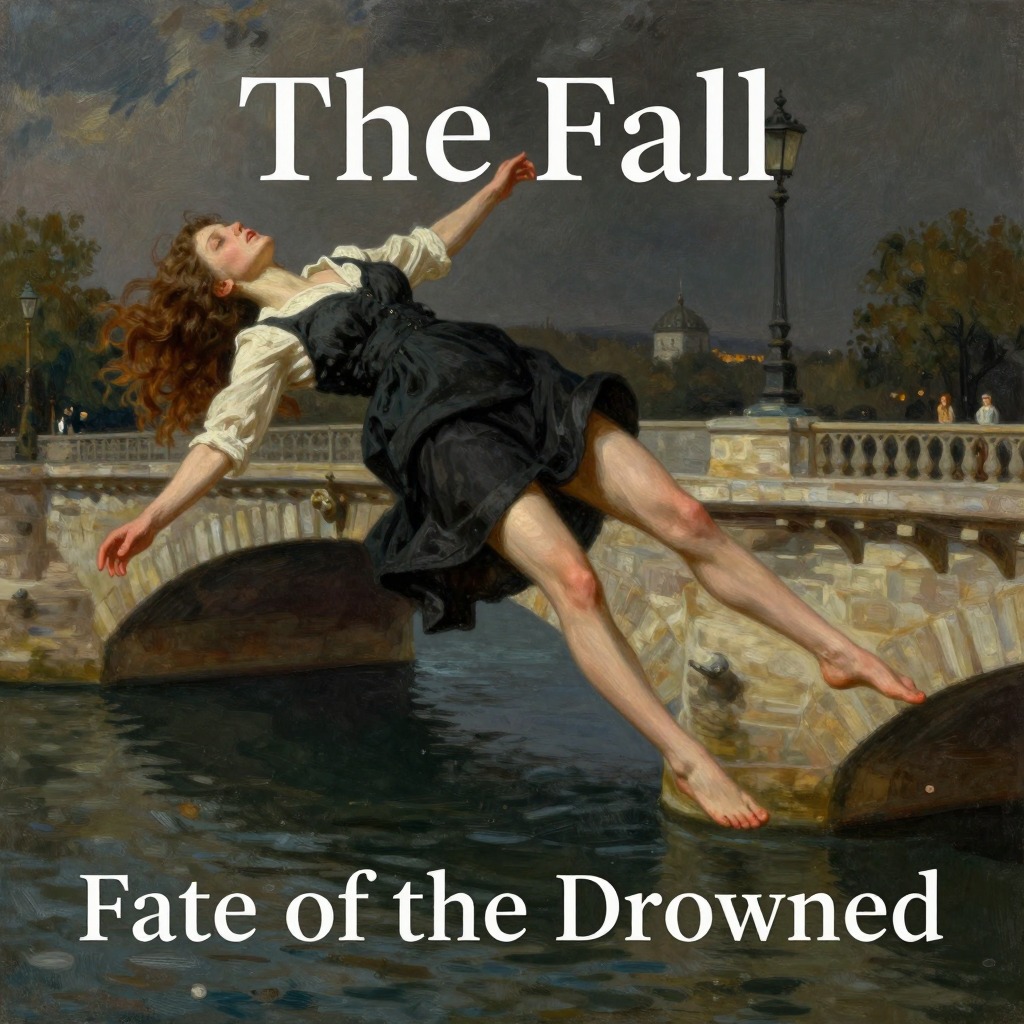
The event itself is stark and brief. Two or three years before the evening on the Pont des Arts when he first heard the mysterious laugh, Clamence was returning home to the Left Bank across the Pont Royal, a little past midnight, under a fine drizzle. He had just left a mistress and was enjoying a walk, his body "calmed and irrigated by a flow of blood gentle as the falling rain." On the bridge he passed a slim young woman dressed in black, leaning over the railing and staring at the river. The back of her neck, "cool and damp between her dark hair and coat collar," stirred him, but after a moment's hesitation he continued on. He had gone some fifty yards when he heard the sound of a body striking the water, "dreadfully loud in the midnight silence." Almost at once he heard a cry, repeated several times, going downstream, then suddenly ceasing. Clamence stopped short but did not turn around. He stood motionless, trembling from cold and shock, telling himself he had to be quick yet feeling an "irresistible weakness" steal over him. He thought, "Too late, too far ..." or something of the sort. Then, slowly, under the rain, he went away. He informed no one. The next day and the days following, he did not read the papers.
The Return of the Repressed
For a time, Clamence managed to bury the memory. But the cry did not stay buried. It resurfaced first as the inexplicable laugh he heard on the Pont des Arts, a laugh that seemed to come from nowhere and that left him dazed and breathless. After that evening, he ceased to walk along the Paris quays; when he rode along them in a car or bus, a "sort of silence" would descend on him, and he would wait, though nothing would happen. The cry then began to echo in his dreams of domination. He had always loved to help blind people cross streets, rushing forward to snatch them from any solicitude but his own, leading them gently but firmly, and separating with mutual emotion. But after the fall, he recognized that he had been "spitting daily in the face of all the blind." The same impulse that made him a defender of widows and orphans also made him a man who could walk past a drowning woman. The cry became the measure of his hypocrisy.
The Inescapable Sound
The cry pursued Clamence across the globe. Years later, aboard an ocean liner, he perceived a black speck on the steel-gray ocean and turned away at once, his heart beating wildly. He realized then that the cry which had sounded over the Seine behind him had never ceased; it had been carried by the river to the waters of the Channel, across the limitless expanse of the ocean, and had waited for him there until the day he encountered it. He understood that it would continue to await him on seas and rivers everywhere, wherever lies "the bitter water of my baptism." Even in Amsterdam, surrounded by canals and fog, he could not escape. The cry became the foundation of his new identity. He had to submit and admit his guilt, to live in the "little-ease," a cell not high enough to stand in nor wide enough to lie down in, where innocence consists in stretching joyously. The cry taught him that every man is guilty, that the judgment of men is worse than any Last Judgment, and that the only way to bear it is to accuse oneself in order to accuse everyone else.
The Unanswered Question
At the very end of his confession, Clamence turns to his listener—a Parisian lawyer—and asks him to utter the words that have never ceased echoing through his nights: "O young woman, throw yourself into the water again so that I may a second time have the chance of saving both of us!" But he immediately recoils, recognizing the risk: "Just suppose, cher maître, that we should be taken literally? We'd have to go through with it. Brr ...! The water's so cold! But let's not worry! It's too late now. It will always be too late. Fortunately!" The cry thus remains unanswered, a permanent reproach that Clamence can neither silence nor answer, and which he transforms into the engine of his endless, self-serving confession.