The water of a dying comrade
The FallThe water of a dying comrade is the central, shameful memory that Jean-Baptiste Clamence unearths in the course of his long confession, the act that finally closes the circle of his self-knowledge and confirms his conviction that every man is guilty. It is the moment that transforms his abstract theories about human depravity into an irrevocable personal experience, the point at which his pontificate in the prison camp—his election as a kind of pope among the prisoners—reaches its moral terminus. Clamence does not present this as a single, dramatic transgression but as the logical outcome of a system of small concessions and distinctions he had already begun to make, a system that revealed the true nature of his authority and his soul.
The Context of the Pontificate
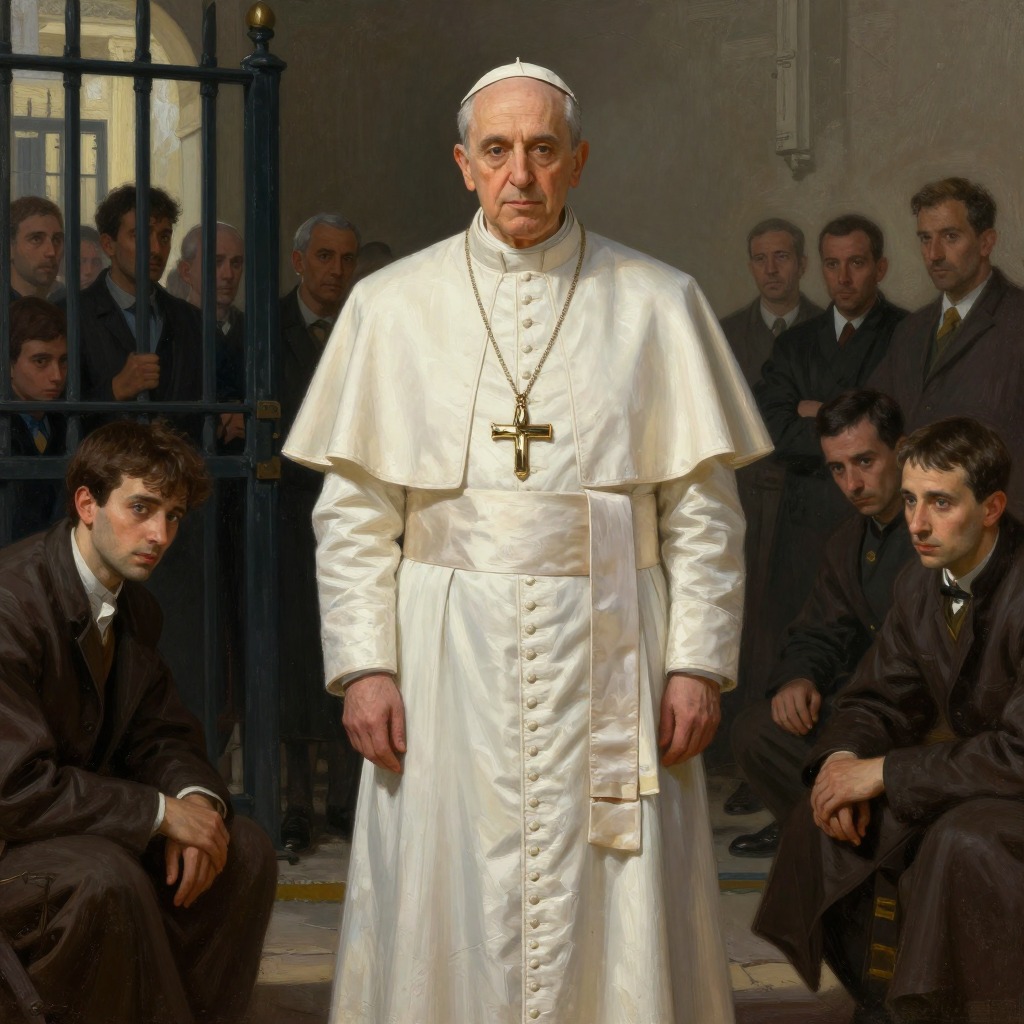
Clamence's election as pope occurred in a prison camp near Tripoli during World War II, where he was interned after being arrested in Tunisia. The camp was a place of extreme deprivation: heat, vertical sun, flies, sand, and above all, a desperate lack of water. The election was proposed by a young French prisoner Clamence calls Du Guesclin, a man of faith who had become melancholic and unhinged by his experiences. Du Guesclin declared the need for a new pope who would live among the wretched, and he asked which of the prisoners had the most failings. Clamence, as a joke, raised his hand and was the only one to do so. The others agreed, half in fun but with a trace of seriousness, and Clamence exercised his pontificate for several weeks with increasing seriousness. He became something like a group leader, and even those who lacked faith got into the habit of obeying him. The big problem in the camp was the water allotment, and Clamence was led to favor his own comrades, making small concessions and giving advantages to some over others according to their condition or the work they had to do. He discovered that it was not as easy as he had thought to be a pope, and that such distinctions are far-reaching.
The Act Itself
The decisive moment came when Clamence drank the water of a dying comrade. He specifies that the dying man was not Du Guesclin, who had already died, having stinted himself too much. Clamence admits that had Du Guesclin been there, out of love for him he might have resisted longer, for he loved him, or so it seems to him. But he drank the water, that is certain, while convincing himself that the others needed him more than this fellow who was going to die anyway, and that he had a duty to keep himself alive for them. This self-justification is the very mechanism of guilt that Clamence later generalizes into a universal principle: empires and churches are born under the sun of death. The act is not presented as a moment of weakness but as a calculated, if desperate, choice that reveals the priority of the self over any other, even in the face of death.
The Revelation of Universal Guilt
The drinking of the water becomes for Clamence the definitive proof of his own guilt and, by extension, the guilt of all. It is the experience that allows him to state with certainty that every man testifies to the crime of all the others. This act is the foundation of his later profession as a judge-penitent, for it gives him the authority to accuse himself and, through that accusation, to judge others. He realizes that the essential thing is to extend condemnation to all, without distinction, in order to thin it out at the start. The water of a dying comrade is not merely a personal failing; it is the archetypal sin of the survivor, the crime of continuing to live while others die. It is the same logic he later applies to Christ, whom he imagines haunted by the Slaughter of the Innocents, knowing that crime consists less in making others die than in not dying oneself. Clamence's act is the empirical proof of this principle, the bitter water of his own baptism.
The Narrative and Thematic Significance
In the structure of Clamence's confession, the water of a dying comrade is the climax of his exploration of his own duplicity. It follows his accounts of the laugh on the Pont des Arts, the motorcycle confrontation, and the suicide of the young woman on the Pont Royal, each of which chipped away at his self-image. But this act is the one he cannot forget, the memory that awaited him at the heart of his exploration. It is the event that forces him to abandon his life in Paris and to seek a new existence as a judge-penitent in Amsterdam. Thematically, it embodies the novel's central argument about the impossibility of innocence and the universal complicity in evil. Clamence's pontificate, which began as a joke and ended with him drinking a dying man's water, is a microcosm of all human authority, which is always built on the sacrifice of others. The water of a dying comrade is the bitter truth that Clamence carries with him, the proof that he is not a hero but a man who, like everyone else, will choose himself over another when the moment comes.