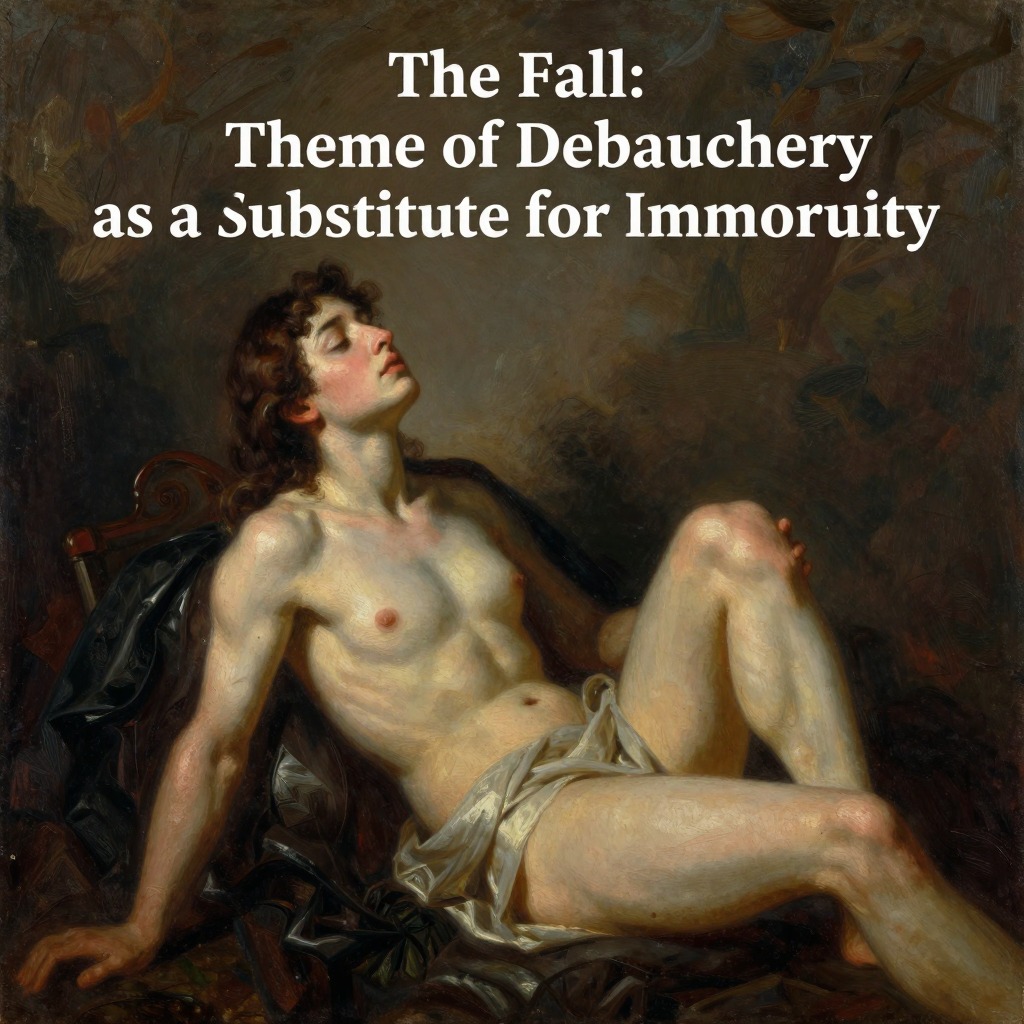
fever
The FallFever is a persistent, ambivalent condition that pervades Jean-Baptiste Clamence's monologue in The Fall, functioning as a physical manifestation of his spiritual and moral crisis. It is not merely a medical ailment but a state that intertwines with his memories of guilt, his retreat from the world, and his eventual embrace of the judge-penitent role. The fever appears at key moments, often coinciding with his most intense self-revelations or his attempts to dominate his listener, and it becomes a tool for both self-indulgence and self-justification.
Origins and Physical Manifestations
Clamence attributes his fever to a bout of malaria contracted during his time as a self-styled "pope" in a prison camp in North Africa, where he was interned near Tripoli during World War II. He mentions this explicitly when his listener visits him in bed: "It's nothing, just a little fever that I'm treating with gin. I'm accustomed to these attacks. Malaria, I think, that I caught at the time I was pope." The fever thus has a concrete origin in the extreme conditions of the camp—the heat, the vertical sun, the flies, the sand, and the lack of water—but it also becomes a chronic, recurring condition that he manages with alcohol. The fever is accompanied by a profound fatigue that gnaws at his body, a fatigue he describes as having "cauterized many raw spots in me" after his period of debauchery. This physical debilitation contrasts sharply with his earlier life, when he was a man of "perfect health," "generously gifted," and "skilled in bodily exercises as in those of the mind." The fever marks the irreversible decline of that former vitality.
Fever as a Catalyst for Confession and Self-Justification
Clamence uses his fever strategically within his narrative, both as a pretext for his rambling confessions and as a symbol of his moral state. When his listener arrives at his Amsterdam room, he is in bed with a fever, which he treats with gin, and he immediately launches into a defense of his lies: "But what do I care? Don't lies eventually lead to the truth? And don't all my stories, true or false, tend toward the same conclusion?" The fever thus becomes an alibi for his self-indulgent monologue, allowing him to claim physical weakness while simultaneously asserting his intellectual and moral authority. Later, as he describes his judge-penitent technique, he admits that the fever is rising again, and he yields to it: "Since finding my solution, I yield to everything, to women, to pride, to boredom, to resentment, and even to the fever that I feel delightfully rising at this moment." The fever is not something he fights; it is something he embraces as part of his new identity, a physical counterpart to his spiritual surrender.
Fever and the Collapse of the Former Self
The onset of fever coincides with the broader collapse of Clamence's former life of success and harmony. Before the pivotal evening on the Pont des Arts, he had experienced a period of dejection and difficulty in recovering his good spirits, which he describes as a "sort of difficulty in recovering my good spirits." He saw doctors who gave him stimulants, and he felt that he was "half unlearning what I had never learned and yet knew so well—how to live." This vague malaise precedes the more dramatic physical symptoms. Later, after the laugh on the Pont des Arts and the subsequent realization of his guilt, the fever becomes a more concrete and recurring presence. It is part of the "little-ease"—the dungeon cell of the Middle Ages that was neither high enough to stand nor wide enough to lie down—in which he feels condemned to live. The fever, like the little-ease, is a constraint that forces him to live "on the diagonal," unable to stretch out in joy or innocence.
Fever and the Judge-Penitent's Performance
In the final stages of his confession, Clamence's fever becomes a theatrical element in his performance as judge-penitent. He lies in bed, weak and feverish, but insists on continuing his monologue, claiming that "real vocations are carried beyond the place of work. Even in bed, even with a fever, I am functioning." The fever does not incapacitate him; it fuels his self-dramatization. He speaks of the weight of freedom being "too heavy to bear, especially when you're down with a fever, or are distressed, or love nobody." The fever is thus linked to the burden of freedom and the desire to escape it through submission to a master. At the climax of his confession, he rises from bed, declaring, "I must be higher than you, and my thoughts lift me up. Such nights, or such mornings rather (for the fall occurs at dawn), I go out and walk briskly along the canals." The fever, which had kept him in bed, is momentarily overcome by his manic energy, but it remains a constant companion, a reminder of his mortality and his guilt.
Thematic Significance: Fever as a Metaphor for Guilt and Redemption
Fever in The Fall is not merely a physical symptom but a metaphor for the inescapable guilt that Clamence both embraces and exploits. It is a state of being that is neither fully healthy nor fully ill, just as his moral condition is neither innocent nor fully repentant. The fever is treated with gin, a substance that provides temporary relief but also perpetuates the cycle of debauchery and self-loathing. It is a "bitter taste of the mortal state" that follows his nights of debauchery, and it is the physical counterpart to the "cry" of the drowning woman that he hears across the oceans. The fever, like the cry, is a constant presence that he cannot escape, but which he learns to use as a tool for his judge-penitent performance. In the end, the fever is part of the "happiness" he claims to have found—a happiness that is "unto death," a happiness that is inseparable from his physical decay and his moral compromise.