judgment
The FallJudgment pervades Jean-Baptiste Clamence's monologue in The Fall as the inescapable condition of human existence. It is the axis around which his former life of success and his present life of confession both revolve. Clamence's story is not merely a personal history but a treatise on the universal human compulsion to judge and be judged, a compulsion he identifies as the defining torment of the modern era.
The Immunity of the Summit
In his former life as a celebrated Parisian lawyer, Clamence experienced judgment as something he dispensed but never received. His profession, he explains, "set me above the judge whom I judged in turn, above the defendant whom I forced to gratitude." He lived "with impunity," concerned in no judgment, positioned "somewhere in the flies like those gods that are brought down by machinery from time to time to transfigure the action and give it its meaning." This vertical separation—living on heights, dominating from above—was essential to his identity. He felt himself to be a "superman," shielded from any verdict. The satisfaction of being "on the right side of the bar" and an "instinctive scorn for judges in general" fueled his professional life. He could not understand how a man could offer himself to perform the "surprising function" of a judge, accepting the fact only as one accepts locusts. This immunity was the foundation of his happiness, a state he describes as "Eden."
The Fall into the Dock
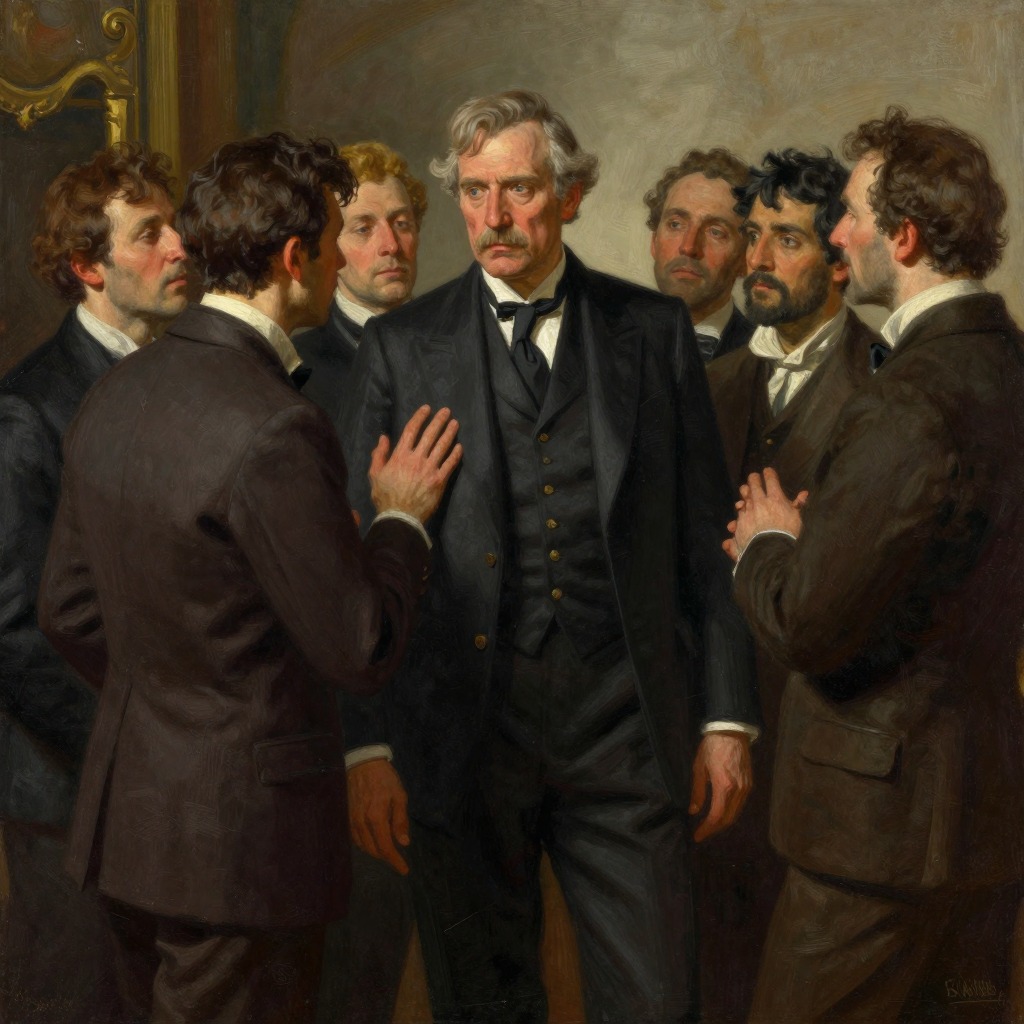
The illusion of immunity shattered when Clamence became aware that he was himself an object of judgment. The pivotal moment was the inexplicable laugh he heard on the Pont des Arts, which he later understood as the sound of universal mockery. From that evening, he felt "vulnerable and open to public accusation." The circle of which he was the center broke, and his fellows "lined up in a row as on the judge's bench." He realized that everyone he encountered was looking at him with a "hidden smile." This discovery was catastrophic: "The whole universe then began to laugh at me." He understood that his success and happiness were unforgivable, and that he was "condemned for past successes." The judgment he had always evaded now rained upon him from all sides. He learned that the keenest of human torments is "to be judged without a law." Deprived of a natural curb, the judges, "loosed at random, are racing through their job."
The Universal Vocation for Judgment
Clamence generalizes his personal experience into a universal law: the irresistible human vocation for judgment. He observes that "the idea that comes most naturally to man, as if from his very nature, is the idea of his innocence." To protect this innocence, people "hasten to judge in order not to be judged themselves." This dynamic is inescapable. He notes that "we are all exceptional cases. We all want to appeal against something! Each of us insists on being innocent at all cost, even if he has to accuse the whole human race and heaven itself." The desire to dodge judgment is so powerful that people strive for wealth, which "shields from immediate judgment, takes you out of the subway crowd to enclose you in a chromium-plated automobile." Wealth is not acquittal, but a reprieve. Clamence's own philosophy becomes a radical extension of this: "I am for any theory that refuses to grant man innocence and for any practice that treats him as guilty." He sees himself as an "enlightened advocate of slavery."
The Judge-Penitent: Mastering Judgment
Clamence's final solution to the torment of judgment is the invention of the judge-penitent. He discovered that "inasmuch as one couldn't condemn others without immediately judging oneself, one had to overwhelm oneself to have the right to judge others." The profession consists of a public confession that is also a mirror. He constructs a portrait of universal vice, saying, "This, alas, is what I am!" and then imperceptibly passes from the "I" to the "we." The trick is played: "The more I accuse myself, the more I have a right to judge you. Even better, I provoke you into judging yourself, and this relieves me of that much of the burden." By confessing his own crimes, he claims the right to judge everyone else. He sits "enthroned among my bad angels at the summit of the Dutch heaven" and watches the multitude of the Last Judgment ascend toward him. He "pities without absolving, understands without forgiving, and above all, feels at last that I am being adored." This is his final, ironic triumph: he has become the judge he once scorned, and he has made judgment itself his profession and his refuge.