Goblins
The Faraway TreeGoblins are one of the magical peoples who populate the worlds reached through The Faraway Tree. Their decisive significance lies in their practical command of manufactured magic: they sell spells in a crowded marketplace, labor over medicines in a factory-like land, and serve powerful masters when ordered to enforce control. The book repeatedly presents them through work, tools, and collective activity, making Goblins a visible part of the machinery that turns wonder into something usable, purchasable, and sometimes dangerous.
Identity and Social Presence
Goblins belong to a broad gathering of fairy folk encountered in the Land of Spells. They appear alongside Pixies, Gnomes, and Elves, each group crying out its wares in the marketplace at the tops of their voices. This setting gives Goblins a recognizable place within a larger magical economy: they are not merely mysterious creatures hidden in the forest, but participants in a public trade in remedies, transformations, and other supernatural services.
Their identity is therefore associated with specialized labor and public display. The marketplace contains little shops and stalls, with tall Wizards and green-eyed Witches making spells, while fairy folk offer their goods outside. Goblins share this commercial environment without being reduced to a single kind of magic. Their presence helps establish that enchantment in this world is made, packaged, exhibited, and exchanged much like a craft or trade.
Spell-Making and the Goblin Shop
When Jo needs a way to stand upright again after being caught by the Topsy-Turvy rule, Moon-Face takes him into the Land of Spells and searches for a suitable remedy. Moon-Face enters a low shop occupied by a strange Goblin whose blue, pointed ears and sparkling eyes give the encounter an uncanny theatricality. The Goblin is approached as a specialist from whom a particular spell may be obtained, not as a beast to be avoided.
The surrounding stalls show the range of magical services available there. A Pixie advertises a spell to straighten a crooked nose, a Gnome offers blue juice said to grow blue daffodils, and another Gnome claims to have a spell that can make cats sing. Against this backdrop, the Goblin shop represents the possibility that even an extraordinary bodily predicament can be addressed through a purchasable technical solution. The scene also reveals the practical limits of the children’s knowledge: they must identify the right practitioner and negotiate a world whose remedies are bewilderingly specialized.
Labor in the Land of Magic Medicines
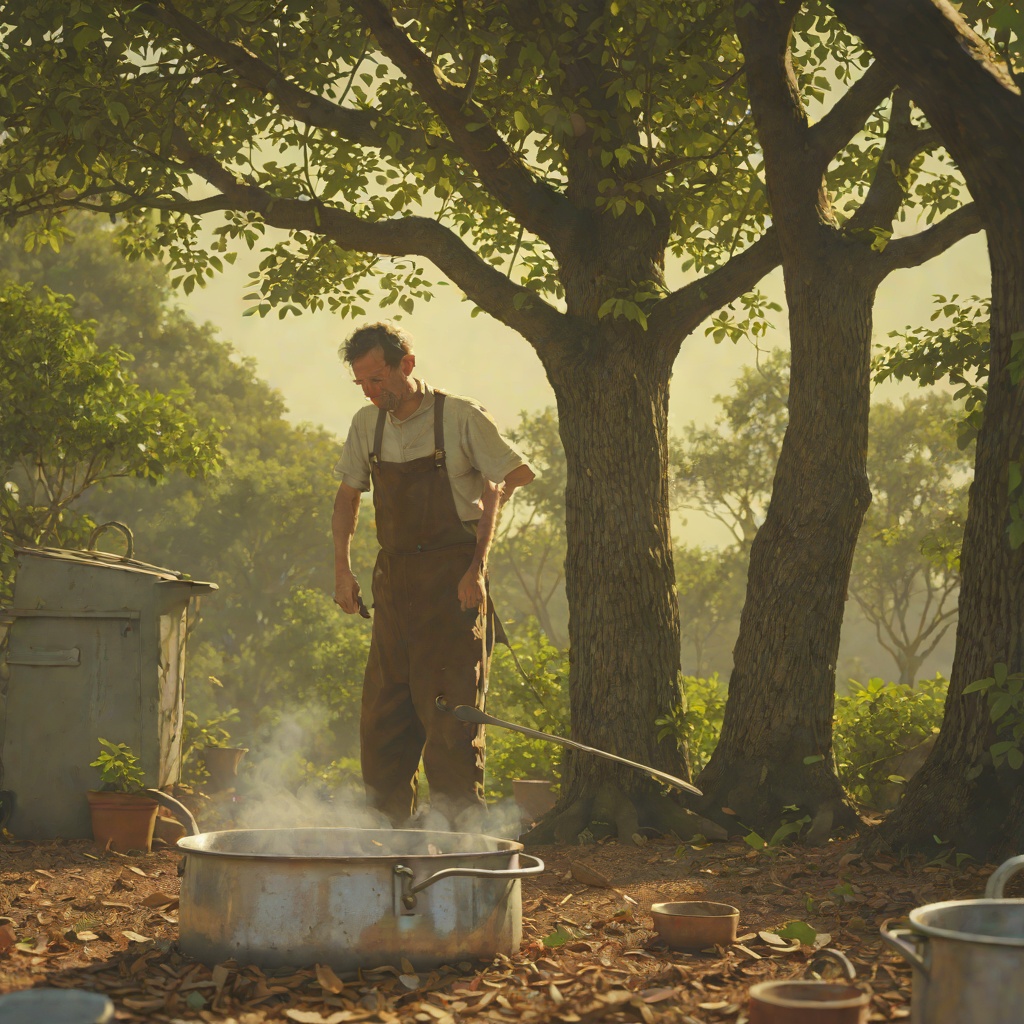
Goblins are also prominent as workers in the Land of Magic Medicines. The children find that place not in the form of an ordinary landscape but as a great factory where pills, medicines, bandages, and related products are produced. Goblins work beside Gnomes, Pixies, and Fairies, stirring large pots over curious green fires, pouring medicines into shining bottles, and counting pills into colored boxes.
This factory setting gives Goblins a collective identity grounded in repetitive, organized production. Magic is not presented only as an individual Wizard’s mysterious gift; it is also the result of coordinated labor, containers, ingredients, measurement, and distribution. A Goblin stirring a purple mixture in a yellow basin becomes the clearest emblem of this process. The mixture is recognized as an ointment, and the children’s attention shifts from the spectacle of the land to the question of what each substance is made to do.
That practical system eventually produces the Get-Well Medicine used for the children’s mother. After the medicine is brought home, it tastes pleasant and seems to ease her headache almost at once. By evening she is sitting up knitting; by the next morning she is eating a large breakfast, laughing, and joking. Before the bottle is half-finished, she is up and active again, singing while she washes and irons. The Goblins’ industrial labor thus has a direct consequence in the ordinary household: magical production restores the person whose illness had interrupted the family’s routine.
Service, Authority, and Coercion
The book also shows Goblins in a much darker institutional role. In the Enchanter’s tower, the Enchanter accuses the children and their companions of being robbers and orders his servants to capture and bind them. About a dozen small Imps run down into the cellar, while the Goblins are included among the servants carrying out the command. The captives are pulled up the cellar steps into a large sunlit room and are told that they will be tied up.
This episode contrasts sharply with the Goblins’ role as makers and sellers of useful magic. In the medicine factory and the marketplace, their work supports exchange and healing; in the tower, their labor is subordinated to a master’s suspicion and greed. They do not appear as the originators of the accusation, but as the organized force that gives the Enchanter’s command material effect. Their presence exposes how magical expertise and magical labor can be absorbed into systems of ownership and punishment.
Work, Care, and the Wider Magical Economy
The Goblins’ appearances gain additional meaning from the children’s domestic responsibilities. At home, Jo is expected to dig potatoes with Dick, while Bessie and Fanny must finish their mother’s ironing. The children initially hope to take Dick to the Enchanted Wood, but accept that everyone in a family must help when able. Their promised holiday is conditional on completing these tasks, and their next outing begins only after breakfast preparations, sandwiches, biscuits, chocolate cake, and apples have been arranged.
The contrast places Goblin labor beside human household labor. Both worlds depend on often-uncelebrated work: food must be prepared, clothes ironed, illness attended, medicines stirred, bottles filled, and pills counted. When the mother becomes ill, the children worry that she is still concerned about the washing, and Silky offers Dame Washalot’s help. The Goblins are not the figures who perform that particular service, but their manufactured medicine belongs to the same larger pattern in which care is organized through labor and material assistance. Their magic does not erase work; it redirects the form that work takes and helps return the household to functioning order.
In this respect, Goblins occupy an important middle ground between the marvelous and the mundane. Their fires, basins, bottles, and pill-boxes make supernatural power look like production. The resulting medicine then crosses back into domestic life, where its success is measured by concrete changes: the mother can sit up, eat, laugh, wash, and iron again.
Narrative Role and Significance
Goblins broaden the moral and social range of the magical world. They are capable practitioners in the Land of Spells, numerous workers in the Land of Magic Medicines, and obedient servants in the Enchanter’s tower. The repeated shift in role prevents them from functioning as a single species-level stereotype. Instead, the narrative uses them to show how a magical community is structured by occupations, workplaces, trade, hierarchy, and orders.
Their most constructive appearance is connected with healing, where collective technical labor yields the Get-Well Medicine that cures the children’s mother. Their most threatening appearance is connected with imprisonment, where the same general image of organized service helps an unjust authority restrain others. Through that contrast, Goblins reveal that magic itself is not morally self-interpreting. Its value depends on who controls the work, what purpose the product serves, and whether the labor supports care or coercion.