Land of Goodies free-taking rule
The Faraway TreeThe Land of Goodies free-taking rule is the governing custom of a realm where food is not merely sold but built into the landscape and made available for visitors to take. It creates an intoxicating version of freedom: houses, shops, trees, bushes, fences, and manufactured foods all become part of an edible environment, so eating appears to require neither money nor permission. Yet the rule is local rather than universal. The central irony is exposed when the Saucepan Man carries the custom into the Land of Toys and is arrested because he mistakes a sweet shop there for one governed by the same permission.
Definition and Material Setting
The rule is introduced through the physical abundance of the Land of Goodies. The realm is a small place of crooked houses and shops, with every structure made from things to eat. Sugar forms walls, chocolate forms chimneys, peppermint cream becomes window-sills, brown chocolate makes shop walls, marzipan makes doors, and gingerbread supplies other architectural details. The setting turns a normally scarce commodity into public surroundings: food is no longer confined to a plate or shop counter but becomes the material of shelter and infrastructure.
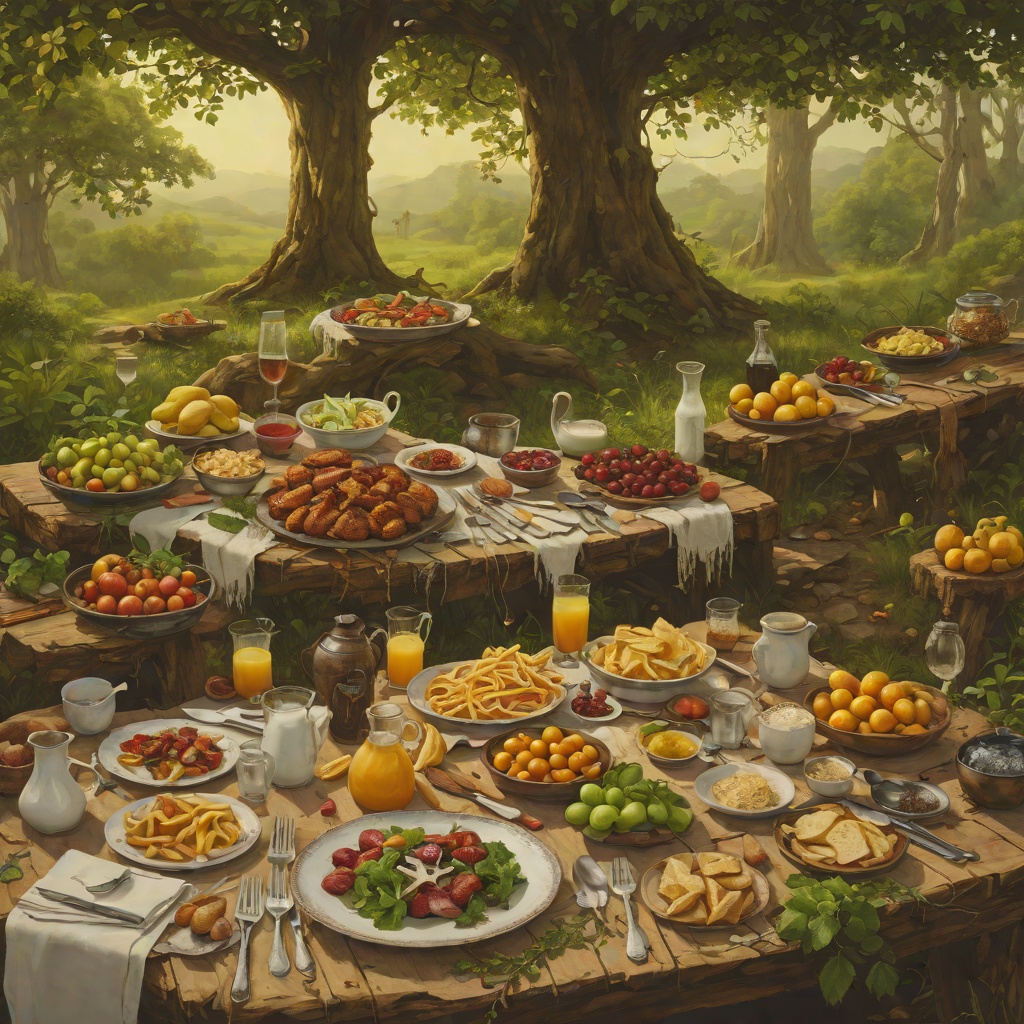
The landscape extends this edible logic beyond buildings. One tree grows currant buns, another opens biscuit buds, and a small tree produces flowers whose centers contain jelly. The children taste the flowers and find that they really are jelly. A bush bears clusters of multicoloured, flat fruit that become boiled sweets when picked, while a yellow fence proves to be made of barley sugar. The children break off large sticks from it and suck them, treating the fence as both boundary and refreshment. In this environment, taking food is not an exceptional act of trespass; it is the ordinary way visitors experience the place.
Operation Through Eating and Taking
The rule permits a sustained sequence of consumption rather than a single sample. The children enter shop after shop and taste tomato soup, poached eggs, ginger buns, chocolate fingers, ice-creams, and other foods. Cakes appear with each child’s name written in pink sugar letters, and the group eats all seven cakes despite initially wondering how they could finish them. The abundance therefore includes personalised production as well as spontaneous picking: the land answers the visitors’ presence with edible objects marked for them.
The rule also makes appetite a form of movement through the realm. Jo enters a sausage-roll shop, where rolls tumble from a machine as a peculiar flat brown man turns its handle. Shops are not simply places of exchange but stages in an apparently limitless tour of tasting. The children’s bodies become the measure of the land’s generosity, and the experience shifts from curiosity to excess when Silky admits that she has been greedy and cannot eat more, while Dick insists that he can continue for a long time.
Local Permission and Misapplication
The rule’s limits become visible when Dick continues taking food after the others warn him to stop. Jo notices that Dick is getting very fat and may be unable to descend through the hole, so he tells him not to enter any more shops. Dick obeys only in form. He breaks off part of a gingerbread window-sill and removes a barley-sugar door knocker, which he sucks with delight. The owner sees him, opens the door, and angrily demands the knocker’s return. Even in the Land of Goodies, the evidence distinguishes between permitted consumption and taking an attached object after a warning: abundance does not erase every boundary.
The more decisive boundary is geographical. In the Land of Toys, the Saucepan Man sees a sweet shop and assumes that he is still in the Land of Goodies. Moon-Face explains that the older man did not understand the change of realm; he believed he could take as many sweets as he liked because that was allowed in the Land of Goodies. The mistake is not simply personal carelessness. It is a collision between two legal and social orders, in which an action that counts as ordinary participation in one land becomes stealing in another.
The consequence is immediate institutional punishment. A golliwog reports seeing the Saucepan Man take the sweets, and the policeman removes him to prison. His arrest demonstrates that the free-taking rule has no authority outside its own space. It also shows how quickly a traveller’s identity can be recoded: the Saucepan Man is not treated as a hungry visitor following a familiar custom but as a thief under the Land of Toys’ enforcement system.
Contrast with Other Land Rules
The Land of Goodies free-taking rule belongs to a wider pattern in which each land at the top of the Faraway Tree imposes its own sharply defined order. In Topsy-Turvy Land, the rule requires everything and everyone to be upside-down, including houses standing on chimneys, trees with roots in the air, and people walking on their hands. A policeman enforces that order by demanding that outsiders conform. In the Land of Dreams, the Sandman’s handful of sand makes visitors sleepy, turning entry into a threat of involuntary rest. In another land, the sudden change from night to daytime as the children climb through the cloud shows that ordinary expectations do not necessarily cross the threshold either.
Against these coercive or disorienting systems, the Land of Goodies rule initially feels generous because it invites participation through the senses. Its freedom is nevertheless structured by place, material form, and local recognition. The Land of Presents later supplies an explicit contrast: there, a visitor may obtain things only to give them to other people, not for personal use. The comparison clarifies that the unusual feature of the Land of Goodies is not unrestricted possession in general, but a specialised permission to take and eat food within a realm designed for that purpose.
Narrative Significance
The rule transforms setting into social instruction. The children learn what the Land of Goodies is by testing its materials with their hands and mouths: they pick, break, taste, enter, and consume. The land’s promise of free food also produces a practical danger when appetite makes Dick too large for the exit and when the Saucepan Man carries an assumed rule into a new jurisdiction. Pleasure and regulation are therefore inseparable. The realm appears to offer pure abundance, but its freedom depends on recognising where it applies and what kind of object is being taken.
Most importantly, the rule makes the story’s rotating worlds legible as separate normative communities. The same sweet can be a freely available part of the environment in one place and evidence of a crime in another. The children’s adventures consequently turn a playful fantasy of endless treats into a lesson in contextual law: conduct cannot be judged apart from the space, customs, and authorities that give it meaning.