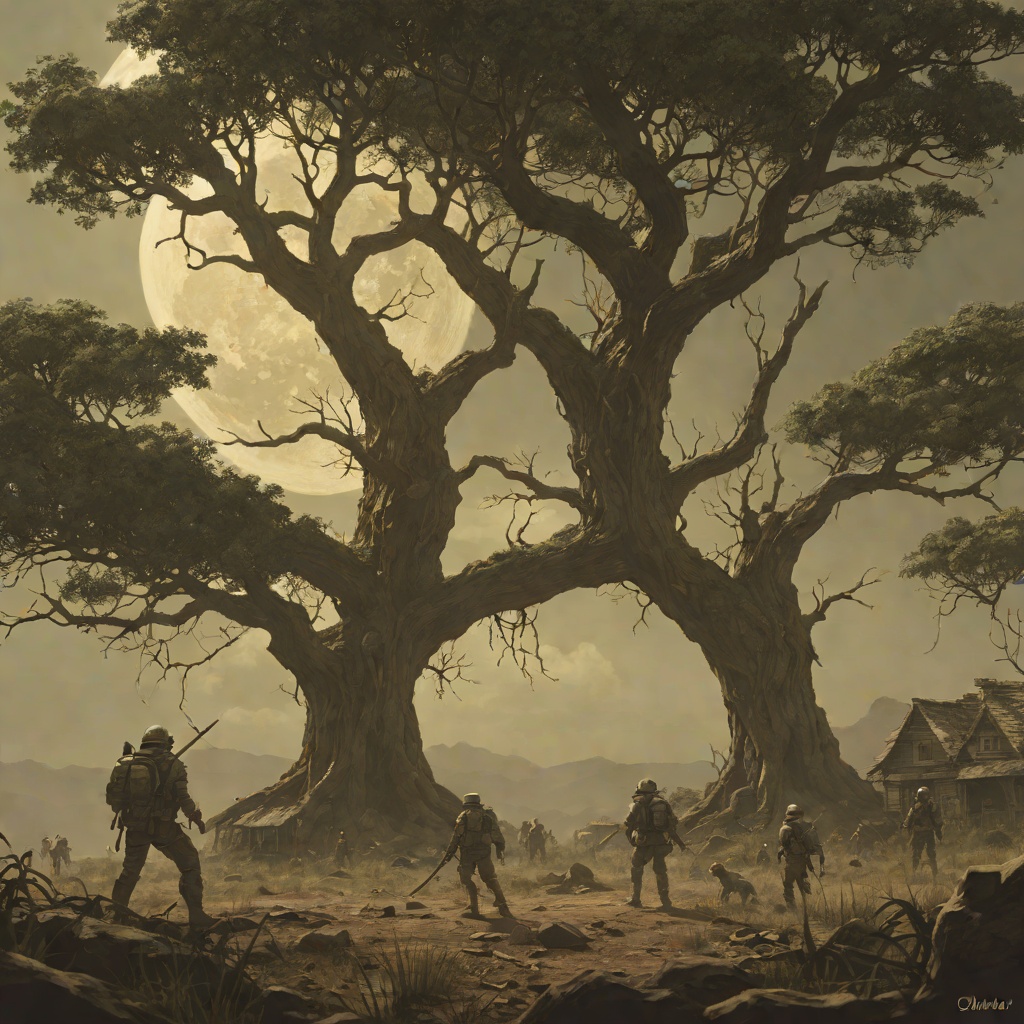
Land of Tempers rule
The Faraway TreeThe Land of Tempers rule establishes a severe condition of residence: once a visitor loses their temper in the land, they must live there permanently. Its force lies in converting anger from a passing feeling into an irreversible change of status. The children therefore enter not as carefree explorers but as people under a constant disciplinary test, aware that a single angry reaction could separate them from the Faraway Tree and from home forever.
Definition and Operation
Dame Washalot explains that anyone who loses their temper in the Land of Tempers has to live there for always. The rule is not presented as a punishment imposed after a trial; the emotional act itself activates the consequence. Anger functions simultaneously as violation, admission, and sentence. A person who becomes angry is no longer simply a visitor who has behaved badly, but a potential permanent inhabitant of the land.
The rule also governs entry into the local community. The head man states that no one is allowed to live there unless they first lose their tempers and then receive permission from him to take a house. Permanent residence therefore requires two stages: an uncontrolled emotional failure followed by authorization from the land’s authority. This makes the rule more than a moral warning. It is an institutional system in which the head man controls the transition from outsider to resident, while anger supplies the necessary proof that the newcomer belongs.
The Children’s Risky Visit
The rule shapes the children’s decision to investigate the disappearance of Silky, Moon-Face, and the Saucepan Man. Jo recognizes that visiting the Land of Tempers is dangerous, and he initially proposes going alone so that the others will not have to share the risk. The others reject this separation, insisting that they will keep their tempers together and leave immediately if their friends are not there. Their plan depends on treating emotional restraint as a collective survival skill.
The danger is difficult precisely because the land is populated by people who are constantly rude, impatient, and provocative. Jo is roughly pushed by a man while trying to ask about the missing friends. He becomes angry and is about to push back, but Fanny warns him not to lose his temper and tells him to smile. Jo forces himself to smile, because he understands that the rule can be defeated only by interrupting anger before it becomes action. The moment shows how narrow the boundary is between ordinary self-defence and permanent entrapment.
The same pressure soon affects the whole group. A boy pulls Fanny’s hair sharply, bringing tears to her eyes. Dick and Jo begin to chase him, shouting, until Watzisname calls them back and warns that they are losing their tempers again. They stop and make themselves look pleasant. Later, two naughty boys trip Watzisname, who rises with a frown and begins to threaten them. Bessie immediately tells him to smile. He complies, though with great difficulty, and the children continue forward while reminding themselves that they must not become angry.
Authority, Belonging, and Exclusion
The rule gives the Land of Tempers a distinctive form of jurisdiction. The children are outsiders, but their bodies and reactions are still subject to the land’s law. They do not need to agree to the rule, understand its justice, or accept the land as home; they need only display anger for its permanent consequence to take effect. The result is a form of authority that reaches across the boundary between visitor and resident.
The head man confirms that Silky, Moon-Face, and the Saucepan Man have not moved into the land, because no one may live there without first losing their temper and receiving his permission. His statement also reveals that residence is controlled by a gatekeeping hierarchy rather than by personal choice alone. When Fanny tells him that Stamp-a-Lot and Yell-Around escaped from the land and are living in the Faraway Tree, he reacts as though their departure violates the land’s order. The rule is thus paired with enforcement and territorial possession: those admitted are meant to remain, and those who escape are treated as fugitives.
This structure contrasts with the children’s experience in other lands. In Topsy-Turvy Land, the policeman insists that everything and everyone must be upside-down, making bodily orientation a legal requirement. In the Land of Toys, a policeman arrests the Saucepan Man after he mistakenly treats the local sweet shop as subject to the Land of Goodies free-taking rule. In the Land of Presents, a goblin refuses Dick’s request for a parcel for himself because gifts may be obtained only for other people. Across these settings, visitors repeatedly discover that freedom in one land does not transfer to another: each place has its own rule, authority, and penalty. The Land of Tempers rule is especially intimate because it uses the visitor’s own emotional response as the mechanism of capture.
Emotional Discipline and Escape
The children’s method of survival is not argument, force, or flight, but deliberate management of expression. Smiling becomes a practical countermeasure. Fanny uses it to interrupt Jo’s anger; Bessie uses it to interrupt Watzisname’s. The repeated instruction to smile turns a visible facial gesture into a legal defence. It also shows that the land’s rule operates through escalation: provocation creates anger, anger threatens permanence, and conscious performance of pleasantness breaks the chain.
The rule therefore makes emotion bodily and social at once. A shove, a glare, a frown, a sharp pull of the hair, and the impulse to chase an offender are not merely private experiences. Each can spread through the group, drawing one person after another toward the danger of residence. Watzisname’s warning prevents the boys’ anger from becoming a collective failure, while Bessie’s intervention prevents his own anger from completing the same process. The group remains mobile because its members watch one another’s faces and intervene before the rule can claim them.
Narrative Significance
The Land of Tempers rule transforms the children’s adventure into a test of freedom under emotional pressure. Other enchanted lands impose strange external demands—walking upside-down, obeying a prison system, accepting sleep, driving a runaway train, or respecting limits on taking and giving—but this rule makes the boundary between self and world unstable. The land does not merely tell visitors what to do; it makes their own anger the doorway through which it can possess them.
Its permanent consequence also gives ordinary irritation unusually high stakes. A rude stranger, a mocking child, or an unfair shove could produce a lifelong change in location. The children’s repeated acts of restraint consequently become active choices rather than passive good manners. They preserve their friendships, their freedom to return to the Faraway Tree, and their ability to continue searching for Silky, Moon-Face, and the Saucepan Man by refusing to let provocation define their conduct. The rule’s central irony is that the land of anger can be escaped only by sustaining an outward composure that its inhabitants themselves seem unable to maintain.