Off to the Enchanted Wood
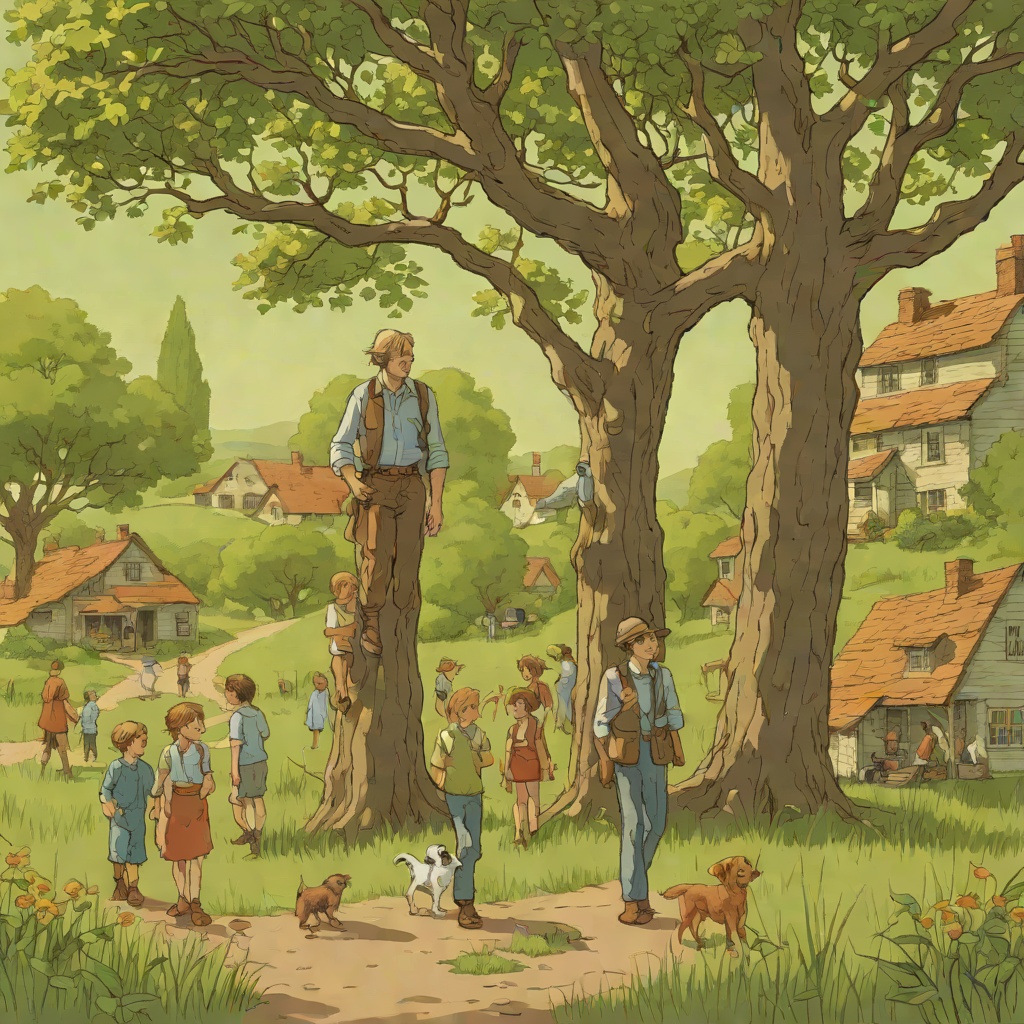
The Faraway TreeOff to the Enchanted Wood is the children’s first guided expedition with their cousin Dick into the Faraway Tree, and it establishes the tree as the decisive gateway between ordinary family life and a world of endlessly changing adventure. Jo, Bessie, Fanny, and Dick cross from the lane into the wood, climb through the tree, meet its inhabitants, enter the Land of Topsy-Turvy, and learn that the tree’s rooms, ladders, branches, clouds, and Slippery-Slip form a continuous but unpredictable system of passage. The expedition is therefore more than a visit: it is Dick’s initiation into the children’s community and into the practical rules of a place where the environment, animals, magical objects, and residents all help determine what happens next.
Departure from the Ordinary World
The expedition begins under the supervision of the children’s family life. Mother has prepared them to leave with a warning not to come home too late and has specifically told Jo to look after Dick. Jo accepts that responsibility, packs the food into a leather bag, slings it over his shoulder, and leads the other three children toward the Enchanted Wood. The departure has the shape of a small domestic errand, but the packed provisions and Jo’s assigned care already establish two stakes: the children are seeking freedom and wonder, yet they remain connected to home and to the obligations of looking after one another.
The first threshold is a narrow ditch between the lane and the wood. Jo tells Dick that he must jump over it, and all four children make the leap together. Dick, however, stops once he is inside the wood. The pause distinguishes him from the others: for them, the wood is familiar territory, while for him it is the first unmistakable sign that the ordinary landscape has ended. His astonishment is not merely fear. He is immediately attentive to the strange sound made by the leaves, hearing the trees as though they were speaking secretly among themselves.
The trees repeat the whispering sound “Wisha, wisha, wisha, wisha,” and Bessie explains that the children can hear any message meant for them by pressing their left ears against the trunks. This detail gives the wood an active form of communication rather than treating it as scenery. Dick’s first encounter with the Enchanted Wood is consequently an encounter with a living environment whose signs must be heard and interpreted. Jo, impatient to move onward, calls the group toward the Faraway Tree, while Bessie’s explanation supplies Dick with the first rule of the new world.
The Faraway Tree and Its Community
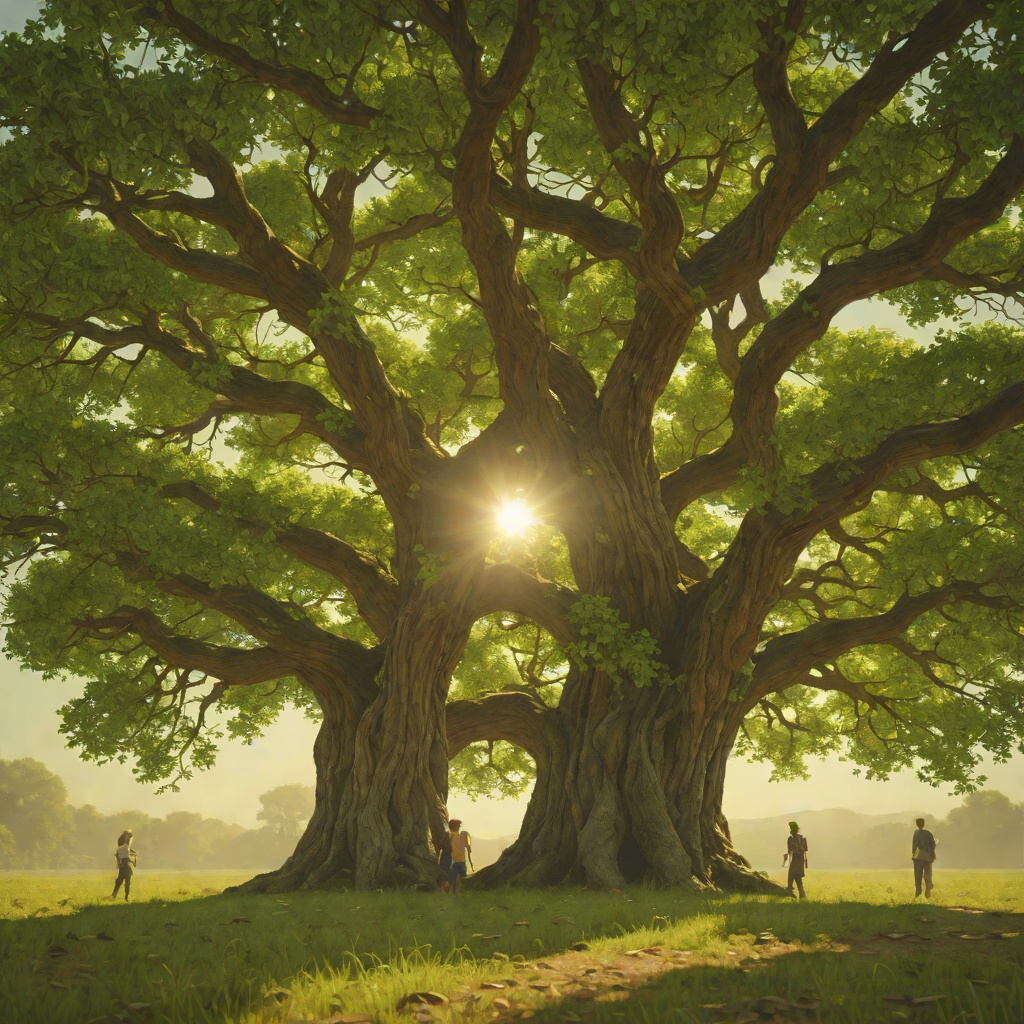
The children soon reach the queer magic tree, and Dick stares at its enormous height because its top cannot be seen. Its appearance refuses a single stable identity: it has oak leaves and yet does not seem to be an ordinary oak, while its branches may produce acorns, plums, apples, or pears at different times. The tree’s changing growth makes uncertainty part of its nature. It is not simply a route to adventure; it is itself a shifting organism that continually unsettles Dick’s expectations about what a tree can be.
As the children climb, the tree reveals a network of inhabited spaces. Dick discovers a small yellow door set into the trunk, complete with a knocker and bell. Jo identifies the resident as Silky, and Dick rings the bell. A pretty little elf with hair like a golden mist opens the door, and Jo introduces Dick as their cousin, explaining that he has come to live with them and is already enjoying his exploration of the Faraway Tree. Silky’s doorway therefore performs a social function as well as a spatial one: Dick does not enter the tree alone but is presented to an established friend, making his initiation a communal welcome.
Further up, the children pass through the discomfort of Dame Washalot’s falling water and eventually reach the upper part of the tree, where voices come from another door. Jo recognizes Moon-Face and the Saucepan Man, and Moon-Face greets the visitors warmly before inviting them into his curious round room. The room’s furniture is curved to match the trunk: the bed, chairs, sofa, and stove all conform to the tree’s circular interior. At its centre is the opening of the Slippery-Slip, the wonderful slide that spirals down through the inside of the tree to the bottom. The room joins domestic comfort to vertical movement, turning a home into both a refuge and a launch point.
Thresholds, Lands, and Reversible Space
The children’s ascent culminates in a literal passage through the clouds. They climb the topmost branch of the Faraway Tree, follow it upward through a purple hole in a vast white cloud, and use a small ladder at the branch’s end. Jo emerges into the Land of Topsy-Turvy first; the others follow one by one until all seven stand together in the strange land. The sequence makes the threshold collective rather than solitary. Although Jo leads, Dick is not left behind, and the group’s unity is preserved as each child crosses into the new space.
The Land of Topsy-Turvy reverses the familiar order of the world. Houses stand upside down on their chimneys, trees have their heads buried in the ground with their roots in the air, and the people walk upside down as well. Dick, less accustomed than the others to strange lands, reacts with overwhelming astonishment. His wide-eyed response confirms how radically the expedition has altered his frame of reference: the Faraway Tree does not merely take the children to another place, but repeatedly changes the rules by which place can be understood.
The route home demonstrates that this magical geography can also fail to connect as expected. After an adventure in which the children must escape through darkness, Jo finds the hole and climbs down the ladder, expecting to reach the Faraway Tree and the safety of Moon-Face’s room. Instead, the ladder ends at a narrow passage lit by a swinging green lantern. The familiar route has become an unfamiliar interior, turning return into another threshold and showing that movement through the tree is never guaranteed simply because a path has been used before.
The Tree as an Active Network
The expedition repeatedly depends on nonhuman and material participants. The whispering trees communicate, the Faraway Tree changes its leaves and fruit, and the Slippery-Slip converts the tree’s interior into a rapid route between its upper and lower levels. Even the cushions in Moon-Face’s room circulate through the tree: a red squirrel dressed in a jersey collects them, ties them to a rope, and sends them upward with three gentle tugs. The squirrel’s work is practical and organized, while Moon-Face’s rope system extends hospitality beyond the boundaries of his room.
Later rescues reveal an even broader network of cooperation. When the others fall asleep in the Land of Dreams, Silky finds Dame Washalot, Mister Watzisname, and the Angry Pixie and tells them that the sleepers need help. Their rescue depends on water, a wash-tub, a kettle, Watzisname’s pocket-knife, and the Sandman’s own sack. Dame Washalot wets the sand so that it cannot be thrown properly; the Angry Pixie empties his kettle over the Sandman; Watzisname cuts the bottom of the sack and throws dry sand into the Sandman’s eyes, causing him to fall asleep. The solution is improvised from the properties of ordinary objects and magical beings rather than supplied by a single heroic figure.
Silky then uses a tiny dab of Whizz-Away Ointment on the head of the large white bed and commands it, “Whizz-Away Home!” The bed shoots through the air so fast that it nearly throws Silky off and frightens the birds below. Its movement is not passive transport: the bed becomes the vehicle that carries the sleepers and rescuers out of the Land of Dreams, though it later catches on a branch of the Faraway Tree and makes everyone slide off. The expedition’s spaces and objects continually generate both escape and complication.
When Silky, Moon-Face, and the Saucepan Man become trapped, Jo proposes another collaboration between human intelligence and animal labour. He explains that a woodpecker’s strong beak can peck a large hole through wood and suggests opening the back of the room directly into the Slippery-Slip so that the captives can be pulled through. The first woodpecker returns with five others, making six birds in all. Standing in a row, they peck rapidly and powerfully until their blows produce a drumming roar. The rescue plan therefore turns knowledge of animal behaviour into a practical map through the tree.
Return and the Meaning of Initiation
The expedition repeatedly moves between discovery, danger, rescue, and renewed departure, but it ends with the children returning from the Land of Presents. They descend to the Faraway Tree, say goodbye to Moon-Face and the others, and sit carefully on cushions with their presents balanced on their knees. One by one they shoot down the Slippery-Slip and emerge through the front door onto the moss outside the tree. The carefully handled gifts contrast with the speed of the slide: the same passage that produces reckless exhilaration must also be negotiated with care when the children carry fragile objects home.
The final image keeps the magical world from closing neatly behind them. Jo notices a roar and suspects that the funny old lion has followed them down the ladder. He imagines that Dame Washalot may have to wash the animal every day if it refuses to leave her. The joke preserves the tree’s capacity to leak into ordinary consequences: creatures and problems can travel across its thresholds, and the return home is never a complete restoration of the old boundary.
As an initiation narrative, Off to the Enchanted Wood changes Dick’s position from newcomer to participant. He begins by needing instruction about the ditch, the trees, and the inhabitants, and by standing motionless in wonder when the group enters the wood. He is then carried into a shared system of friendship, danger, shelter, rescue, and return. The children’s expedition establishes the Faraway Tree as a communal threshold where curiosity is permitted but survival depends on memory, cooperation, practical knowledge, and attention to the living world around them.