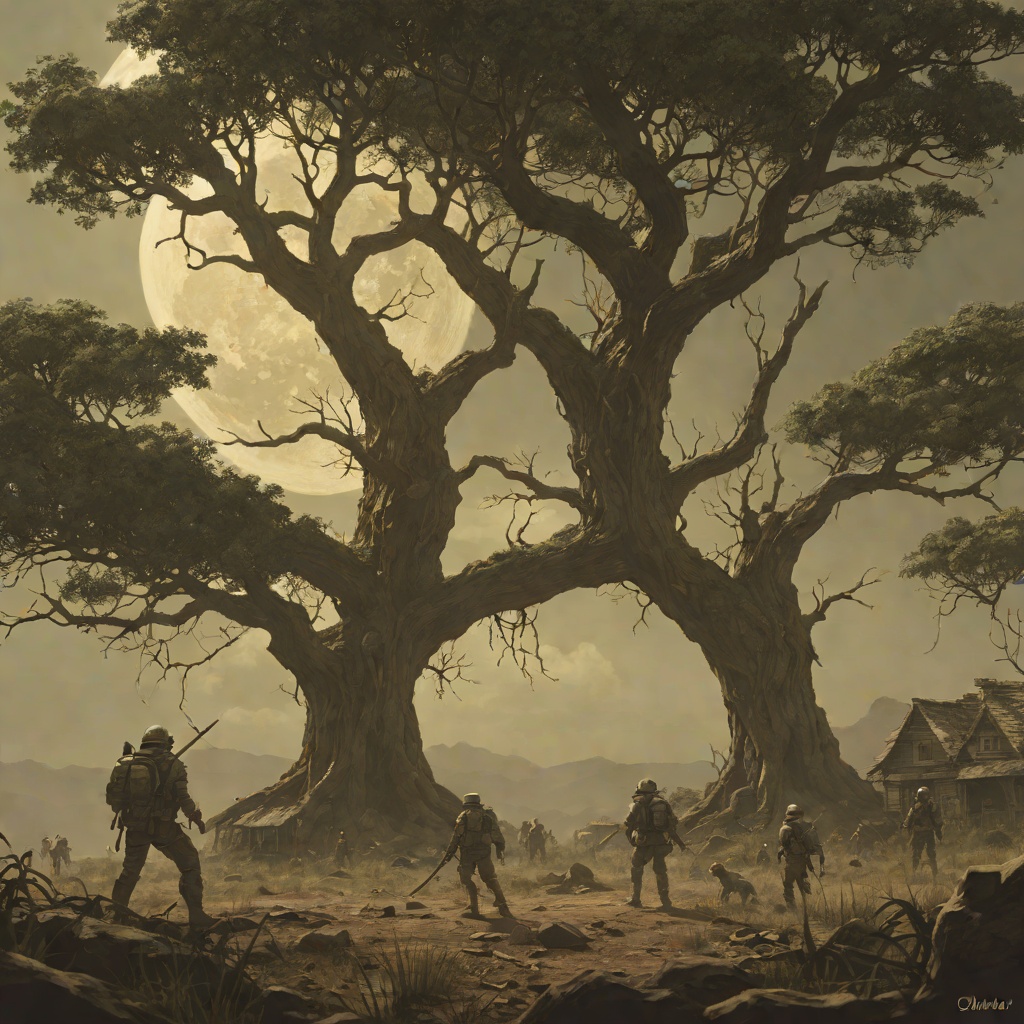
Sir Stamp-a-Lot–Lady Yell-Around cousin relationship
The Faraway TreeThe Sir Stamp-a-Lot–Lady Yell-Around cousin relationship is presented as the family link behind a disruptive invasion of the Faraway Tree. Sir Stamp-a-Lot identifies Lady Yell-Around as his cousin, and their kinship is not merely a biographical detail: the two leave the Land of Tempers together, settle in the tree, and pursue neighboring homes as coordinated replacements for the life they have abandoned. Their relationship therefore connects personal family allegiance with the larger conflict between the tree’s established residents and the angry fugitives from the Land of Tempers.
Kinship and Common Origin
Sir Stamp-a-Lot introduces the relationship during a confrontation over Moon-Face’s house. When Jo challenges his claim to the home, he insists that he is Sir Stamp-a-Lot and explains that his cousin, Lady Yell-Around, has taken a house lower down. Both have come to live in the Faraway Tree, making their cousinhood the first clear explanation of why two people from the same hostile land appear together in the tree and occupy its houses as a pair.
Their origin in the Land of Tempers gives the relationship a shared social and behavioral context. Jo asks whether Sir Stamp-a-Lot belongs there and whether he is permitted to leave his own land, while Sir Stamp-a-Lot responds with anger rather than explanation. Later, Moon-Face recounts that Sir Stamp-a-Lot and Lady Yell-Around wanted to leave because the head-man of the Land of Tempers was furious with them over something; Moon-Face thinks they had broken his windows in a temper. The cousins’ departure is thus linked to the very volatility associated with their homeland, and their family bond becomes part of a joint flight from its authority.
A Coordinated Escape
Moon-Face’s later account supplies the relationship’s fuller history. He remembers sitting in his house with Silky and Saucepan when the two people from the Land of Tempers suddenly appeared at the window, looking in at them. Jo recognizes them as Sir Stamp-a-Lot and Lady Yell-Around. Their arrival is intrusive from the beginning: they do not enter as welcomed visitors but inspect the occupants’ home before announcing their intention to leave their own land and live in the Faraway Tree.
The cousins have also discovered how to reach the tree. They learned by accident that the Land of Tempers was situated over it, so their escape is not a random wandering but a deliberate relocation based on their knowledge of the tree’s structure. Their movement from one land to another makes the Faraway Tree an alternative territory beyond the control of the head-man who was angry with them. Yet the change of setting does not produce a change in conduct. They carry their quarrelsome disposition with them and immediately reproduce conflict in their new surroundings.
Division of the Stolen Homes
The relationship operates practically as well as emotionally. The cousins identify two houses that can be taken: Silky’s house is empty because Silky is staying with Moon-Face, so Lady Yell-Around claims it for herself, while Sir Stamp-a-Lot claims Moon-Face’s house. Their actions are therefore divided but mutually reinforcing. Each cousin obtains a separate dwelling, and the pair’s occupation of both homes makes it harder for the displaced residents to return.
Sir Stamp-a-Lot later offers a false account of this arrangement, saying that Moon-Face had allowed him to have the house while he went to live for a time in the Land of Tempers, and that Silky had said the same. Moon-Face directly contradicts this story: he says the cousins had seen that Silky’s house was empty and had taken it for themselves, with Lady Yell-Around intending to keep Silky’s house and Sir Stamp-a-Lot intending to keep his. The contrast between the cousins’ claim and Moon-Face’s testimony shows how their family alliance is supported by shared appropriation and then protected by deception.
Conflict with the Tree’s Residents
The cousins’ occupation becomes more threatening because it includes a plan to isolate the original inhabitants. Silky explains that Sir Stamp-a-Lot and Lady Yell-Around had stopped up the trapdoor at the bottom and meant to push Moon-Face, Silky, and Saucepan down the Slippery-Slip. They would then stop up the hole in Moon-Face’s room, leaving the three prisoners inside the slide. The cousins are consequently not simply squatters seeking shelter; they are acting together to remove the rightful occupants and prevent their return.
Their family relationship intensifies the danger by giving the two aggressors a ready-made partnership. Sir Stamp-a-Lot speaks for the arrangement in the present confrontation, while Moon-Face’s recollection reveals Lady Yell-Around’s corresponding claim below. The cousins’ separate houses and shared plan form one operation, transforming a private quarrel over rooms into a coordinated attempt to control access through the Faraway Tree.
Narrative Significance
The cousinhood creates a compact contrast between family solidarity and communal friendship. Sir Stamp-a-Lot and Lady Yell-Around support each other in escaping punishment, selecting occupied territory, and displacing Moon-Face, Silky, and Saucepan; the threatened residents, by contrast, respond through mutual warning, testimony, and practical cooperation. The kinship tie thus helps explain why the invaders act with confidence as a unit, while the story uses their behavior to show that shared blood does not guarantee generosity or loyalty toward outsiders.
The relationship also gives the episode its pattern of repetition. The cousins come from the Land of Tempers because their temper has brought them into conflict there, yet they bring that same conflict into the Faraway Tree. Their flight is meant to escape an angry authority, but their occupation of the houses creates a new crisis for others. In this way, the Sir Stamp-a-Lot–Lady Yell-Around cousin relationship is both a bond and a mechanism of recurrence: it carries the habits of one land into another and converts family alliance into the immediate cause of the residents’ displacement and threatened imprisonment.