The Faraway Tree
The Faraway TreeThe Faraway Tree is the enormous magical tree in the Enchanted Wood around which the children’s adventures are organized. Its astonishing height, changing growth, inhabited trunk, internal slide, and cloud-top passage turn it into more than a tree: it is a vertical network linking the ordinary world with strange lands, while its spaces repeatedly become places of welcome, peril, imprisonment, rescue, and return.
Definition and Appearance
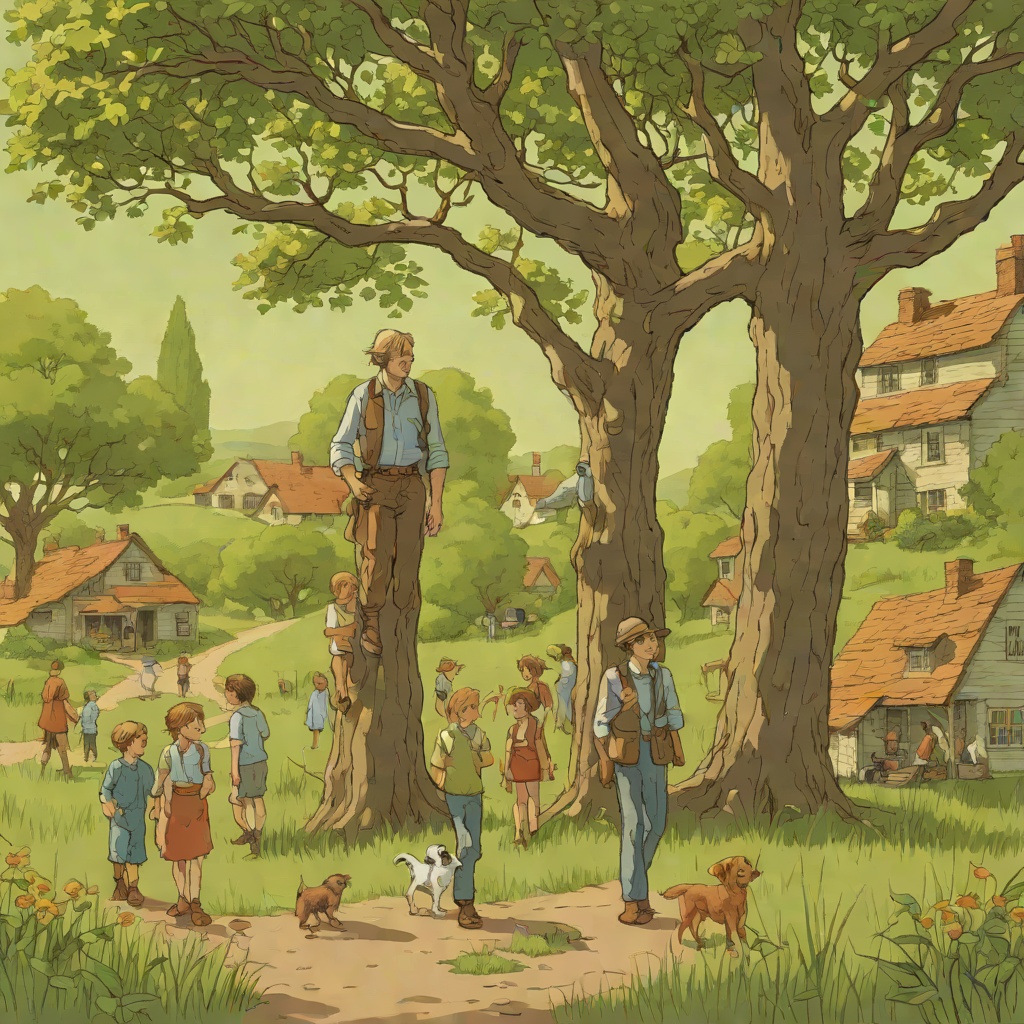
The Faraway Tree is first presented to Dick as a tree so immense that its top rises into the clouds and cannot be seen from below. Its form is not fixed in the manner of an ordinary oak. It may show oak leaves and grow acorns for a while, then produce plums, apples, or pears on another day. This shifting vegetation makes its magic visible even before anyone reaches its summit: the tree is alive with unpredictable variety, and its very identity resists a single natural classification.
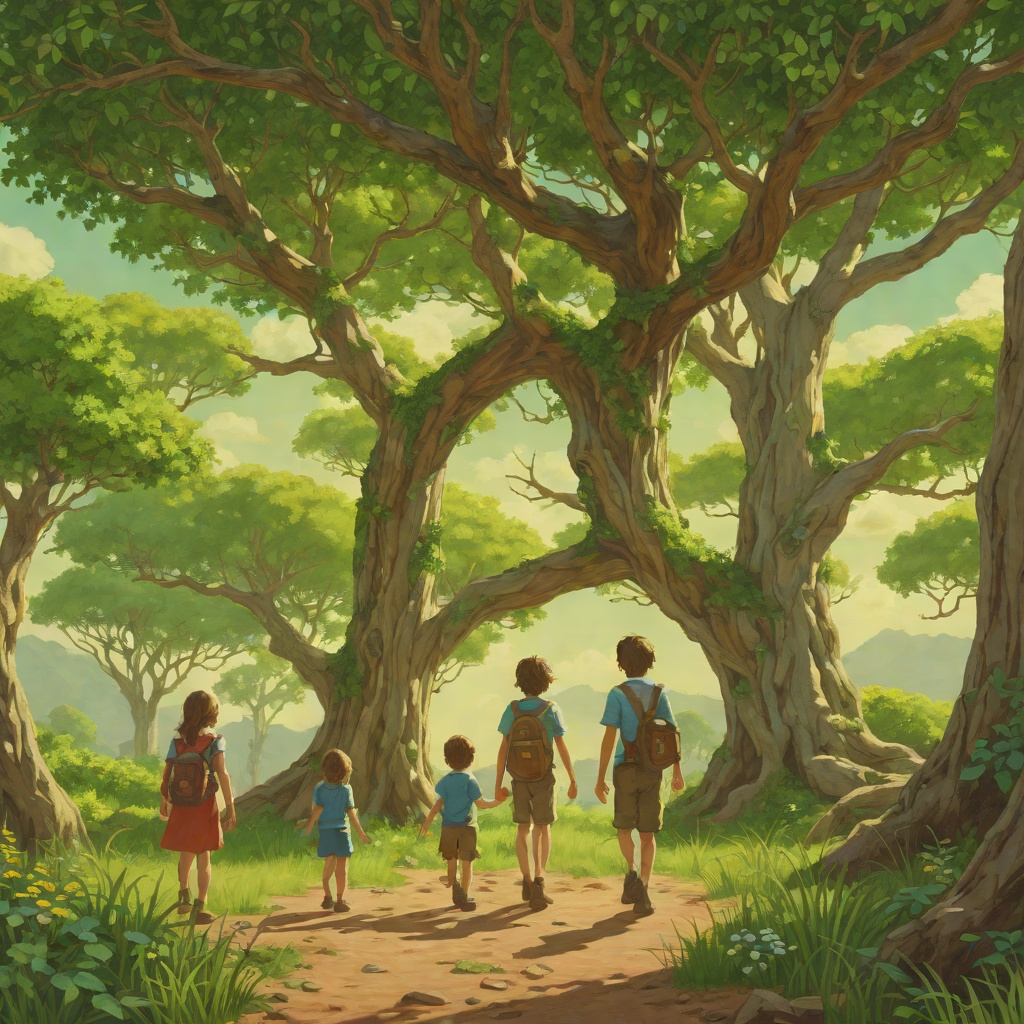
The tree stands in the middle of the Enchanted Wood, beyond a narrow ditch that the children and Dick must jump. When Dick enters the wood, he hears the leaves whispering as if the trees were telling secrets to one another. The repeated “Wisha, wisha, wisha, wisha” gives the forest a communicative life, while the instruction to press the left ear against a trunk establishes that the trees can convey messages to attentive visitors. The Faraway Tree therefore belongs to a wider living environment rather than existing as an isolated marvel.
Internal World and Vertical Structure
The Faraway Tree contains a complete inhabited architecture. Moon-Face’s round room is set inside the trunk, with furniture arranged around the curved interior: the bed, chairs, sofa, and stove all fit the tree’s circular walls. A large hole in the middle of the room begins the Slippery-Slip, the remarkable slide that spirals down through the inside of the tree to the bottom. The room is simultaneously a home and a transit point, giving domestic life a direct connection with exhilarating movement.
The tree’s upward route is equally distinctive. Near the summit, a final branch rises through a purple opening in a vast white cloud, ending at a little ladder. By climbing this branch and ladder, the children reach the Land of Topsy-Turvy, where the tree’s upper threshold opens into an entire foreign realm. The Faraway Tree thus joins several kinds of space in sequence: the woodland floor, the trunk’s rooms, the descending slide, the ascending branches, the cloud, and the lands above it.
This arrangement makes direction itself narratively unstable. The tree offers upward passage into adventure and downward passage toward home, yet either route can be altered by size, obstruction, or motion. When several characters become enormous in the Land of Spells, the hole through the cloud appears too small for them; Moon-Face tries to descend but becomes stuck because he and the others are too large. The tree remains physically present, but its familiar route has ceased to function, turning a dependable entrance and exit into a source of danger.
Homes, Services, and Nonhuman Agency
The Faraway Tree shelters a community whose members depend on its structure. Moon-Face lives in the curved room, and the Saucepan Man is a regular presence there. The room’s design makes the tree’s material form part of everyday life: even furniture must adapt to the trunk’s curve, while the Slippery-Slip passes through the middle of domestic space rather than remaining outside it.
The tree also supports practical systems of cooperation. When cushions are returned to Moon-Face, a red squirrel dressed in a jersey emerges from a hole in the trunk to collect them. A rope swings down from above; the squirrel ties the cushions to its end, gives three gentle tugs, and the rope pulls them upward. The tree’s cavities, branches, ropes, and animal inhabitants form a small working infrastructure, showing that its magic is sustained through repeated labor rather than through spectacle alone.
Other nonhuman beings act within the tree’s network as allies. During the rescue of sleepers from the Land of Dreams, Dame Washalot, the Angry Pixie, and Mister Watzisname use the tree’s ladder to reach the upper lands. Later, when Silky, Moon-Face, and the Saucepan Man are trapped inside a blocked section of the trunk, Jo recognizes that ordinary pulling cannot free them and proposes asking a woodpecker to make a passage into the Slippery-Slip. The woodpecker returns with five others, making six birds in all; together they peck through the wood in a rapid, echoing rhythm. The tree’s living inhabitants therefore become essential agents in preserving movement through its interior.
Obstruction, Imprisonment, and Escape
The Faraway Tree repeatedly changes from a welcoming route into a structure of confinement. The Slippery-Slip normally promises swift descent, but when the characters are too large, its connecting openings become unusable. In another crisis, objects are stuffed into the bottom trap-door and into the passage itself. Jo discovers that the people from the Land of Tempers have blocked the route and that Silky and the others are trapped between masses of material, unable to move either upward or downward.
The blocked tree produces a clear reversal of value. A passage designed for freedom becomes a sealed container; a home becomes a dark place of helplessness; and the ordinary solution of pulling objects away fails because even a great ball of moss will not move. The rescue must therefore be inventive and collaborative. Jo’s knowledge of woodpeckers converts the tree’s substance from an obstacle into the means of liberation: the same wood that imprisons the characters can be opened by the birds’ powerful beaks.
The tree can also carry people away from danger in unexpected ways. After the sleepers are rescued from the Land of Dreams, a large white bed travels through the air, reaches the edge of that land, passes through a cloud, and heads back toward the Faraway Tree. It becomes caught among the branches, causing the passengers to slide off and seize branches and twigs as they wake. Even return is not simple arrival; the tree receives the travelers through another precarious transition.
Narrative Significance
The Faraway Tree is the book’s central spatial engine. Its top is never merely a destination, because the land there changes; its inside is never merely a shelter, because rooms open onto slides and escape routes; and its branches are never merely supports, because they carry travelers toward clouds and unfamiliar worlds. The tree’s shifting geography creates the recurring pattern of departure, discovery, reversal, rescue, and return.
Its importance also lies in the contrast between scale and intimacy. From outside, it is so vast that Dick cannot see its crown. Inside, it contains a curved room, a bed, a sofa, a stove, a rope, and small holes used by animals. The immense and the domestic coexist without canceling one another. That contrast allows the tree to feel both sublime and habitable: it overwhelms the children with its size, yet it gives them recognizable places in which friendships can be formed and plans made.
Most importantly, the Faraway Tree makes wonder depend on relationships. Its whispered forest, animal workers, resident friends, ladders, slides, and cloud opening create possibilities, but the children must listen, climb, improvise, call for help, and work with the tree’s other inhabitants. The tree is therefore not simply a magical object to be explored. It is a living, changeable community-space whose physical structure continually tests whether curiosity can be joined to cooperation.