Abdellah Spares David
The ForgivenAbdellah’s decision to spare David is a reprieve, not a reconciliation. At first light, with a knife in his hand and David before him, Abdellah stops short of violence and lets Anouar take David away. The choice allows David to leave Tafal’aalt, but it does not settle Abdellah’s grief or resolve his uncertainty about his son. By the following night, he regrets the decision; the scene makes clear that sparing David and forgiving him are not the same act.
The confrontation at first light
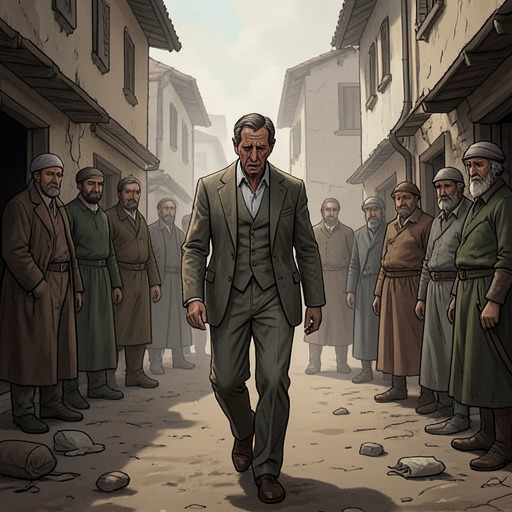
The encounter follows Abdellah’s admission that he had been awake, and his question to David about whether he had been trying to beat the dawn. He orders Anouar to switch off the headlights. In the returning darkness, the two men are left together while the sky begins to lighten. Abdellah reaches into his overcoat and takes out the SOG knife he had used to peel apples the previous evening. A familiar household object becomes the immediate focus of a confrontation whose outcome is not yet certain.
Abdellah does not advance. David takes a step and notices the open ground around him, but Abdellah remains where he is, undecided and governed, as the narration presents him, by pain rather than by a settled purpose. He lurches forward, stops, and grips the knife until it shakes. Then he draws back from the possibility of acting on his anger and raises the blade to point toward Alnif. The gesture redirects the threat away from David: it marks a choice to end the confrontation without striking him, though it does not make the conflict between them disappear.
Anouar’s intervention and David’s release
Abdellah tells David that Anouar will take him back and that his bags are already loaded in the jeep. Anouar approaches, visibly afraid and repelled, yet also showing a compassion he cannot readily express. He calls to David and tells him he can get into the car. His presence gives the decision a practical form: David is not simply left to find his own way out but is offered transport away from the village.
Abdellah lowers the blade to his side and steps back. The narration describes an inner force leaving him, a release that dissipates rather than becoming a public declaration or a reconciliation between the men. Anouar’s invitation and Abdellah’s retreat together make David’s departure possible. Abdellah himself turns toward the jeep but does not climb in. He walks instead toward the oued as the morning opens over Tafal’aalt. David’s reprieve is therefore also a separation: Anouar takes him away, while Abdellah remains behind with the consequences of his choice.
After the decision
Abdellah continues on without joining the departure. A village dog runs to greet him; from the cliffs come the sounds of children working stone, and a cock crows in Tafal’aalt. He keeps his eyes lowered, trying to control the emotion rising in him, and feels privately glad that he can restrain what is darkest in his character. These details do not turn his action into a clean moral victory. They show restraint as something he manages in the aftermath, with emotion still present and unresolved.
He returns to the house, prepares a pipe and tea, and hears the children’s hammers from the cliff. The sound recalls Driss as a boy, secured by a long rope while working on a high ledge. Later, Abdellah lingers in Driss’s room, where he believes a faint trace of the absent young man remains. He remembers Driss’s return from France, his secrecy about Paris, his smoking alone, and his effort to find quarry work at Hmor Lagdad. He also recalls that Driss had changed: he became more aloof, guarded his small earnings, and resisted questions about what he had made in Europe. Abdellah’s grief thus settles on a son whose life he can recall in fragments but never fully explain.
Regret and the limits of forgiveness
During the following night, Abdellah regrets that he did not kill David. The narration distinguishes this regret from certainty about David’s guilt: Abdellah is not convinced of what David did, but he cannot forgive him for Driss’s death. He interprets his restraint as weakness and believes that, because he exacted no punishment, Driss’s life and death have gone to waste. After midnight, he goes to Driss’s grave and sits with that judgment.
The deeper source of his wish for revenge is not only the death itself. Abdellah recognizes that he wanted to avenge the fact that he had never known his son. Driss’s death has made that ignorance permanent: the road accident ended the possibility of learning what Driss had concealed or what his life had meant to him. The final reflection returns to the distinction that structures the release scene. Abdellah can stop himself from harming David, yet he cannot convert that restraint into forgiveness or recover the knowledge of Driss that he longs for. David leaves; Abdellah remains with grief, regret, and questions that death has made impossible to answer.